
Night sweats associated with hormonal changes have a solution

Waking up in the middle of the night drenched in sweat, with sticky sheets and a pounding heart – this is an experience far more people are familiar with than might initially seem apparent. Night sweats associated with hormonal changes are among the most common yet least discussed health complaints affecting both women and men across various stages of life. Although the topic is increasingly spoken about openly, many people still struggle to understand why it happens and what they can do to finally get a proper night's sleep.
The hormonal system functions as a complex network of interconnected signals that govern nearly every process in the human body – from mood and digestion to body temperature regulation. This last function is key to understanding night sweats. When significant hormonal fluctuations occur, the brain receives confused signals about what the correct body temperature should be, and responds the best way it knows how – by triggering sweating to cool the body down. The problem is that this response occurs even when there is no actual overheating.
Try our natural products

When hormones throw off the body's thermostat
The most common period during which people struggle with hormone-related night sweats is undoubtedly the transition known as menopause. According to the World Health Organization, every woman goes through menopause, with the average age of onset around 51, though symptoms of premenopause can begin up to ten years earlier. The decline in oestrogen levels that accompanies this transition directly affects the hypothalamus – the part of the brain responsible for thermoregulation. The hypothalamus then becomes hypersensitive even to minimal temperature changes, triggering so-called hot flushes, which at night manifest as intense sweating.
This is not, however, solely a women's issue. Men go through their own version of hormonal transition, sometimes referred to as andropause, during which testosterone levels gradually decline. This decline tends to be more gradual and less dramatic than in women, but its consequences are very real. Middle-aged men are increasingly reporting disrupted sleep, night sweats and fatigue, yet the connection to hormones often escapes them, as andropause is nowhere near as embedded in public awareness as menopause.
Other hormonal conditions that can trigger or worsen night sweats are also worth mentioning. Thyroid disorders – particularly hyperthyroidism, meaning an overactive thyroid gland – lead to an overall acceleration of metabolism and elevated body temperature, which manifests at night as excessive sweating. Similarly, insulin resistance or blood sugar fluctuations, which are closely linked to hormonal balance, can cause nocturnal episodes of hypoglycaemia accompanied by sweating and trembling.
A particularly notable chapter is the postpartum period. New mothers experiencing the dramatic drop in oestrogen and progesterone following childbirth very commonly experience intense night sweats in the first weeks after giving birth. If breastfeeding is added to the equation – which itself lowers oestrogen levels – the situation can be even more pronounced. Although this is a natural physiological process, it can be extremely uncomfortable for exhausted mothers.
What to do when sweating wakes you from sleep
The first and most important step is always talking to a doctor. Night sweats can have causes other than hormonal ones – ranging from infections and certain medications to more serious conditions – and an accurate diagnosis is the foundation of any successful treatment. An endocrinologist or gynaecologist can recommend hormonal tests to determine whether a hormonal imbalance is truly behind the problem, and suggest appropriate solutions, whether that be hormone replacement therapy or another approach.
Alongside medical care, however, there are numerous practical steps that can significantly improve sleep quality and reduce the intensity of night sweats. As leading British menopause specialist Dr Louise Newson says: "Lifestyle changes are not a substitute for treatment, but they are an essential part of it." And it is precisely within lifestyle that a surprisingly large scope for improvement lies.
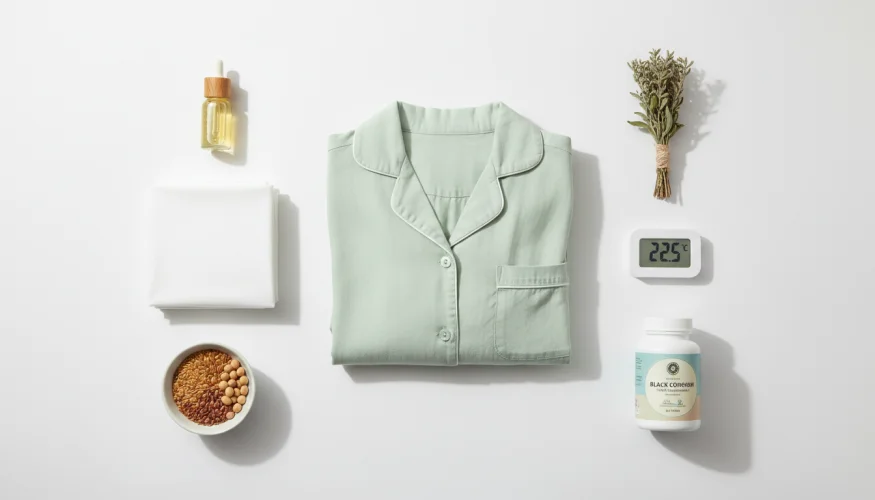
A good place to start is the bedroom itself. The temperature in the room where one sleeps should ideally be between 16 and 18 degrees Celsius – as recommended by the National Sleep Foundation. A cooler environment helps the body naturally regulate its temperature and reduces the likelihood of the sweating trigger being activated. Bedding choices can also help: natural materials such as cotton, linen or bamboo wick away moisture more effectively than synthetic fabrics and allow the skin to breathe. The same applies to pyjamas – loose, lightweight and made from natural fibres is significantly better in this regard than tight synthetic clothing.
Diet plays a greater role in hormonal balance than most people realise. There are foods that demonstrably worsen night sweats: alcohol, caffeine, spicy foods and refined sugar are among the most common triggers. Conversely, a diet rich in phytoestrogens – plant-derived compounds that mimic the mild effects of oestrogen in the body – may reduce the intensity of hot flushes and night sweats in some women. Foods rich in phytoestrogens include soya, flaxseed, chickpeas and tofu. Research in this area remains inconclusive, but many women report positive effects after incorporating these foods into their diet.
Exercise is another powerful tool. Regular physical activity helps stabilise hormone levels, improves sleep quality and reduces stress – and stress is one of the factors that significantly worsens hormonal imbalance and night sweats. Cortisol, the stress hormone, directly interferes with the production of sex hormones and can throw thermoregulation into even greater disarray. Yoga, walking, swimming or strength training – each of these activities can bring relief when it becomes a regular part of the day.
Dietary supplements and herbal preparations also play an interesting role. St John's wort, black cohosh and sage are herbs traditionally used to alleviate menopausal symptoms including night sweats. Scientific evidence for their effectiveness varies, but for example a review study published in the journal Menopause suggests that black cohosh may genuinely reduce the frequency and intensity of hot flushes in some women. Before taking any supplements, however, it is always advisable to consult a doctor, as some herbs can interact with medications or have contraindications.
Take Markéta, a forty-four-year-old teacher from Brno, who began waking up three or four times each night drenched in sweat. Initially she attributed it to work stress and an overheated bedroom. It was only after several months, when irregular menstrual cycles and irritability were added to the picture, that she visited a gynaecologist. Blood tests showed she was in perimenopause – the transitional period before menopause, which can last several years. Following a combination of dietary adjustments, lowering the bedroom temperature, regular exercise and, after consulting her doctor, hormonal support, the quality of her sleep improved significantly. "I thought that was just how it was going to be," she says, "but it turned out there was a lot that could be done about it."
Markéta's story is not exceptional – on the contrary, it is very typical. Many people suffer unnecessarily for too long because they dismiss night sweats or do not realise it is a symptom that can be addressed. The key is to recognise that hormonal changes are a natural part of life, but we do not have to passively accept their symptoms.
The psychological dimension of this problem also deserves separate attention. Chronically disrupted sleep caused by night sweats leads to fatigue, irritability, difficulty concentrating, and in the long term can contribute to the development of anxiety or depression. Sleep is not a luxury – it is a fundamental physiological need, without the fulfilment of which neither body nor mind can properly regenerate. It is therefore important to take night sweats seriously and actively seek solutions, rather than waiting for them to pass on their own.
In recent years, there has been growing interest in natural and holistic approaches to health that view the person as a whole and do not focus solely on isolated symptoms. This approach makes great sense when addressing hormone-related night sweats, because hormones genuinely affect the entire organism and changes in one area always have repercussions elsewhere. Caring for the gut microbiome, ensuring adequate magnesium and B-vitamin intake, and reducing exposure to endocrine disruptors in cosmetics and the home environment – these are all factors that may play a role in overall hormonal health.
Night sweats during hormonal changes are unpleasant, but they are far from unsolvable. With a combination of appropriate medical care, informed lifestyle changes and patience, their intensity can be significantly reduced and restful nights can be reclaimed. And that is well worth pursuing.