
# Homemade Gnocchi from Leftover Potatoes Are Better Than Store-Bought
There is something almost magical about turning a handful of forgotten potatoes from the fridge into a dinner that could easily be served in an Italian trattoria. Homemade gnocchi from leftover potatoes are one of those recipes that prove the best meals don't come from expensive ingredients, but from ingenuity, patience, and respect for what we have on hand. And yet the process is so simple that anyone who has ever held a wooden spoon can manage it.
At a time when more and more people are thinking about how much food they needlessly throw away, this recipe takes on a special significance. According to data from the Food and Agriculture Organization of the United Nations (FAO), approximately one third of all food produced worldwide is wasted. Potatoes are among the most frequent victims of household food waste – cooked but uneaten, they lose all appeal within a few days and end up in the bin. Gnocchi are an elegant way to break this cycle.
Try our natural products



What gnocchi actually are and why to make them at home
Gnocchi (pronounced "nyoki") are Italian potato dumplings whose history stretches back to the Middle Ages. Although dozens of variations exist today – made from ricotta, spinach, pumpkin, or cornmeal – the most classic and widespread version is made from potatoes and wheat flour. Traditions vary across different regions of Italy: in the north, gnocchi tend to be dense and hearty, while in the south they are lighter and airier. The common denominator, however, is always a simple, honest ingredient.
Why make them at home when they can be bought in almost any supermarket today? The answer is straightforward: the taste of store-bought gnocchi simply cannot compare to homemade ones. Packaged varieties are typically loaded with starch, preservatives, and artificial additives to keep them on the shelf as long as possible. Homemade gnocchi, by contrast, are soft, slightly fluffy, and have a pronounced potato flavour that makes itself known with every bite. And if you add the fact that you're making them from potatoes that would otherwise go to waste, you also get the satisfaction of having thrown nothing away.
Italian chef and writer Marcella Hazan captured it perfectly: "Italian cooking is not about complexity. It is about knowing your ingredient and respecting it." Gnocchi made from leftover potatoes are a perfect embodiment of this approach.
How to do it: from potatoes to dumplings, step by step
Let's start with the most important thing – choosing the right potatoes. Not every variety works equally well. Ideal are floury potatoes with a higher starch content, such as Agria, Désirée, or classic yellow boiling potatoes labelled type B or C. Avoid waxy varieties, which have a higher water content – the resulting dough would be sticky and the gnocchi would fall apart during cooking. Leftover potatoes from the previous day are often a better choice than freshly cooked ones, because overnight in the fridge they lose some of their moisture, which is advantageous for making the dough.
The basic ratio is approximately 500 grams of cooked potatoes, 100 to 150 grams of plain flour, and a pinch of salt. Some cooks also add one egg, which gives the dough cohesion, while others swear by the egg-free version as the authentic one. Both work – it depends on personal preference and the specific potatoes you are working with.
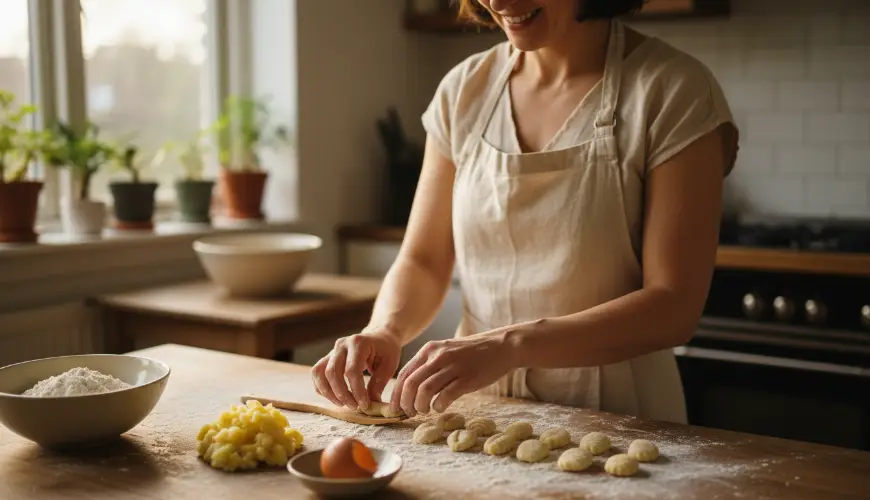
The process begins by grating the potatoes or pressing them through a potato ricer directly onto a floured work surface. Never blend them with a stand mixer or hand mixer – too much starch would be released and the dough would turn rubbery. Add the flour and salt, and if you like, an egg yolk as well, then work it all quickly but gently into a smooth dough. The key word is quickly – the less you knead the dough, the better. Over-kneading activates the gluten in the flour and the result will be tough, rubbery dumplings instead of the fluffy ones you're after.
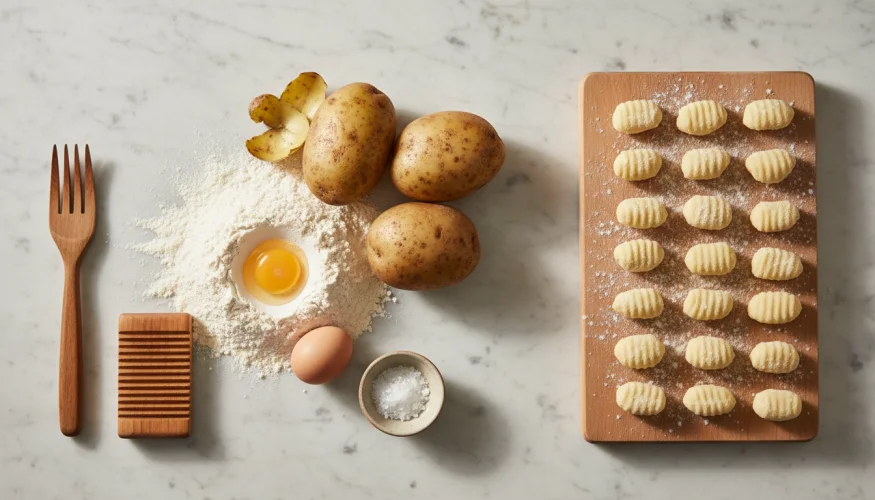
Divide the finished dough into several portions and roll each one on a floured surface into a log about two centimetres in diameter. Then cut the logs into pieces roughly two centimetres long using a sharp knife. This is where the poetic part of the preparation comes in: if you want truly Italian-style gnocchi, roll each piece over the tines of a fork or a special wooden board called a "rigagnocchi." This creates the characteristic ridges that not only look attractive but also serve a practical purpose – they grip the sauce better.
Drop the shaped gnocchi in batches into a large pot of heavily salted boiling water. They are done as soon as they float to the surface – this usually takes two to three minutes. Remove them with a slotted spoon and add them immediately to the prepared sauce. There is no point in letting gnocchi wait – they would quickly stick together.
Inspiration from real life: how one portion of leftovers fed a whole family
Imagine a situation that is by no means unusual: four larger boiled potatoes are left over after Sunday lunch. They're not interesting enough for anyone to eat on their own, yet too good to throw away. This is precisely the moment when this recipe comes into its own. From those four potatoes, a little flour, and an egg, a complete dinner for four people can be made on Monday evening – all it takes is a simple tomato and garlic sauce, or just clarified butter with sage, which is a classic Italian combination that suits gnocchi perhaps better than anything else.
This is the philosophy of responsible cooking, which has been enjoying growing popularity in recent years. The goal is not a perfect ingredient in a perfect quantity – the goal is creativity and a willingness to approach cooking with an open mind. Organisations such as Too Good To Go and various initiatives focused on reducing food waste repeatedly emphasise that the greatest changes in consumer behaviour happen precisely in the kitchen, in everyday decisions about what to cook from what we have.
Variations and tips for different tastes
The basic recipe is a great starting point, but the real fun begins when you start adapting it. A spoonful of ricotta can be worked into the dough for extra tenderness, a handful of grated Parmesan for cheesy depth, or a little nutmeg, which pairs beautifully with potatoes. Those who want colourful gnocchi can add spinach purée – the result will be not only visually appealing but also interesting in flavour.
When it comes to sauces, the possibilities are virtually endless. Among the most popular are:
- Burro e salvia – clarified butter with fresh sage, a quick yet luxurious classic
- Sugo al pomodoro – a simple tomato sauce with garlic and basil
- Gorgonzola e noci – a creamy sauce with blue cheese and walnuts
- Pesto alla genovese – basil pesto that transforms gnocchi into a summer feast
For those who want to go even further, there is a technique called "gnocchi alla romana," where the finished dumplings are transferred to a baking dish, sprinkled with cheese, and briefly baked in the oven. The result is a dish that is tender on the inside and crispy on the outside – and one that nobody at the table wants to stop eating.
An important practical tip: if you don't plan to cook the gnocchi straight away, they can be frozen. Simply spread them out on a floured tray so they don't touch, and place them in the freezer for an hour. Once firm, transfer them to a bag or container. When cooking, drop them directly from frozen into boiling water – just add a minute or two extra and the result will be virtually identical to fresh ones.
Gnocchi made from leftover potatoes are proof that sustainable cooking need not be boring or a compromise. On the contrary – it is precisely the constraints that leftovers impose on us that force us to be creative, to think about ingredients differently, and to discover combinations we would never have arrived at otherwise. Italian cuisine has known this wisdom for centuries and passes it from generation to generation not through sophisticated techniques, but through simple recipes just like this one. Give it a try – and you will most likely find that leftover potatoes never end up in the bin again.