

# Strengthen the Deep Stabilization System with the Dead Bug Exercise The dead bug exercise is one
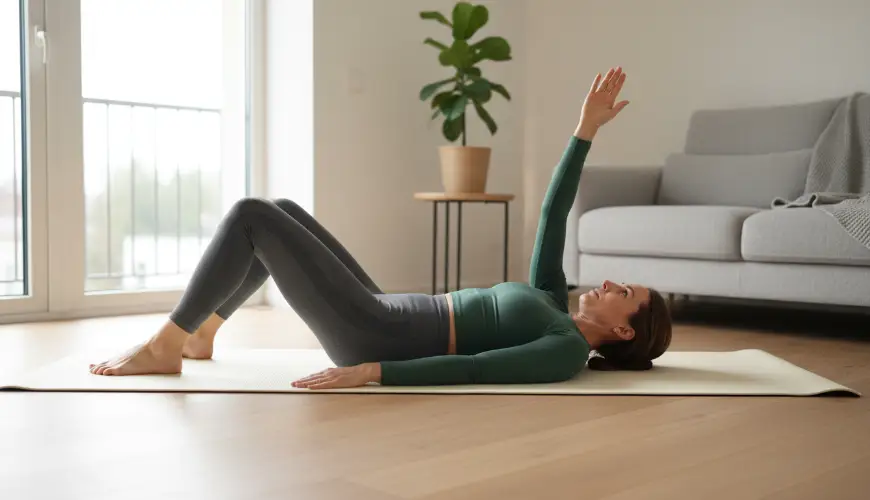
There is an exercise that looks almost ridiculously simple – you lie on your back, raise your legs and arms into the air, and then slowly alternate the movements of your limbs. Yet the dead bug is one of the most effective exercises recommended by physiotherapists and trainers for people with back pain, athletes, and those who want to truly strengthen their core from the inside. How is it possible that such an unassuming movement can accomplish so much?
The answer lies deep beneath the surface – literally. While most people are familiar with classic abdominal exercises like crunches or planks, few realise that true trunk strength and stability does not come from the visible muscles on the surface, but from a deep layer hidden beneath them. This is precisely where the deep spinal stabilisation system operates, and strengthening it is the primary goal of the dead bug exercise.
Try our natural products






What is the deep stabilisation system and why does it matter
The deep spinal stabilisation system, abbreviated as DSSS, is a group of muscles that surround the spine and pelvis like a natural corset. It includes primarily the transverse abdominal muscle (musculus transversus abdominis), the pelvic floor muscles, the diaphragm, and the deep back muscles – known as the multifidi. These structures do not work consciously; they are not muscles you control through deliberate tensing. They activate automatically, reflexively, as a response to movement or load. When they function properly, they protect the spine from excessive stress, maintain correct posture, and enable smooth and safe movement of the entire body.
The problem of modern life is that a sedentary lifestyle, stress, poor movement habits, or previous injuries can "switch off" this system. The DSSS muscles stop responding in time and correctly, and their function is taken over by superficial muscles that are not designed for this purpose. The result is an overloaded back, chronic pain, instability, and gradual wear of the spine. According to research published in the journal Spine, dysfunction of the deep stabilisation system is one of the key factors in the development of chronic lower back pain.
And this is precisely where the dead bug comes in – an exercise designed to deliberately engage the deep stabilisation system, train it, and gradually restore its proper function. Unlike superficial exercises that merely "inflate" muscles, the dead bug teaches the body coordination, control, and conscious breathing during movement.
Physiotherapist Pavel Kolář, one of the pioneers of Dynamic Neuromuscular Stabilisation (DNS) in the Czech Republic, put it simply: "Spinal stability is not about muscle strength, but about their correct coordination and timing."
How to perform the dead bug correctly
The basic position of the dead bug exercise is straightforward: you lie on your back, bend your knees to a right angle, thighs perpendicular to the floor, and arms extended straight up towards the ceiling. This starting position is not accidental – it forces the body into natural DSSS activation, because the spine must be stable to maintain this position without arching in the lower back.
The key moment before beginning the actual movement is activating the deep stabilisation system. This means gently pressing the lumbar spine into the floor, activating the pelvic floor (as if you were trying to stop the flow of urine), and slightly drawing in the lower abdomen. It is equally essential not to hold your breath – breathing should be calm, smooth, and diaphragmatic, because the diaphragm is part of the DSSS and without correct breathing the entire system cannot function as it should.
The actual movement consists of slowly lowering one leg towards the floor – the heel approaches the ground but does not touch it – while simultaneously lowering the opposite arm behind your head. You then return to the starting position and alternate sides. It sounds simple, but in practice many people find it surprisingly demanding. Why? Because as soon as the DSSS stops functioning, the lumbar spine begins to arch, the pelvis tilts, and the entire movement loses its purpose.
Consider Martina, a forty-five-year-old accountant who had suffered from lower back pain for years. She went for massages, took medication, tried various strengthening exercises – and nothing provided lasting relief. Her physiotherapist eventually prescribed the dead bug as the foundation of her rehabilitation. At first, she could not complete a single correct repetition without her pelvis lifting off the floor. After three weeks of regular exercise – five minutes a day – she began to experience significant relief. Not because she had built large muscles, but because her body had learned to stabilise the spine automatically again, during every movement.
It is important to progress patiently. Beginners can simplify the exercise by lowering only the arms, or only the legs, not both simultaneously. Only when they can maintain a stable spinal position throughout the entire movement should they add the combination of both limbs. The number of repetitions is not decisive – quality of execution is far more important. Five perfectly performed repetitions are more valuable than twenty poor ones.

Why the dead bug is better than classic crunches
This question deserves an honest answer. Classic crunches (sit-ups) are still very widespread, but their reputation in professional circles has declined significantly in recent years. The main reason is that crunches primarily engage the superficial rectus abdominis muscle and the hip flexors, while the deep stabilisers remain out of the picture. Moreover, repeated spinal flexion under load may contribute to intervertebral disc degeneration, as suggested by research from Canadian biomechanist Stuart McGill, who has been studying spinal biomechanics for decades.
The dead bug, by contrast, does not load the spine with flexion. The movement occurs in a neutral spinal position, without bending, without disc compression. At the same time, it intensively trains the body's ability to maintain this neutral position even during limb movement – which is precisely what you need in everyday life. When you lift bags from the floor, sit at a computer, or play tennis, your spine needs stability, not strength in the rectus abdominis.
Another difference is the engagement of the diaphragm and pelvic floor. The dead bug, performed with correct breathing, trains the entire "cylinder" of stabilisers – the diaphragm at the top, the pelvic floor at the bottom, the transverse abdominal muscle at the sides, and the multifidi at the back. This comprehensive approach is closer to the natural function of the body than isolating a single muscle.
Who is the dead bug particularly suitable for? Practically everyone – from people in rehabilitation to elite athletes. Pregnant women can use it in a modified form (after consultation with a physiotherapist) to strengthen the pelvic floor. Seniors will appreciate it as a safe way to maintain trunk stability without the risk of injury. Athletes incorporate it as part of their warm-up or compensatory training. And people with sedentary jobs can practise it at home every day without any equipment.
Incorporating the dead bug into a regular routine is not complicated. It is sufficient to practise it three to five times a week, ideally in the morning as part of waking the body up, or in the evening as a wind-down after a demanding day. You do not need a gym; simply unroll a mat at home on the carpet. Five to ten minutes a day is enough for results to begin showing – better posture, less back pain, greater stability in sport and in everyday life.
It is important to recognise that the dead bug is not a miracle cure for all back problems. If you suffer from acute pain or have a diagnosed spinal condition, consulting a doctor or physiotherapist always comes first. The exercise should be part of a broader approach to movement and a healthy lifestyle – one that includes sufficient physical activity, an ergonomic working environment, quality sleep, and a balanced diet.
The world of fitness and rehabilitation has shifted considerably over recent decades, moving away from superficial body shaping towards a deeper understanding of how the body truly functions. The deep spinal stabilisation system has become the focus of attention not only for physiotherapists, but also for trainers, sports physicians, and researchers. And the dead bug – despite its somewhat amusing name – is one of the most elegant tools for awakening, training, and keeping this system in good condition.
If you have not yet tried it, perhaps now is exactly the right time to lie on your back, raise your legs and arms, and give your deep stabilisers the chance to show what they are capable of.