

# Pain Behind the Eye Associated with Screens and What to Do About It ## Why Does Pain Behind the E

Modern life takes place largely in front of screens. A computer at work, a phone on the subway, a tablet on the couch in the evening – the average person today spends more than ten hours a day in front of digital displays. It's no wonder that more and more people describe the same uncomfortable sensation: a dull or throbbing pain behind the eye that sets in after several hours in front of a monitor. Sometimes it's accompanied by a feeling of pressure, other times mild nausea or blurred vision. Although this sounds alarming, in most cases it's a well-described and manageable problem – if we know what's behind it.
Eye doctors and neurologists refer to this set of symptoms as digital eye strain, or computer vision syndrome. According to the American Optometric Association, approximately 50 to 90 percent of people who regularly work in front of a screen suffer from this syndrome. That's a staggering number, yet it's surprisingly rarely discussed – most people attribute the pain to stress, poor sleep, or general fatigue and don't look for the real cause.
Try our natural products




Why do screens actually cause pain behind the eye?
To be clear: the display itself won't "burn" your eyes or cause permanent vision damage. The problem is more subtle and lies in how the eyes work when viewing digital content. Unlike reading printed text, where characters are sharp and contrast is stable, pixels on a screen are made up of light points that flicker slightly and whose edges are not perfectly sharp. The brain and eyes must constantly compensate for this difference, and that is exhausting work.
Added to this is the problem of blink rate. Under normal circumstances, a person blinks approximately fifteen times per minute – this reflexive movement moistens the cornea and keeps it in good condition. A study published in the journal Investigative Ophthalmology & Visual Science showed that when working with a computer, blink rate drops to one-third to one-half of the normal value. The result is dry, irritated eyes that then send out pain signals – and these very often manifest as pressure or pain behind the eye or at the temples.
Viewing distance and angle also play a crucial role. Many people position their monitor too high or too close without realizing it. The eyes must then constantly converge – that is, turn toward each other – and maintain focus on a nearby object. The muscles responsible for these movements are small, and after hours of continuous work they simply start to ache, much like a bicep would ache after carrying heavy shopping for a long time.
The blue light emitted by screens at higher intensities than natural light sources also cannot be overlooked. Its effect on eye pain is scientifically debated and not entirely clear-cut, but there is evidence that blue light disrupts melatonin production and thereby worsens sleep quality – and insufficient sleep itself increases the eyes' sensitivity to light and impairs the ability to concentrate, creating a vicious cycle.
Tomáš, a thirty-year-old graphic designer from Brno, describes a situation that is typical for many working people: "I arrive at work feeling fine in the morning, but around three in the afternoon I feel like someone is pressing on my eyes from the inside. For a moment I think a migraine is starting, but then it passes once I take a half-hour break from the monitor." His story illustrates the classic course of digital eye strain – the pain sets in gradually, intensifies throughout the day, and subsides after rest. This dependence on time spent in front of a screen is precisely the key diagnostic indicator.
When to see a doctor and what to do in the meantime?
It's important to distinguish between fatigue caused by screens and symptoms that may signal a more serious condition. Sudden, severe pain behind the eye – especially if accompanied by redness, vision disturbances, nausea, or headache – can be a symptom of elevated intraocular pressure or another condition requiring immediate medical attention. Likewise, anyone who suffers from recurring eye pain should have their vision examined, as an uncorrected or poorly corrected refractive error significantly increases the strain of working with a screen.
However, if pain behind the eye arrives predictably after prolonged time at a computer and disappears after rest, it is most likely digital eye strain. And this can be prevented, or at least significantly reduced, through a range of practical measures.
The best-known and simplest recommendation is the 20-20-20 rule: every 20 minutes, look at an object at least 20 feet (approximately 6 meters) away for 20 seconds. This short break ritual allows the eye muscles to relax and also naturally increases blink rate. The American Academy of Ophthalmology actively promotes this rule as one of the most effective and yet most accessible ways to reduce eye fatigue.
Proper setup of the work environment is also important. The monitor should be approximately 50 to 70 centimeters from the eyes, and its top edge should be roughly at eye level or slightly lower – never higher. The screen's brightness should roughly match the room's lighting; a screen that is too bright in a dark room, or conversely a dark display in an overly bright space, unnecessarily burdens the eye's adaptive mechanisms. An anti-reflective coating on glasses or on the monitor itself can significantly reduce the amount of scattered light reaching the retina.
More and more people are reaching for blue light filter glasses. Their effectiveness is scientifically debatable – a review study by the Cochrane Collaboration from 2023 found no convincing evidence that these glasses reduce eye fatigue better than a placebo. Nevertheless, many users report subjective relief, and if you wear the glasses in the evening, they can genuinely help preserve a more natural sleep rhythm by limiting blue light before bedtime.
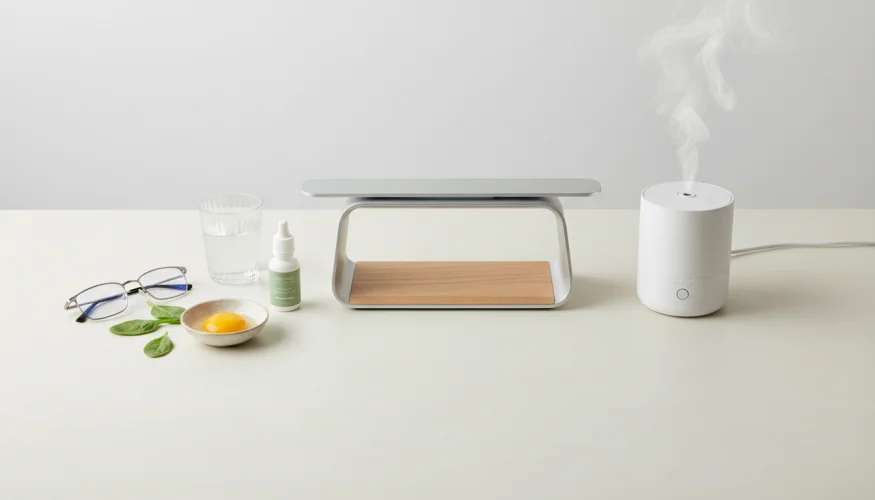
Hydration is another factor that tends to be underestimated in discussions about eye pain. Dry eyes hurt significantly more and are more prone to irritation. Adequate fluid intake throughout the day, or the use of preservative-free artificial tears, can significantly reduce the symptoms of digital eye strain. The same applies to the air in the room – air conditioning and heating dry out the air and thus the eye surface, so a humidifier in the office is not merely a luxury but can be a genuinely functional tool.
As ophthalmologist and researcher Mark Rosenfield from the New York College of Optometry said: "Digital eye strain is not a disease – it is a natural response of a healthy eye to conditions that human evolutionary development did not account for." This perspective is liberating: the problem is not with you or with your eyes themselves, but with the environment we have created, which can be adjusted.
In addition to environmental and work habit adjustments, there are also products that can support eye health from within over the long term. Nutrition plays a role that is increasingly coming to the forefront of researchers' interest. Lutein and zeaxanthin – pigments naturally found in the retina – help filter blue light and protect photoreceptors. They are found primarily in dark green leafy vegetables such as kale or spinach, but also in eggs. Omega-3 fatty acids, in turn, support the formation of the tear film and can alleviate symptoms of dry eye. A varied diet rich in antioxidants is therefore not just a healthy lifestyle cliché, but has a direct impact on how well your eyes handle the daily digital workload.
The growing interest in eye care in the context of a digital lifestyle is also reflected in the range of products focused on overall wellbeing. Quality preservative-free eye drops, ergonomic tools for proper monitor setup, or natural dietary supplements with lutein and vitamin A are part of a broader approach to self-care that doesn't end at the gym or a healthy plate. The eyes are an organ that works continuously and whose comfort directly affects productivity, mood, and sleep quality – and they deserve the same attention as the rest of the body.
Interestingly, pain behind the eye caused by screens can also be amplified by the overall level of stress and mental tension. Tense neck and shoulder muscles – a typical companion of long hours sitting at a computer – transfer tension to the area of the temples and eye sockets. Therefore, regular stretching of the neck and shoulders, as well as conscious relaxation of the forehead muscles, is an integral part of prevention. Yoga, breathing exercises, or even a short walk during the workday do more for eye health than might appear at first glance.
Digital screens will not disappear from our lives – nor is it necessary for them to do so. The key is a mindful approach to how we use them. Small changes in monitor setup, regular breaks, adequate hydration, and attention to overall lifestyle can change how your eyes feel at the end of the day. And that's a difference that anyone who knows that uncomfortable feeling of pressure behind the eye – the kind that spoils an otherwise productive afternoon – will truly appreciate.