

# What to do with expired medicines and batteries
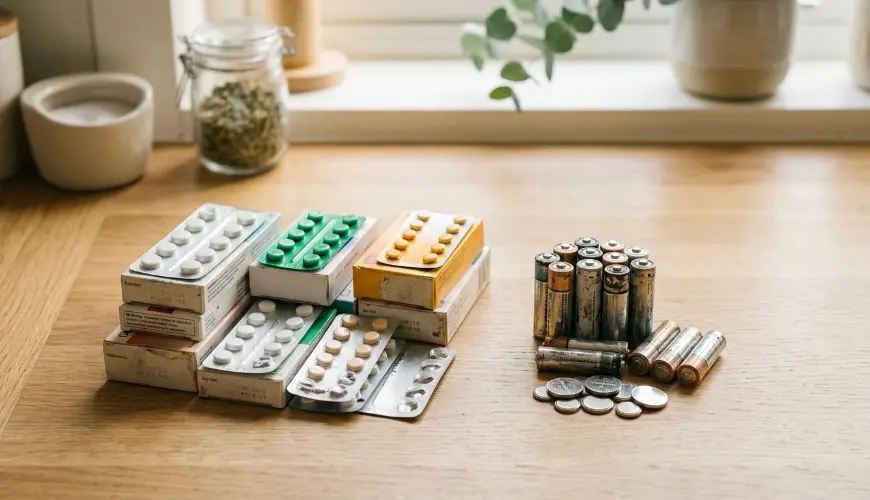
Everyone knows it – during spring cleaning, a whole stash of medicines suddenly appears in the bathroom or wardrobe, with expiry dates that passed two years ago. In the drawer by the television, there's a pile of used batteries that have been sitting there since last Christmas, waiting for someone to decide what to do with them. The question of what to do with expired medicines and batteries and where to take them affects practically every household in the Czech Republic, yet many people handle it improvised or incorrectly. Medicines end up in the bin, batteries in general waste – and yet both of these things belong somewhere else entirely.
This isn't just about ecological responsibility in an abstract sense. It's about specific impacts on people's health, soil quality and drinking water. Expired medicines thrown into regular waste can end up at landfill sites, where their active substances seep into groundwater. Batteries contain heavy metals such as mercury, lead and cadmium, which when disposed of incorrectly are capable of contaminating the surrounding environment for decades to come. The World Health Organization (WHO) repeatedly warns that pharmaceutical waste is among hazardous wastes with a direct impact on public health, and recommends its strict regulation and separate collection.
Why expired medicines aren't just "old rubbish"
It's natural to think that an expired medicine is simply something that has stopped working and can therefore be thrown away without concern. But the reality is more complex. Medicines past their expiry date do lose their effectiveness, but their chemical composition can change – some substances break down into by-products that are toxic or irritating. Antibiotics thrown into waste also contribute to the development of antibiotic resistance in the environment, which is one of the greatest global health problems of our time. According to data from the European Environment Agency, pharmaceutical substances are increasingly being detected in European waterways and groundwater, with one of the main sources being the improper disposal of medicines in households.
Let's take a specific example: a family with children buys syrups, tablets and drops during flu season. Some are used up, some remain in the medicine cabinet waiting for the next season. After two years, several dozen different products have accumulated. If they throw them all in the bin or flush them down the toilet – and flushing is unfortunately still a widespread habit – the chemical substances end up at a wastewater treatment plant, where not all of them can be captured. The result is trace amounts of pharmaceuticals in drinking water, which don't cause acute poisoning, but their long-term effects on the human body and aquatic ecosystems are the subject of intensive research and legitimate concern.
The correct approach is simple and free of charge: expired medicines belong in a pharmacy. In the Czech Republic, pharmacies are legally required to accept unused and expired medicines from members of the public, regardless of where they were originally purchased. Simply come in with a bag of old medicines and hand them in at the counter. The pharmacist will then pass them on to a specialist company that ensures their safe disposal – most commonly by incineration in a hazardous waste facility. This system works reliably in the Czech Republic and is completely free of charge.
In addition to pharmacies, there are also hazardous waste collection centres that accept medicines. Their list and opening hours are generally available on the website of the relevant town or municipality. Large cities such as Prague, Brno and Ostrava also regularly organise mobile hazardous waste collections directly in individual districts, where medicines can be handed over in person without the need to travel to a collection centre.
Try our natural products
Batteries: a small object with a big impact
Batteries are one of the most common items in every household and at the same time one of the most problematic in terms of disposal. The average Czech household throws away dozens of batteries per year – from small button cells in watches and calculators, through AA batteries in remote controls and toys, to larger D-cell batteries in torches. And that's not counting the rechargeable batteries from mobile phones, laptops or electric bikes, which are a chapter in themselves.
Why are batteries so problematic? Because they contain substances that are perfectly safe when used correctly, but cause serious damage when released uncontrolled into the environment. Alkaline batteries contain potassium hydroxide, nickel-cadmium rechargeable batteries are a source of highly toxic cadmium, and lithium batteries can under certain circumstances catch fire or explode. Mercury button cells, although less widespread today than in the past, still circulate in households and contain one of the most dangerous metals of all. As environmental chemist and science communicator Andrew Szasz said: "Hazardous waste is not an industry problem. It is everyone's problem, because every one of us produces it every day."
So where should used batteries go? The network of collection points in the Czech Republic is surprisingly dense and accessible. Red or yellow containers for used batteries can be found in virtually every supermarket, hypermarket, electronics store, drugstore or post office. Retailers who sell batteries are legally required to ensure their take-back – and this also applies to online shops, which must provide customers with information on how to return batteries. A list of collection points in your area can easily be found, for example, on the website of ECOBAT, the largest battery take-back system in the Czech Republic, which operates thousands of collection points throughout the country.
A special category is batteries from electric vehicles and electric bikes – so-called lithium-ion accumulators. These are large, heavy, and their improper disposal poses a fire risk. They should never end up in a container for regular batteries or in general waste. The correct procedure is to contact the seller or service centre for the vehicle in question, or alternatively a specialist collection centre equipped to handle such waste.
Many people store used batteries in a drawer with the intention of "taking them in sometime". This intention is commendable, but the follow-through tends to be postponed indefinitely. A practical solution is to keep a small container or bag at home specifically for used batteries – once it's full, that's a natural signal to make a trip to the nearest collection point. Such a habit can easily be adopted by children too, for whom sorting waste is a natural part of learning responsibility towards the world around them.
How to do it practically and without unnecessary effort
Proper disposal of expired medicines and batteries doesn't have to be complicated or time-consuming. The key is having a system and knowing that collection points are genuinely accessible almost everywhere. Nevertheless, it's worth summarising the most important rules:
- Expired and unused medicines belong in a pharmacy – any pharmacy, free of charge, no receipts required. Never throw medicines in the bin or flush them down the toilet or sink.
- Used batteries belong in red or yellow collection containers in shops, drugstores or post offices. Return rechargeable batteries from electronics to the retailer or hand them in at a collection centre.
- Neither medicines nor batteries belong in any coloured recycling container for sorted waste – not paper, not plastic, not glass. They are hazardous waste and require special handling.
- Collection centres are a safety net for cases where there is no pharmacy or suitable container nearby – they accept both.
The entire system of medicine and battery take-back in the Czech Republic is the result of European legislation and domestic waste laws, which have been progressively tightening the rules for handling hazardous waste. Act No. 541/2020 Coll. on Waste, which came into force in 2021, brought a number of changes and clarifications specifically in the area of product take-back, including batteries and accumulators. The Czech Republic is thus approaching the standards of the most progressive European countries in the field of waste management.
It is worth knowing that proper battery disposal directly feeds into their recycling. Valuable materials can be recovered from used batteries – zinc, manganese, nickel, cobalt or lithium – which serve as raw materials for the manufacture of new batteries or other products. Battery recycling is therefore not only an ecological obligation but also an economically sensible process that reduces industry's dependence on the extraction of primary raw materials. According to the European Commission, new European battery regulations should significantly increase the share of recycled materials in new batteries by 2030.
The take-back of medicines works similarly – pharmaceutical companies and pharmacies work together with incineration facilities that use the thermal energy from burning medicines to generate electricity or heat. Here too, therefore, what appears to be waste can, when handled correctly, still have some value or at least minimise its negative impact.
We live in a time when sustainability and responsible behaviour are becoming increasingly important values – and yet so little is required. Taking a bag of old medicines to the pharmacy and a bag of batteries to the nearest shop every now and then. These small steps, which take just a few minutes, are part of a bigger picture – a world where waste does not mean a burden on nature, but a raw material for the future.