
# Organize a Shoe Rack for the Whole Family Easily and Effectively
The hallway is the first thing you see when you come home, and the last thing you look at before you leave. Yet this is precisely the space that tends to be the greatest source of daily chaos in many households. Shoes scattered across the floor, a forgotten single shoe behind the rack, children's trainers stuffed under coats – these are scenes that almost every family knows. Organising a shoe rack for the whole family is not just a matter of aesthetics, but also of practicality and everyday wellbeing.
Interestingly, most problems with clutter in the hallway do not stem from laziness or lack of space, but from the fact that the storage system simply doesn't work. When someone comes home with shopping in hand and two children in tow, there's no time to think about exactly where the shoes belong. If the system isn't intuitive and quick, nobody will stick to it long-term. And that is precisely the key point from which all planning should begin.
Try our natural products
Start with what you have – a household shoe inventory
Before you start buying new shelves, baskets or organisers, you need to know what you're actually working with. How many pairs of shoes does each family member have? The average Czech adult owns around ten to fifteen pairs of footwear; children typically have fewer, but their shoes change more quickly and are more varied – school slippers, football boots, sandals, winter snow boots. The total for a family of four can easily climb to forty or more pairs.
A good starting point is therefore a complete inventory. All shoes are brought to one place and sorted according to a simple rule: do I wear this, or not? Shoes that nobody has worn for a whole year are ready to be donated or thrown away. This step is unpopular, but absolutely essential. No shoe rack in the world can organise forty pairs of shoes if half of them don't belong there in the first place.
Once unnecessary items have been removed, the remaining shoes are divided into categories – seasonal versus year-round, work versus leisure, sports versus smart. This division then directly influences how the entire system is designed. Seasonal shoes worn only a few months a year don't need to be within easy reach. They can be stored higher up, in boxes or in a storage room, freeing up space for everyday footwear.
Take as an example a family with two children aged six and ten. The parents together have around twenty pairs of shoes, and each child has approximately eight. After the inventory, they find that eight pairs can go straight to a charity collection point, three pairs end up in storage as backup, and another five pairs are strictly seasonal. Suddenly, instead of forty pairs, they're dealing with just twenty-five – and that's a completely different starting situation.
How to design a system the whole family will actually use
Here comes the most important part – designing a system that will work in practice. Not just for the first week after a big tidy-up, but long-term. The key is simplicity and a clear assignment of every item to a specific place.
Each family member should have their own dedicated space. Whether it's a specific shelf, basket or section of the shoe rack, this personalisation dramatically reduces chaos. Children then know exactly where their shoes belong, and parents don't have to sort out who owns what every evening. This approach works especially well with younger children, whose space can additionally be labelled with their name or a small sign.
The height of the shelf plays a greater role than one might think. Shoes worn most frequently – everyday trainers, work shoes, school slippers – should be stored at a height that everyone can reach without difficulty. For adults, this means roughly waist height; for children, lower shelves. Shoes for special occasions or seasonal footwear belong higher up or in closed storage spaces.
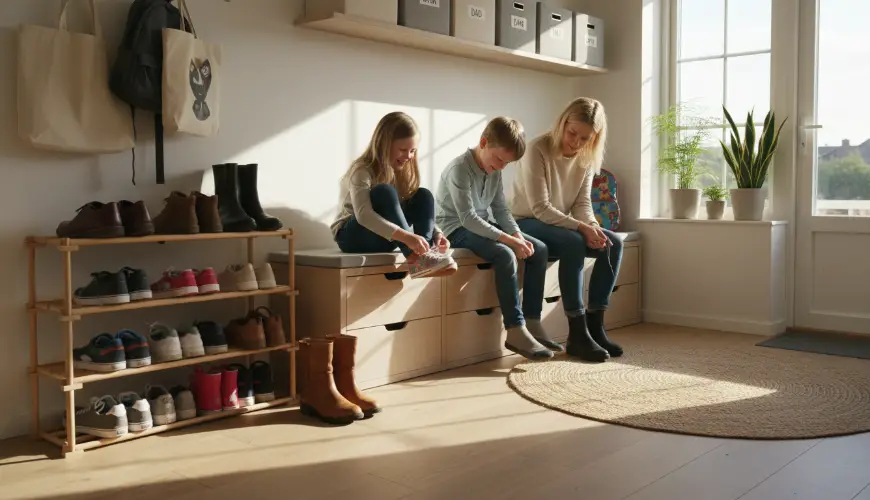
A very practical solution that has become popular in Scandinavian countries in recent years is the so-called entry system, or "mudroom" approach. This is a combination of a shoe rack, coat hooks and a bench for sitting while putting on shoes, all in one compact unit. This concept naturally guides every member of the household to sit down, take off their shoes and store them right on the spot. It gently creates the right habit without the need for constant reminders.
Another tried-and-tested trick is the so-called rotation system. Instead of keeping everything in the shoe rack at all times, only currently needed footwear is kept there. At the start of each season, a small swap is made – winter boots go into storage, summer sandals and trainers come out. This approach is also recommended by home organisation experts at the Marie Kondo Institute, who emphasise that a well-organised space reduces everyday stress and helps the whole family function better.
Practical tools and sustainable materials
Once the system is designed, it's time to choose specific tools. And this is precisely where there is room for conscious decisions that are good not only for the family, but also for the planet. Sustainable and eco-friendly materials are now making their way into the area of home organisation, with very good results.
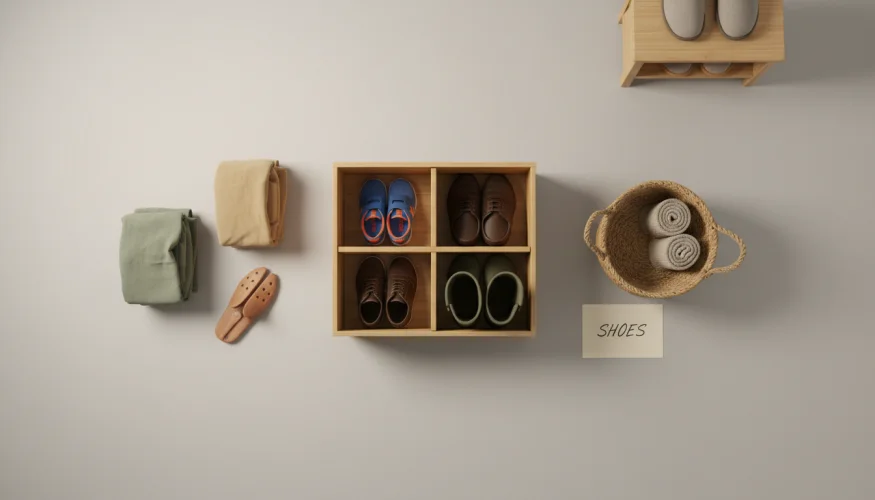
Bamboo shelves and organisers are sturdy, lightweight and naturally resistant to moisture and mould – which is an absolutely essential quality in a hallway where shoes bring in rain and mud. Bamboo is also one of the fastest-growing plants in the world, making it a choice that makes sense from an ecological perspective too. Similarly good alternatives are shelves made from recycled wood or FSC-certified solid wood, which combine durability with environmental responsibility.
For storing seasonal footwear, fabric boxes made from organic cotton or hemp are ideal. Unlike plastic boxes, they allow footwear to breathe, preventing unpleasant odours and mould from developing. Transparent versions with a small window allow for quick identification without having to rummage through everything.
As Danish designer Cecilie Manz once said: "Good design is not about how things look, but about how they function in everyday life." This idea applies to shoe rack organisation just as much as to furniture design. A beautiful shelf that is inconvenient to use will soon turn into chaos. Function must go hand in hand with form.
Doormats and mats in front of the shoe rack also deserve special attention. A quality absorbent mat made from natural materials – such as jute or coconut fibres – captures most dirt and moisture right at the door, significantly reducing the amount of work involved in cleaning the entire hallway. Such mats are also compostable at the end of their lifespan, which is a major advantage over synthetic alternatives.
For families with young children, low benches with storage space under the seat are also very practical. A child sits on the bench, puts on or takes off their shoes themselves, and stores them in the compartment directly beneath them. This simple mechanism builds independence in children while maintaining order without the need for constant parental supervision.
If the hallway is really small, there are clever solutions for vertical storage. Hanging pocket organisers made from recycled canvas, wall-mounted grids with hooks, or narrow fold-out shoe cabinets can store a surprising number of shoes in a minimal floor footprint. Fold-out systems are particularly interesting because when closed they look like an ordinary cupboard, and the hallway appears tidy even when nobody has actually tidied it recently.
An often-overlooked element of shoe rack organisation is the care of the footwear itself. Shoes that are stored correctly last longer – and that is both an economic and an ecological advantage. It's worth placing cedar wood shoe trees inside each pair; these absorb moisture, eliminate odours and maintain the shape of the footwear. Cedar wood also has a naturally repellent effect on moths, so it protects stored seasonal shoes as well. Leather footwear should be regularly treated with natural products based on beeswax or linseed oil, rather than aggressive chemical sprays.
Keeping the shoe rack tidy is not a one-off action, but an ongoing process. Once a month, five minutes is enough for everyone to return their shoes to their place, check whether anything needs repair or cleaning, and move seasonal items as needed. If the system is well designed, this mini-maintenance takes almost no time and prevents chaos from returning.
Families who have adopted this approach often describe a surprisingly pleasant side effect – morning departures to school and work suddenly become calmer. Nobody is searching for a missing shoe, nobody is shouting about where the slippers are, nobody is standing in their socks in the middle of a pile of footwear trying to remember where they left their trainers yesterday. A well-organised hallway with a functional shoe rack simply reduces everyday stress in a way that is hard to appreciate in advance, but once established, becomes impossible to imagine living without.
Organising a shoe rack for the whole family is therefore not about perfection or an Instagram-worthy hallway. It is about a system that respects real life – with wet shoes after rain, with football boots full of mud, with children's school slippers that have a mysterious ability to disappear at the most inconvenient moments. A well-designed system won't solve these situations perfectly, but it will significantly ease the day-to-day running of the household and turn the hallway into a place where you feel good from the very first step through the door.