
# How to Reduce Clutter at Home Without Throwing Things Away Getting rid of clutter doesn't always
There is one moment that almost everyone knows. You open the door to the living room, look at the pile of things on the sofa, the overcrowded shelves and the drawers that can barely be closed, and suddenly you are overcome with a feeling of complete exhaustion before you even begin. Clutter in the home is not just an aesthetic problem – research repeatedly shows that overcrowded spaces negatively affect our mental wellbeing, raise cortisol levels and make it harder to concentrate. Yet most people think the only path to tidying up involves large bin bags and a painful farewell to half of their possessions. Fortunately, it does not have to be that way.
It is possible to reduce clutter in your home without radically throwing things away. The key is a different approach to what we own, how we store things and how we think about the space around us. And this is precisely where real change begins.
Try our natural products

Why clutter accumulates and why it is so hard to deal with
Before you start tidying, it is useful to understand why clutter occurs in the first place. Most things in a home do not appear overnight – they accumulate gradually, imperceptibly, one item at a time. A handbag left on a chair, a book that never made it back to the shelf, a kitchen appliance that "might come in handy". Psychologists call this phenomenon the gradual accumulation effect, where each individual item does not seem like a problem on its own, but their combined total creates chaos.
Another factor is emotional attachment to objects. Research in behavioural psychology, including studies published in the scientific journal Journal of Consumer Psychology, shows that people assign significantly higher value to things they own than to things they do not own – a phenomenon known as the "endowment effect". This is why getting rid of things is psychologically demanding, even when those items are things we do not actually use.
And then there is a third element: the feeling that tidying must be either perfect or not done at all. It is precisely this mindset that leads to never starting to tidy up. Yet even small, gradual steps can have a huge impact on the overall atmosphere of a home.
The key, therefore, is not perfection or speed, but systematicness and intentionality. And these are exactly the qualities that can be developed without a single bin bag.
The art of sorting without throwing away
The core idea behind most modern approaches to home organisation is simple: things do not necessarily have to disappear from your life, but they must have the right place and the right function. Japanese organisation expert Marie Kondō expresses this with the words: "The goal is not to have fewer things – the goal is to have only those things that bring you joy." And even though this approach may seem idealistic, in practice it works surprisingly well.
The first step is a visual audit of the space. This does not mean you have to pull everything off the shelves and throw it on the floor. It is enough to walk through the home and consciously notice where things are and why they are there. Are these items that are actively used? Or are they things that are simply there because they were never given another place?
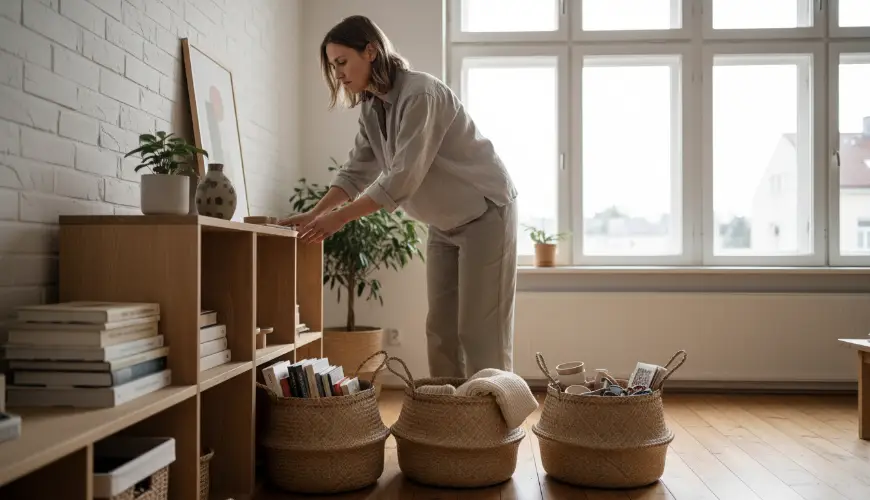
A practical tool that helps at this stage is the so-called three-basket system – sorting things into three categories: things that will stay where they are; things that will be given a new place in the home; and things that will go elsewhere (but not necessarily in the bin). The third category is key – "elsewhere" can mean donating, selling, lending or storing outside the home. Throwing things away is just one option, and not always the best one.
Take, for example, a situation familiar to many families with children: piles of toys that children have outgrown but still have an emotional attachment to. Throwing them away is not appropriate, but having them scattered all over the room does not work either. A solution might be the so-called toy rotation – some toys are stored in boxes and put away, while the other group remains actively available. After a few weeks, the groups are swapped. Children feel as though they have received "new" toys, the room looks tidier and no toy ends up in the bin.
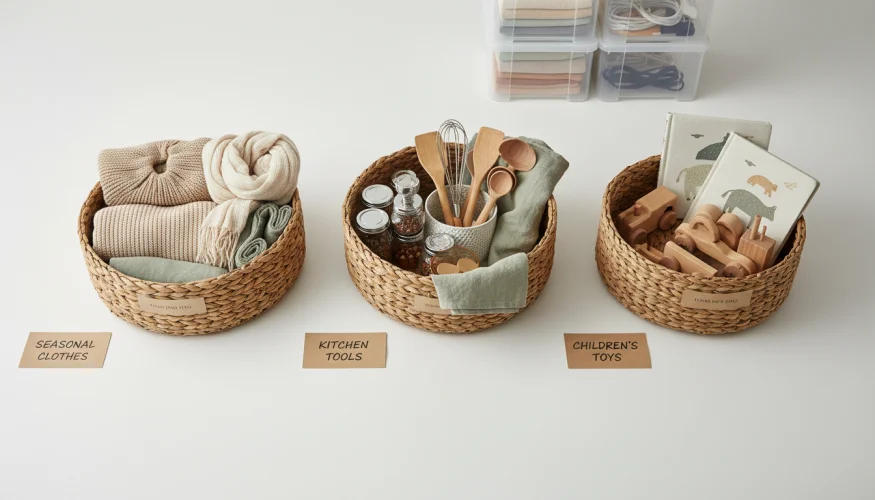
The same principle works for books, seasonal clothing, kitchen equipment or decorations. It is not about having less, but about having only what you actually need available at any given moment.
An important part of sorting is also reconsidering the way things are stored. A large portion of household clutter does not arise because we have too many things, but because things do not have a clearly defined place. Once every item knows "where it lives", it is much easier to return it there. And this is where smart storage systems come into play – not necessarily expensive designer pieces, but well-thought-out solutions that match the real way the household functions.
A sustainable approach to home organisation
Getting rid of clutter is one thing. Maintaining tidiness is another – and in many respects more demanding. Most people who have been through a big spring clean know the feeling: after a few months, everything is back to the way it was. Why? Because they did not change the system, they only cleaned the surface.
Sustainable home organisation rests on several simple principles. The first of these is the "one in, one out" rule – whenever a new item enters the home, an old one leaves. This rule prevents gradual accumulation and forces us to think more consciously about every new purchase. How many of the things we bought in the past year do we actually use regularly?
The second principle is conscious shopping. One of the main causes of overcrowded homes is impulsive or habitual shopping – we buy things because they are on sale, because we liked them in the shop or because we saw them in an advertisement. Yet at home we already have five similar items. A deliberate approach to shopping – where before every purchase we ask ourselves whether we truly need the item and where we will store it – can dramatically reduce the influx of new objects into the home.
The third pillar of sustainable tidiness is regular maintenance instead of large tidying sessions. Rather than one weekend marathon after which we are exhausted and a month later everything is back to how it was, it is more effective to spend five minutes each day consciously returning things to their place. This small habit loop has a surprisingly large effect on the overall state of the home.
Last but not least, the ecological dimension of the whole process deserves mention. Throwing things in the bin is not only wasteful but also environmentally problematic. Donating, exchanging, repairing or selling items we no longer need are approaches that are kind both to the wallet and to the planet. In the Czech Republic, a number of platforms exist – from second-hand markets to community exchange groups and charitable organisations – where items can find a new home instead of ending up at a landfill. Portals such as Bazos.cz or community groups on social networks make it possible to sell or donate items quickly and without unnecessary bureaucracy.
An interesting alternative is also the concept of a "library of things" – shared spaces where one can borrow items needed only occasionally, such as tools, sports equipment or kitchen appliances. This model, widespread particularly in Scandinavian countries and gradually making its way into the Czech environment, directly addresses one of the biggest sources of household clutter: things we bought for one specific situation and which have been lying unused ever since.
Another practical step is to consider digital clutter, which we cannot see physically but which affects our ability to concentrate and relax. An overflowing email inbox, thousands of photos on a phone or dozens of browser bookmarks – all of this creates a mental burden similar to physical clutter. Digital tidying – sorting photos, deleting unnecessary files, unsubscribing from newsletters – is a natural complement to physical home organisation.
Wabi-sabi, the Japanese aesthetic concept that finds beauty in imperfection and transience, reminds us that a home does not need to look like a catalogue photograph. Real tidiness is not about perfect sterility, but about a space that allows you to live the way you want to live. If you feel good in your home, if you can quickly find the things you need and if you return home with a sense of relief rather than stress, then you are probably on the right track.
Reducing clutter in the home is therefore not about giving up things that matter to us. It is about giving every item a purpose, every object a place and every space a function. And that is a change that does not require large bin bags – just a slightly different way of thinking about what surrounds us.