
Try the rule of the third basket and finally get rid of things
Everyone who has ever tried to tidy up a cluttered flat knows the feeling. You stand in the middle of a room surrounded by things you don't know where to put, and suddenly it hits you – I need more storage boxes. You dash to the shop, buy some nicely coordinated boxes, come home and... a few weeks later the situation is exactly the same. Perhaps even worse, because the boxes themselves take up space. Many people are familiar with this cycle, but few know that there is a simple way to break it – and it's called the third bin rule.
The idea seems straightforward at first glance, but its impact on the everyday running of a household is often surprisingly profound. It's not some fashionable Instagram trend or an expensive organisation course. It's about changing your approach to things themselves – ensuring that every item in the home has its place not because we've stuffed it somewhere, but because it genuinely belongs there.
Try our natural products




What the third bin rule actually means
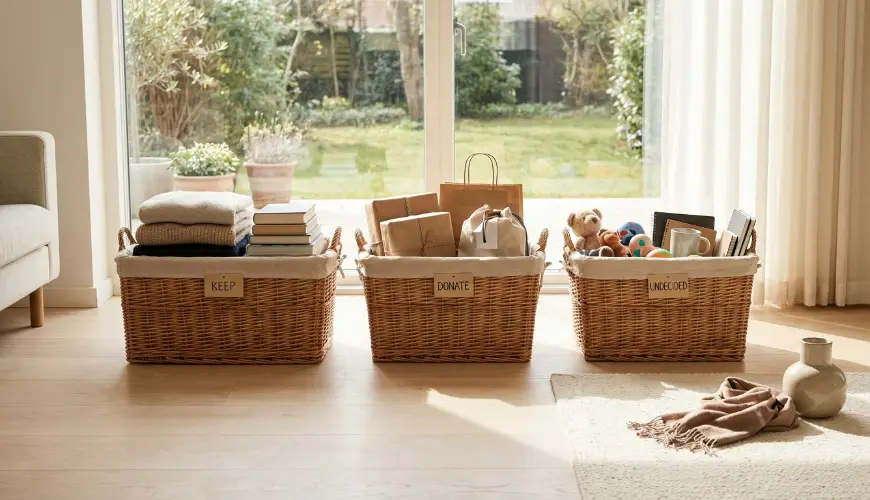
The principle works like this: whenever you sort through things – whether it's a wardrobe, kitchen shelves or a drawer full of miscellaneous junk – you always work with three bins or piles. The first is for things you're keeping that have a clear place. The second is for things you'll donate, sell or recycle. And the third bin is the crucial one – it's the place for things you're not yet sure about. You don't know whether you want to throw them away or keep them. Instead of hastily tossing them back into the cupboard or rashly discarding them, you put them in the third bin and give yourself a specific deadline to decide – say, a fortnight or a month.
Why is this so important? Because most organisational chaos doesn't stem from a lack of storage space, but from indecision. Things we don't know what to do with migrate from place to place without ever finding a true "home". The third bin gives them a temporary home and gives us time – without pressure, without guilt and without the need to decide immediately.
Interestingly, professional organisers advocate a similar philosophy. Marie Kondō, whose approach to decluttering changed the way millions of people think about tidiness at home, speaks about the importance of making conscious decisions when handling each item. The third bin rule takes this idea further – it adds the dimension of time and frees us from the feeling that we must decide right now.
Let's add a concrete example. Imagine Monika, a thirty-four-year-old teacher who decided to tidy up her home workspace. She had piles of papers, old textbooks, various trinkets from school trips and a heap of cables whose purpose she had long since forgotten. Her original plan was to buy new organisers and sort everything into them. Instead, she tried the third bin rule. Over a single afternoon weekend, more than thirty per cent of items ended up in the donation bin, and another twenty per cent went into the third bin for a later decision. And do you know what happened after a fortnight? She opened the third bin and threw most things away without hesitation. It turned out that when you haven't seen something for two weeks and haven't missed it at all, the answer is clear.
Organising without buying boxes – why storage bins actually hold us back
This brings us to the second part of the topic, which is closely connected to the third bin rule. There is a widespread myth that tidiness equals nicely coordinated storage boxes. The home organisation industry is enormous – in the United States alone it exceeds twelve billion dollars a year, and a similar trend is spreading across Europe. But buying a box doesn't mean having order. A box without a system is just clutter that looks different.
Organising without buying boxes rests on a different premise: first reduce, then store. Until we know how many things we actually want to keep, we can't know how much storage space we need. Buying boxes before sorting is like buying bigger trousers instead of thinking about what we eat.
In practice, this means starting with the third bin rule – going through the entire home, or at least one room, and only after thorough sorting discovering what actually remains. Very often it turns out that the storage spaces we need are already in our home – they're just filled with things that don't belong there. A free shelf, an empty drawer, space in the utility room – all of this can appear on its own without spending a single penny on a new organiser.
If you do find that you need some storage space, it's worth reaching for sustainable alternatives. Wicker baskets, second-hand wooden boxes, or old tins and jars can work just as well as expensive plastic systems from shopping centres – and they don't burden the environment with the unnecessary production of new plastic. Research in the field of sustainable consumption repeatedly shows that the most ecological thing we can do is not to buy what we don't need.
It's also interesting to observe what happens to our relationship with things when we stop automatically reaching for new storage solutions. Many people describe how they begin to appreciate their belongings more, remember what they have more easily, and make duplicate purchases less often. How many of us have three identical pairs of scissors at home simply because we forgot where the first pair was? Or five unopened rolls of adhesive tape? A well-organised home where every item has its place naturally leads to more mindful consumption.
The transition from "I'll buy boxes" to "I'll sort and reduce" can feel uncomfortable at first. It's a bit like a diet – the first few days are the hardest, because we encounter habits and emotions tied to our belongings. Some items we carry as memories, others as unfinished projects or promises made to ourselves. "I'll fix it one day." "When I have time, I'll read it." The third bin gives us space to work through these emotions without having to make an immediate decision.
How to get started practically – step by step without stress
Starting with the third bin rule requires no special preparation or a free weekend. All you need is three containers – bags, boxes, or simply designated spots on the floor – and to choose one small area to begin with. Ideally one that bothers you the most, or conversely one that is smallest and where you can quickly confirm that it works.
When sorting, ask yourself three questions about each item: Do I use it? Do I like it or does it bring me joy? Do I need to be the one to keep it, or could it serve someone else better? These questions aren't new – they draw on various approaches to minimalism and conscious consumption – but in combination with the third bin they take on a new dimension. You don't have to answer immediately. Doubts belong in the third bin.
It's important to set a specific date to return to the third bin. Without a deadline, the third bin can easily turn into yet another pile of undecided things. A fortnight is usually ideal – long enough to reveal what you genuinely miss, yet short enough that you don't forget about the bin entirely.
As for items going from the second bin onwards – those to be donated or sold – it pays to have a clear plan in advance. Local charity shops, online marketplaces such as Vinted, or local swapping groups are excellent ways to give items a second life. Something you don't miss could be exactly what someone else has been looking for. And what's more – letting go of things in this way brings a far more pleasant feeling than simply throwing them in the bin.
Gradually, as you work through different parts of the home in this way, you'll begin to notice patterns. You may discover that you tend to accumulate things from a particular category – clothes you'll "wear one day", books you'll "read one day", kitchen gadgets you'll "use one day". This awareness is valuable in itself, because it helps you shop more mindfully in the future.
An organised home is not a destination, it's an ongoing process. The third bin rule in this respect offers something that most organisational systems lack – flexibility and tolerance for human indecision. It doesn't force you to be perfect straight away, but gives you a tool for approaching tidiness at your own pace. And all without buying a single extra box.