

Call while standing and add extra movement to your body

The modern workday largely takes place sitting down. In the morning, a person arrives at the office, sits down at the computer, and before they know it, it's noon. The afternoon looks the same. Meetings alternate with emails, emails alternate with reports, and physical movement shrinks down to a trip to the printer or to the kitchen for coffee. Yet there is one inconspicuous moment that repeats several times a day and holds enormous potential — the phone call. Exercising while standing during a phone call is one of the most natural and accessible ways to get moving throughout the day without needing to change your schedule, buy expensive equipment, or set aside special time for exercise.
This is not some fashionable trend. It is a simple reassessment of what we do with our bodies in moments when we would otherwise let them idle.
Try our natural products





Why sitting is more harmful than we think
Research repeatedly shows that prolonged sitting is associated with a wide range of health risks — from back and neck pain to metabolic disorders and an increased risk of cardiovascular disease. The World Health Organization recommends that adults get at least 150 minutes of moderate-intensity physical activity per week, while also noting that even interrupting long periods of sitting with short active breaks has a demonstrable benefit for health.
The problem is not just that people don't exercise enough. The problem is that people sit continuously for hours at a stretch. Even someone who goes to the gym three times a week can suffer the consequences of a sedentary job if they spend eight or ten hours between workouts without moving. The body does not function like a bank account where movement from the morning is "saved up" for the rest of the day. It needs regular impulses distributed throughout the day.
And this is precisely where phone calls come in. The average working person spends dozens of minutes a day on calls — sometimes an hour or more. These are minutes that can, without any compromise, be devoted to movement.
Standing up and walking: a small change with a big impact
Imagine Martin, a project manager at a mid-sized company. Martin has a packed diary every day — meetings, reports, calls with clients. A year ago, he started with a single rule: whenever his phone rings and the call is going to last more than a few minutes, he stands up and starts walking. At first just around the office, then along the corridor, and in summer even outside in front of the building. After three months, he noticed that his back had stopped hurting, he felt less tired in the afternoons, and in his own words, "the brain worked better when the body was in motion."
Martin's experience is not unique. Walking during a phone call is probably the simplest form of active sitting interruption that exists. It requires no change of clothes, causes no sweating, and does not disrupt concentration — on the contrary, many people report that they think and express themselves more clearly when walking.
The science backs this up: walking increases blood flow to the brain, promotes the release of neurotransmitters such as dopamine and serotonin, and supports creative thinking. A well-known Stanford University study from 2014 showed that walking increases creative thinking by up to 81% compared to sitting. So if someone is working through a complex problem during a call or searching for a new idea, standing or walking can literally help them find the answer.
Of course, not every phone call takes place in conditions where one can walk freely. Video calls, screen sharing, or working from home with small children around have their own specific challenges. But even in such situations, the simple act of standing up from the chair is enough. Standing at a desk, by a window, or at a kitchen counter is in itself significantly better than sitting.
How to turn phone calls into a movement routine
The transition from passive to active phone calling requires no major preparation. It simply means building a few simple habits that gradually become automatic.
The first step is a decision — a literal physical decision to stand up every time the phone rings or every time you make a call yourself. At first it may feel uncomfortable or unnecessary, especially if the call was "just for a minute." But even that one minute standing has value. The body stretches, circulation activates, and the spine gets a brief rest from the static strain of sitting.
The next level is adding simple movements. During a phone call, you can perform the following without disrupting the conversation in any way:
- shifting weight from foot to foot — activates the muscles of the feet, calves, and hip stabilisers
- slow squats or half-squats — unobtrusive but effective for large muscle groups
- shoulder rolls and neck stretches — ideal for releasing tension from long hours at the computer
- walking on the spot or around the room — the most natural form of movement, which won't bother anyone on the other end of the line
It is important that the movement does not feel forced or strained. The goal is not to work out intensively during a five-minute call, but simply to get the body moving, improve circulation, and prepare it for the next period of focused work.
For those working from home, there is another option — a walking pad or treadmill desk, a workstation with an integrated slow-moving belt. These devices are becoming increasingly accessible and allow for slow walking even while working at a computer or during phone calls. This is not a sprint, but movement at a pace of approximately two to four kilometres per hour, which keeps the body in an active state without disrupting concentration.
The phone call as an anchor for a healthier day
One of the most effective principles for building new habits is so-called "habit stacking" — linking new behaviour to an existing routine. A phone call is exactly such an anchor point. People make calls every day, several times a day, and this pattern does not change. If movement is attached to it, a strong and natural association is formed: phone rings → body stands up.
As the author of Atomic Habits, James Clear, puts it: "Every action you take is a vote for the type of person you wish to become." Standing up during phone calls is not just about calories or back health — it is a vote for the kind of person who values their body and treats movement as a natural part of the day, not a duty pushed to the evening.
This approach is particularly valuable at a time when a sedentary lifestyle is affecting ever younger generations. According to data from Eurostat, the proportion of overweight people in Europe has been rising steadily, and lack of physical activity is one of the key contributing factors. Yet the solution does not have to be dramatic. It does not have to be a marathon or crossfit. It can simply be a phone call taken standing up.
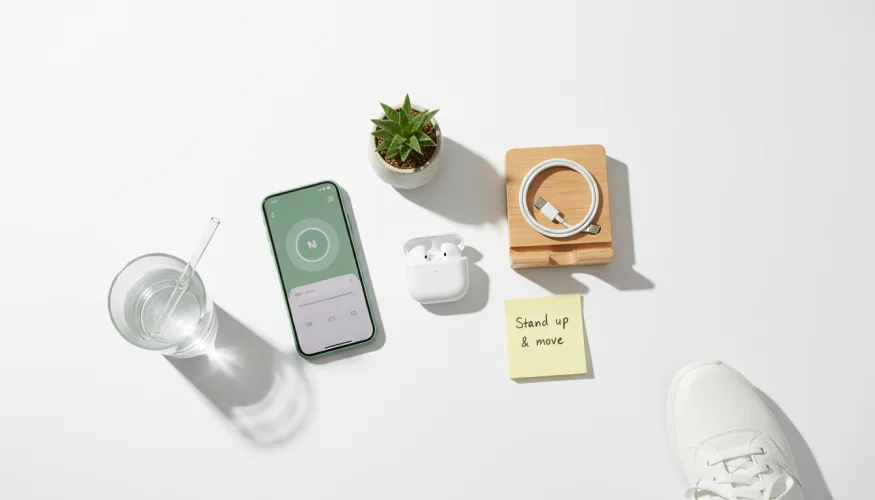
Why small movements throughout the day actually work
There is a concept that movement and metabolism researchers call NEAT — Non-Exercise Activity Thermogenesis, loosely translated as the energy the body burns during all everyday movements outside of intentional exercise — walking, standing, gesturing, carrying groceries, washing dishes. Research shows that NEAT can account for a significant portion of a person's total energy expenditure, and that people with an active lifestyle — even without regular sport — have markedly better metabolic health thanks to NEAT.
Standing and walking during phone calls contributes to precisely this "silent" movement account. It is not visible, it will not show up in a fitness app, but the body registers it and responds to it. A person who spends thirty or forty minutes every day on phone calls while standing rather than sitting will, over the course of a year, have stood or walked for hundreds of additional hours. That is a difference that shows — in back health, in energy levels, in an overall sense of vitality.
Connecting movement with everyday obligations — such as phone calls — is also psychologically less demanding than planning a separate workout. It requires no motivation to "go and exercise," because exercise is not the goal — the phone call is. Movement is merely a by-product. And it is precisely this effortlessness that makes it sustainable.
Anyone looking for inspiration for other small changes that contribute to a healthier lifestyle without radical disruption to their routine can start right here — at the phone, standing up, with the awareness that every small movement counts. And that a day that begins actively tends to stay that way.