
# Practical Tips for Removing Odors from a Trash Can
Everyone knows it. You come home after a long day, walk into the kitchen, and the first thing that greets you isn't the smell of freshly brewed coffee or herbs on the windowsill, but an unpleasant odour coming from the rubbish bin in the corner of the room. It's one of those everyday annoyances that, while not dramatic, can ruin your mood and the impression of an otherwise clean home. Yet eliminating odour from a rubbish bin is no great science – you just need to know why it occurs in the first place and what simple steps will reliably eliminate it.
Bin odour arises primarily from the decomposition of organic matter. Bacteria, moulds and yeasts feed on food scraps, damp paper towels or fruit past its use-by date, releasing gases in the process that our sense of smell perceives as unpleasant. The speed of this process depends on temperature, humidity and the amount of organic material in the bin. In summer, when kitchens are warmer, the problem is therefore more pronounced. This is not a failure of cleanliness, but a natural biological process – and that is precisely why it cannot be solved once and for all with a single magic product, but rather through a combination of good habits and appropriate tools.
Try our natural products
Why Simply Changing the Bag Isn't Enough
Many people are satisfied with changing the bag as soon as it starts to smell. But the problem is often deeper – literally. Juices from food seep through the bag, settle on the bottom and sides of the bin, and become a breeding ground for bacteria. Even after changing the bag, the odour persists, because its source remains inside the container. Regularly washing the bin itself is therefore a fundamental requirement, without which other measures only work halfway.
How to do this in practice? Simply once a week or at least once a fortnight, take the bin outside or into the bath, rinse it with hot water, add a little eco-friendly cleaning product or a solution of vinegar and water, and scrub the sides and bottom thoroughly with a brush. Then leave the bin to air-dry – this is the key step that many people skip. A damp environment encourages bacteria, so a bin put back while still wet will become problematic much more quickly than one that has been properly dried.
Take, for example, a family with two children who complained for a long time about a persistent smell in their kitchen. They changed the bag regularly and bought various fragrances and sprays, but nothing helped. It was only when they started washing and drying the bin regularly that the problem largely disappeared. They solved the rest by changing what they threw in the bin – but more on that in a moment.
Natural Helpers That Actually Work
Chemical air fresheners and synthetic fragrances are a quick fix, but in reality they merely mask odours rather than eliminating them. Furthermore, their composition is often questionable from the perspective of both health and environmental impact. Fortunately, there are natural alternatives that work reliably and are safe for the whole family, including pets.
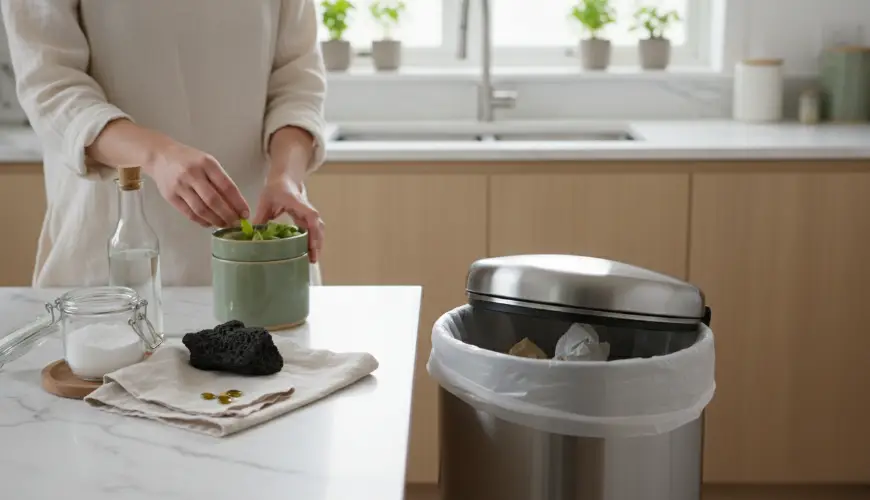
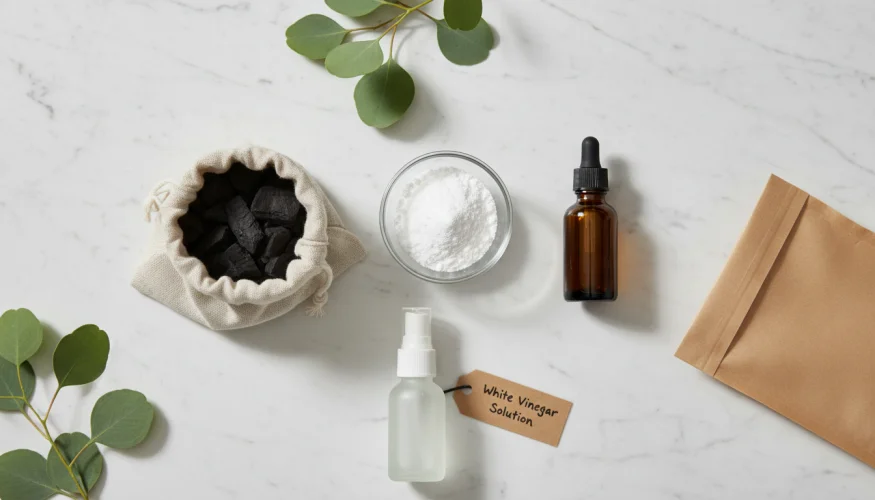
Bicarbonate of soda is a classic in this regard. Sodium bicarbonate has the ability to neutralise both acidic and alkaline odours, and can therefore be used to great advantage in the fight against bin smells. Simply sprinkle a little bicarbonate of soda on the bottom of the bin beneath the bag, or sprinkle it directly onto the waste causing the odour. Regular application significantly reduces the intensity of smells without masking anything with synthetic fragrances.
Equally effective is activated charcoal, which works on the principle of adsorption – capturing odour molecules on its surface. Bags of activated charcoal can be placed inside the bin or directly beside it and refreshed regularly. Various eco-friendly options are available on the market today, such as bags filled with bamboo charcoal, which can be regenerated in sunlight after a period of time and used again. This makes them not only effective, but also a sustainable solution.
Another natural ally is essential oils. A few drops of tea tree oil or eucalyptus on a paper towel placed inside the bin not only smells pleasant, but also has antimicrobial properties that slow the growth of bacteria. As the British portal Healthline notes, tea tree oil has proven antibacterial properties, which is why it finds application in a wide range of household uses.
Let us not forget vinegar either. White distilled vinegar is excellent for washing the bin – it neutralises odours and disinfects the surface without chemicals. After washing with a vinegar solution, simply rinse the bin with clean water and leave it to dry. Vinegar itself also has quite a strong smell, but this odour disappears completely once it has dried.
What We Throw in the Bin Matters More Than We Think
Alongside cleaning and natural neutralisers, what we do with the waste itself plays a crucial role. Organic waste – vegetable and fruit scraps, meat or cooked food – is the main culprit behind odours. The longer it stays in the bin, the more it decomposes and the more intense the smell it produces.
One of the most effective solutions is composting. If you have a garden or access to a communal composting site, organic waste need never go into the ordinary bin at all. Specialist composting containers for home use are now available even for flat-dwellers – so-called bokashi systems allow organic waste to be fermented directly in the kitchen without odour, and the resulting substrate then serves as an excellent fertiliser. The Czech Environmental Information Agency CENIA has long highlighted that organic waste accounts for up to 40% of municipal waste, and its separate processing has a significant impact not only on household odours, but also on the overall burden on landfill sites.
Wrapping food scraps correctly before throwing them away is also important. Leftovers wrapped in newspaper or in a compostable bag decompose more slowly and smell less than those thrown loosely into the bin. Meat and fish are a special case – ideally, these scraps should not wait in the bin for more than one day, or should be stored in a sealed bag in the freezer until bin collection day.
As British ecological activist and author of books on sustainable living Bea Johnson once said: "The best waste is the waste that is never created." Even if we don't always manage to achieve this ideal, being mindful about what we throw away has a direct impact on how our home smells and how large a footprint we leave on the planet.
Choosing the Right Bin and Bags
The design and material of the bin itself play a greater role than one might think. Bins with tightly fitting lids significantly reduce the spread of odour into the surrounding space. Pedal-operated models are practical in this respect, as the lid remains closed most of the time and only opens when waste is being deposited. Lidless bins, however attractive in design, are disadvantageous when it comes to odour.
The material of the bin also matters. Plastic bins tend to absorb odours into their surface, whereas stainless steel or enamel bins are more resistant and easier to clean. If you use a plastic bin, regular washing and drying is all the more important.
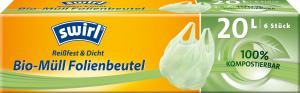
As for bags, eco-friendly compostable bags are an excellent choice for organic waste, but for ordinary mixed waste, standard bags of an appropriate size are perfectly adequate. The key is not to overfill them – an overflowing bin not only smells more intensely, but is also harder to close and attracts insects. Changing the bag regularly, ideally every two to three days, significantly reduces odour intensity without any additional measures being necessary.
The placement of the bin in the kitchen also helps. Direct sunlight and proximity to the cooker or heating accelerate the decomposition of organic waste and thus the development of odour. A cooler, shadier spot, such as under the sink, is preferable in this regard – although it is of course necessary to ensure good ventilation so that moisture does not accumulate under the kitchen units.
Eliminating odour from a rubbish bin is therefore not about one miraculous product, but about a combination of several simple measures. Regular cleaning, natural neutralisers, mindful handling of organic waste, and the right choice of bin and bags – these are the tools that, used together, work reliably and in the long term. And as a bonus: most of these solutions are kinder to the environment and to the family budget than constantly buying chemical air fresheners that merely mask the problem anyway. A clean, fresh-smelling home does not begin with a scented spray, but with understanding where the odour actually originates.