

Learn how to avoid unnecessary watering and save water
Water is precious. Although it sounds like a cliché, the reality is that in recent years, drought has become an increasingly common visitor not only in Mediterranean countries, but also in the Czech Republic. Every summer brings news of falling groundwater levels, restrictions on withdrawals from watercourses, and dried-up wells. And yet many of us water our gardens or houseplants in a way that can only be described as wasteful. Unnecessary watering – too often, too much, at the wrong time and in the wrong place – is one of the most common mistakes growers make. Yet it only takes a small change in approach to achieve a double benefit: healthier plants and significantly lower water consumption.
It is not just a matter of ecology, although that is of course important. Unnecessary watering has a direct impact on your wallet, on the health of your plants, and on soil quality. Waterlogged soil loses its structure, creates conditions for the development of moulds and root diseases, and ultimately weakens even the most resilient plants. So how do you water smartly, economically, and with respect for water as a precious resource?
Try our natural products


When, where, and how much – the basics of smart watering
One of the simplest yet most effective changes you can make is timing your watering. Watering at noon or in the afternoon under direct sunlight is a classic mistake made by a great many gardeners. In such cases, water evaporates quickly from the soil surface before it has a chance to reach the roots. Some of the water also remains on the leaves, where it can act like a magnifying glass and cause burns, or conversely create a moist environment favourable for fungi.
The best time to water is early in the morning, ideally before eight o'clock. The water has time to soak into the soil, the roots can absorb it throughout the day, and the leaves have time to dry. If morning watering is not possible, late afternoon is an option – but be careful, watering just before dark can contribute to the development of moulds, as wet soil and leaves will remain damp overnight.
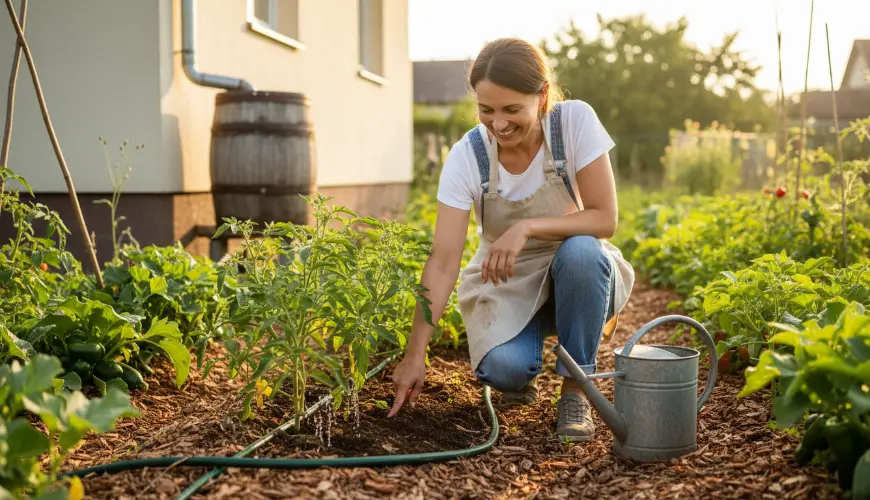
Just as important as timing is where you direct the water. Watering onto the leaves is unnecessary or even harmful for most vegetables and ornamental plants. Water belongs at the roots, not on the surface of the leaves. Drip irrigation or simple soaker hoses led directly to the base of the plants are invaluable in this regard. They reduce water consumption by up to 50% compared to conventional spraying with a hose or watering can, while also minimising the risk of disease.
Another factor is the amount of water. Many people water a little every day – and that is precisely the problem. Such watering encourages a shallow root system that is more susceptible to drought and damage. A much better strategy is to water less frequently but more generously. Deep watering once or twice a week encourages plants to grow their roots deeper into the soil, where it is naturally moister and cooler. The result is more robust plants that cope with dry periods considerably better.
But how do you know when it is actually time to water? A simple test involves inserting your finger or a wooden stick into the soil to a depth of about five centimetres. If the soil is still moist, watering is not needed. If it is dry, it is time. This test is more reliable than any fixed schedule, as it takes into account the current weather, soil type, and the specific plant.
Mulching, compost, and rainwater harvesting as the foundation of a sustainable garden
Saving water when watering is not just about how you water – equally important is what you do with the soil and how you manage water across the garden as a whole. Three pillars that can significantly reduce the need for watering are mulching, improving soil structure, and using rainwater.
Mulching is probably the most effective technique for retaining moisture in the soil. A layer of organic material – whether wood chips, straw, cut grass, leaves, or compost – placed on the surface of a bed acts as natural insulation. It slows the evaporation of water from the soil, regulates temperature, suppresses weeds (which would otherwise compete with plants for water), and gradually decomposes, enriching the soil with nutrients. Studies by the National Sustainable Agriculture Information Service in the USA have repeatedly confirmed that properly mulched beds require up to 70% less watering than unmulched ones.
Soil quality plays a fundamental role in how effectively water can be absorbed and retained. Clay soils hold water but conduct it poorly to the roots and are prone to waterlogging. Sandy soils, on the other hand, drain water quickly and do not store it. The ideal is a sandy loam soil rich in organic matter – and compost is the simplest way to create such soil. Regularly working compost into beds improves soil structure, increases its water-retention capacity, and at the same time reduces the need for fertilisation. It is an investment that pays back many times over.
Rainwater harvesting is another step that makes sense both ecologically and economically. A barrel tank connected to a roof downpipe can collect hundreds of litres of water during a heavy rain shower that would otherwise flow into the drainage system. This water is ideal for plants – it contains no chlorine or other chemicals that are present to varying degrees in tap water, and it is at a natural temperature. Larger gardens can invest in underground tanks or grey water harvesting systems, but even a simple plastic barrel costing a few hundred crowns makes a big difference.
Let us take a specific example: a family with a small 200-square-metre garden in the South Moravian Region. Every summer they watered morning and evening from the mains, water consumption rose significantly in summer, and yet they still had problems with drought in the second half of summer. After introducing drip irrigation, mulching the beds with wood chips, and installing two 500-litre rain barrels, their mains water consumption fell by more than half. The plants were in better condition than in previous years, because they stopped receiving excess water and began to develop a deeper root system.
The same principles apply to balcony and terrace gardens or container growing. Containers generally dry out faster than in-ground beds, but even here daily watering is not automatically correct. The key is again the moisture test – and choosing the right growing medium. Substrates enriched with hydrogel granules or coconut fibres can retain significantly more water and release it gradually according to the plants' needs.
Houseplants and watering without waste
Overwatering is the most common cause of houseplant death worldwide. More plants die from too much care than from too little – and watering is precisely the area where excessive enthusiasm causes the most harm. Roots need not only water but also air. If the substrate is constantly wet, the roots suffocate, rot, and the plant gradually dies, while the symptoms – yellow leaves, wilting – paradoxically look like signs of water deficiency, so the owner waters even more.
How do you do it correctly? The rule varies according to the type of plant. Tropical plants with large leaves such as monstera or ficus need watering as soon as the top layer of substrate dries out. Succulents and cacti, on the other hand, require the substrate to dry out completely between waterings – in winter, a single watering per month or less is often sufficient. Ferns and orchids have their own specific requirements that are worth researching individually.
A practical aid is a soil moisture meter – a simple and inexpensive device that removes all guesswork. The more sophisticated models can even be connected to smart irrigation systems that water automatically only when it is truly necessary. As garden writer Karel Hieke wrote: "A plant will always tell you what it needs – we just have to learn to listen to it."
Another way to save water with houseplants is to use cooking water. Cooled water from boiling vegetables or eggs is rich in minerals and nutrients, and plants love it. The same applies to aquarium water when cleaning the tank – it contains natural nutrients from fish waste and is very well received by plants. These small habits will not solve the global water shortage on their own, but they are part of a broader approach to life in which waste has no place.
Watering sensibly is neither complicated nor time-consuming. It simply requires a little attention, a willingness to reconsider established habits, and a basic knowledge of the needs of specific plants. The result is not only lower water consumption and lower bills, but also a healthier garden and plants that are naturally more resilient to weather fluctuations. At a time when the Czech Hydrometeorological Institute regularly draws attention to the continuing trend of landscape desiccation in the Czech Republic, every litre of water saved in the garden is a small but real contribution to solving a problem that affects us all. And that is worth doing.