
Learn how to organize your fridge smartly
Everyone knows it. You open the fridge to prepare dinner and come across a forgotten yogurt past its expiry date, wilted lettuce, or cheese with an unwanted green coating. Yet the food was only purchased a few days ago. Very often, the problem lies not in the quality of the food itself or its shelf life – the cause is usually poor fridge organisation. The way food is stored in the refrigerator fundamentally affects how long it stays fresh, tasty, and safe to eat.
Fridge organisation is a topic that may seem trivial at first glance, but in reality there is quite clear science behind it involving temperatures, humidity, and air circulation. According to estimates by the Food and Agriculture Organization of the United Nations (FAO), approximately one third of all food produced for human consumption ends up as waste. A large portion of this waste is generated in households – and proper refrigerator storage is one of the simplest ways to significantly reduce it.
Try our natural products
-1-m.jpg)
-1-m.jpg)
-1-m.jpg)
-1-m.jpg)
-1-m.jpg)
Temperature is not the same throughout the fridge
One of the most widespread misconceptions is that a fridge maintains the same temperature throughout its interior. In reality, the temperature varies significantly in different parts of the refrigerator, and this fact should be the basis of any well-thought-out organisation. The coldest spot in a standard fridge is on the lower shelves, because cold air is heavier than warm air and naturally sinks downward. Conversely, the top shelves tend to be warmer, even though intuitively one might assume it would be cooler at the top.
Door compartments are the warmest spots in the fridge, as they are regularly exposed to warm room air every time the fridge is opened. Yet most households store eggs or milk there – foods that are quite sensitive to temperature fluctuations. This seemingly insignificant decision can shorten their shelf life by several days.
The ideal overall fridge temperature should be between 2 and 5 degrees Celsius, as recommended by organisations such as the British Food Standards Agency. The freezer temperature should be set to minus 18 degrees Celsius or lower. Regularly checking these values using a simple fridge thermometer is a habit that pays off.
A practical example of how much difference proper food placement makes is the experience of many families who, after reorganising their fridge contents, found that milk lasted two to three days longer simply because they stopped storing it in the door compartments and started placing it on the lower shelf near the back wall of the fridge, where the cold is most stable.
What goes where in the fridge
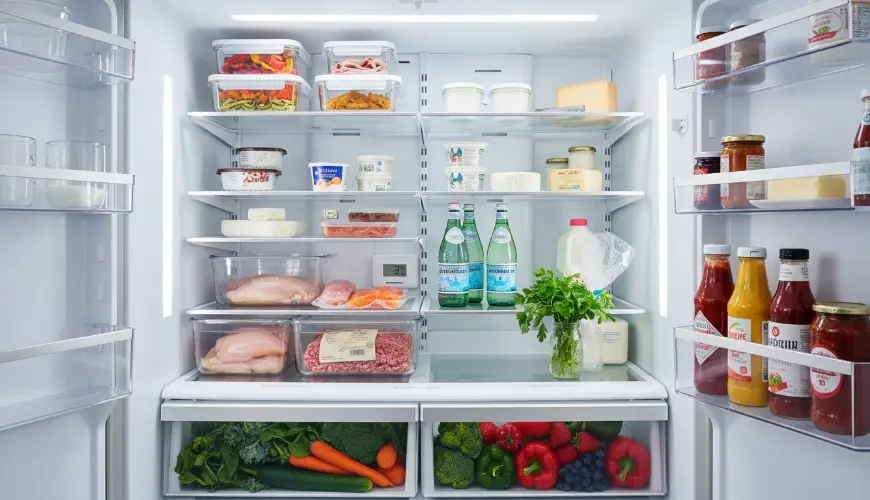
Once it is clear that temperature varies in the fridge according to zones, it becomes easier to understand why each food has its ideal place. Upper shelves are best for foods that do not require very intense cooling and are already heat-treated – this includes leftovers, ready-made dishes, yogurts, hard cheeses, or deli meats in sealed packaging. These foods do not require the lowest temperatures, but do need a stable environment without major fluctuations.
Middle shelves are suitable for dairy products such as soured cream, cottage cheese, or soft cheeses, as well as various drinks. This is the so-called golden middle ground – neither too cold nor too warm, a spot that suits a wide range of foods.
Lower shelves should be used for raw meat, poultry, and fish. In addition to being the coldest part of the fridge, this is also a safety measure – any juices from raw meat cannot drip onto other foods and contaminate them with dangerous bacteria such as Salmonella or Campylobacter. Raw meat should always be wrapped or stored in a closed container.
The vegetable and fruit drawers are designed to maintain higher humidity, which helps preserve the freshness of plant-based foods. However, it is important to know that not all fruit and vegetables belong in the fridge. Tomatoes, for example, lose their characteristic flavour and aroma when chilled, bananas turn black, and avocados that are not yet ripe will not ripen properly in the fridge. On the other hand, leafy greens, carrots, broccoli, and strawberries last significantly longer when kept cold.
Door compartments are for foods that are more resistant to temperature fluctuations and also have a longer shelf life. Various sauces, ketchup, mustard, jams, pasteurised juices, and butter are ideal here. Eggs and milk, as already mentioned, do not belong here, even though fridge manufacturers sometimes design door compartments specifically for eggs.
Order, air circulation, and the right containers
Fridge organisation is not just a matter of where things belong in terms of temperature. Overall clarity and free space for air circulation play an equally important role. An overfilled fridge, in which foods are packed tightly together without any free space, operates less efficiently. Cold air cannot circulate freely, temperatures equalise more slowly, and the fridge has to work harder to maintain the correct temperature. This affects not only food freshness but also electricity consumption.
On the other hand, a fridge that is too empty is not ideal either – a greater quantity of food helps maintain a stable temperature, because the chilled mass acts as a thermal accumulator. The golden rule, therefore, is: the fridge should be reasonably full, with sufficient space for air circulation, but not half-empty.
Transparent containers and sealable boxes are a great help when it comes to organisation. Foods stored in airtight containers last longer because they are protected from drying out and from absorbing foreign odours. The transparency of the containers ensures that the fridge contents are visible at a glance – significantly reducing the risk of forgetting something and food spoiling unnecessarily.
A very practical tool is the FIFO system (from the English "first in, first out"). This principle, commonly used in professional kitchens and the food industry, means that newly purchased foods are placed at the back and older ones remain at the front, where they are more visible and easily accessible. This approach significantly reduces the risk of foods with a shorter shelf life being overlooked.
As British chef and sustainable cooking advocate Hugh Fearnley-Whittingstall says: "The best way to reduce food waste is simply to know what you have at home." And a fridge organised so that its contents are clearly visible is precisely what makes this awareness possible.
Another important rule is to never put warm food in the fridge. Hot or warm foods raise the overall temperature inside the refrigerator, which negatively affects other stored foods. Leftover food should first be cooled to room temperature – ideally within two hours of cooking – and only then stored in the fridge in a closed container.
Regular cleaning of the fridge is another aspect that directly affects food shelf life. Bacteria and mould can settle on the shelves and walls of the refrigerator and from there contaminate fresh foods. It is recommended to thoroughly clean the fridge approximately once a month – remove all food, wash the shelves with lukewarm water and a little bicarbonate of soda or vinegar, and allow everything to dry properly before refilling. Bicarbonate of soda serves not only as a cleaning agent but also helps neutralise unpleasant odours.
Special tips for specific foods
Some foods have their own specific storage rules that are worth knowing. Herbs such as parsley or coriander will last significantly longer in the fridge if stored like a bouquet – the stems are placed in a glass with a little water and loosely covered with a plastic bag. Stored this way, they can stay fresh for a week or more, whereas in a bag or placed loosely they will wilt within two to three days.
Cheeses should be wrapped in special cheese paper or parchment paper, not in plastic film, which prevents the cheese from breathing and accelerates spoilage. Hard cheeses such as Emmental or Parmesan can last several weeks in the fridge when stored properly, while soft cheeses such as Brie or Camembert need to be consumed more quickly.
Interestingly, garlic and onions do not belong in the fridge at all. They need a dry and well-ventilated environment at room temperature. In the fridge they become damp, spoil quickly, and can transfer their strong aroma to other foods. Bread is in a similar situation – it dries out and goes stale faster in the fridge than at room temperature. The exception is when it is very hot and humid at home, or when the bread contains very few preservatives.
Eggs should be kept in the fridge in their original cardboard carton, which protects them from absorbing foreign odours and from losing moisture. The eggshell is porous and eggs easily absorb odours from their surroundings – which is why they should not be stored next to strongly scented foods such as fish or smoked meat.
Proper fridge organisation is therefore not a complicated science, but it does require a little attention and a willingness to change established habits. The result is not only less food waste and financial savings, but also a clearer conscience at a time when sustainability and a responsible approach to consumption are playing an increasingly important role. A well-organised fridge is one of the simplest steps towards a more eco-friendly and mindful household – and it takes no more than half an hour every now and then.