

Why try soap nuts instead of laundry detergent
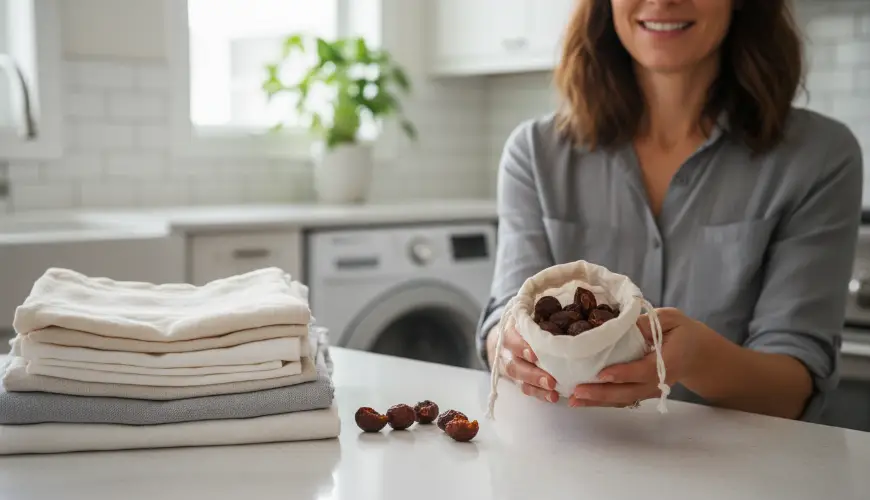
Anyone who has been interested in a more eco-friendly lifestyle in recent years has probably come across soap nuts. The small, dried fruits of the Sapindus mukorossi tree, originating primarily from the Himalayas and Southeast Asia, have slowly but surely made their way into the awareness of people seeking an alternative to conventional laundry detergents. And no wonder – at a time when more and more households are asking what they are adding to their washing machines and what then flows into the sewage system, soap nuts seem like an appealing answer. But do they really work as reliably as a classic laundry detergent? And what can realistically be expected of them?
The story of soap nuts is not new. In India, Nepal and other Asian countries, they have been used for washing and personal hygiene for centuries, long before industrial cleaning products ever appeared on the market. Their cleaning power comes from saponin – a natural substance found in the fruit's shell that foams upon contact with water and acts similarly to synthetic surfactants in conventional detergents. It is saponin that releases dirt from textile fibres and allows it to be removed by water. The difference compared to chemical products is fundamental: saponin is biodegradable, does not burden aquatic ecosystems and leaves no chemical residues in fabrics.
Try our natural products
How soap nuts work in practice
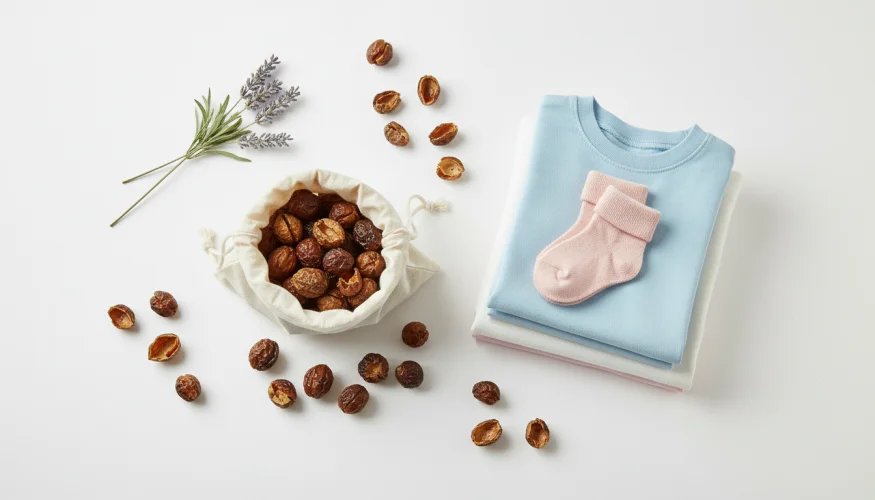
Using soap nuts instead of laundry detergent is surprisingly simple. It is usually recommended to place four to six halved shells into a small cotton bag, which is placed directly into the washing machine drum along with the laundry. The nuts can be reused – they typically last for three to five wash cycles before their saponin is exhausted. Knowing when it is time to replace them is easy: the shells lighten in colour, soften and stop foaming when moistened.
The key question most people ask before their first wash is: can soap nuts really wash laundry as cleanly as a synthetic detergent? The answer is nuanced. For everyday washing of normally soiled laundry – shirts, socks, bed linen, children's clothing – soap nuts work very well. Laundry comes out of the washing machine clean, odour-free and pleasantly soft, because saponin naturally softens fibres without the need to add fabric softener. Many users even notice that the colours of their laundry remain more vibrant for longer, because no aggressive chemical components are acting on the fibres.
Where soap nuts encounter their limitations is when washing at low temperatures and removing heavily set stains. Saponin is released most effectively in water above 40 °C – at cold wash temperatures, its efficacy is lower. If someone washes at thirty degrees, the result may therefore be less convincing. Likewise, greasy stains, dyes or grass on a football kit may require pre-treatment, for example with natural soap or gall soap, before the laundry is placed in the washing machine. This does not mean that soap nuts fail as an alternative – it simply means they are not a universal solution for every situation without exception.
An interesting perspective on the whole matter was offered by research published in the Journal of Cleaner Production, which examined ecological alternatives to synthetic detergents. The results showed that natural saponins, when used correctly, can be comparably effective to conventional laundry detergents, while their environmental impact is significantly lower. This is an important finding at a time when the European Union is increasingly focusing on the regulation of chemical substances in households and their impact on aquatic ecosystems.
The experience of Lucie, a thirty-year-old mother from central Bohemia, illustrates this well. Two years ago she switched to soap nuts because her son was allergic to the synthetic fragrance components in conventional laundry detergents. "At first I was sceptical, but after the first wash I was surprised. The clothes smelled clean, even without the artificial scent I was used to. And most importantly – my son's skin stopped reacting," she describes. Today, soap nuts are a permanent fixture in her household and she only occasionally buys laundry detergent for specific situations, such as washing her husband's work clothes.
The ecological and economic side of things
It is precisely allergies and sensitive skin that are among the most common reasons why people begin looking for alternatives to industrial laundry detergents. Conventional laundry powders and gels contain a whole range of substances – optical brighteners, synthetic fragrances, phosphates or enzymes – which can cause skin irritation, eczema or allergic reactions in sensitive individuals. Soap nuts, by contrast, are a purely natural product with no added chemicals, and are therefore suitable for infants, allergy sufferers and people with atopic eczema. This advantage is also confirmed by the Czech Dermatovenereological Society, which recommends minimising contact with synthetic detergents in cases of atopic eczema.
The ecological dimension is just as significant as the health-related one. According to estimates by the European Chemicals Agency (ECHA), surfactants from laundry detergents are among the common pollutants of surface waters. Soap nuts circumvent this problem elegantly – saponin breaks down rapidly in nature and leaves no toxic traces. Moreover, the nuts themselves can be composted once exhausted, making waste virtually zero. This stands in direct contrast to the plastic packaging of laundry gels or the multi-layered cardboard of powder detergents, which place a burden on waste management.
From an economic perspective, soap nuts are initially more expensive than the cheapest laundry powders available in supermarkets. A kilogram of quality soap nuts costs approximately 150 to 250 Czech crowns, and at an average household consumption rate, they can last several months. When the cost of fabric softener – which soap nuts replace thanks to saponin's natural softening properties – is taken into account, along with the fact that they can be used multiple times, the overall economic balance works out very favourably. As one pioneer of the slow living movement put it: "The cheapest option is not always the one with the lowest price on the label – it is the one that lasts longest and causes no hidden costs."
Beyond laundry itself, soap nuts have a surprisingly wide range of applications. From steeped nuts, a liquid extract can be prepared that serves as a universal cleaning agent for surfaces, hand-washing dishes, or even as a shampoo and body wash. Simply simmer a few shells in water, strain the liquid and pour it into a bottle. This prepared solution has a limited shelf life – without preservatives it keeps in the refrigerator for about one to two weeks – but its preparation is simple and the result is surprisingly effective. For those who want to minimise the number of chemical products in their home, this is an interesting option.
It is also worth mentioning the question of origin and fair trade certification. Soap nuts are grown primarily in India and Nepal, where their harvesting and processing provides a livelihood for many families in rural areas. When purchasing, it is therefore advisable to look for products with fair trade certification or from suppliers who communicate transparently about the conditions of their cooperation with growers. An ecological choice loses part of its meaning if it is underpinned by inappropriate working conditions or an unethical supply chain. Fortunately, the number of Czech and Slovak retailers who place emphasis on the origin and ethics of their products, and are able to provide customers with relevant information, is growing.
Switching to soap nuts instead of laundry detergent is not an overnight revolution – it is more of a gradual change in habits that requires a little experimentation. Some people find that they prefer to combine soap nuts with a dash of baking soda for better results when washing dark laundry. Others develop a fondness for adding a few drops of lavender or tea tree essential oil to the bag for a gentle natural scent. Soap nuts are not a rigid system with a single correct method – they are rather a flexible foundation that everyone can adapt to their own needs.
It is important not to be put off by initial experiments. Laundry washed with soap nuts for the first time sometimes does not look as white as after industrial powder with optical brighteners – but optical brighteners do not actually clean laundry; they simply cause white fibres to reflect more light and appear brighter. This is an optical illusion that people are accustomed to, but which has little to do with actual cleanliness. Truly clean laundry does not need chemical tricks to look good.
Soap nuts as an alternative to laundry detergent are therefore neither a passing trend nor a perfect solution for every situation. They are an honest, centuries-proven choice that makes sense for everyday washing, sensitive skin and households that want to reduce their ecological footprint without dramatic compromises in quality. A world in which it is normal to think about what we add to our washing machines in the same way as what we eat is slowly but surely becoming a reality – and soap nuts are one of the simplest steps towards it.