

# Foot Training with Resistance Bands Relieves Pain
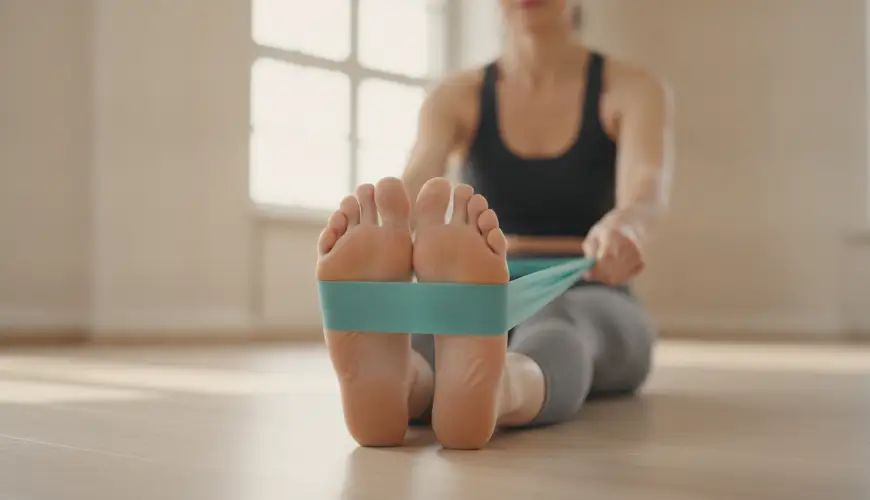
Feet carry a person throughout their entire life – literally. And yet we pay them a fraction of the attention we give to other parts of the body. The feet are the foundation of the entire musculoskeletal system, yet most people only think about them when they start to hurt. Especially after forty, when the body begins to behave differently than it did at twenty, many surprises arrive in the form of knee, back, or hip pain – and the cause is hidden right in the soles of the feet.
Flat feet are not merely an aesthetic problem or a childhood diagnosis. It is a functional condition that can develop or worsen throughout life, with consequences that reach far beyond the foot itself. The good news is that there are concrete ways to do something about it – and one of the most accessible and effective tools is rubber resistance bands.
Try our natural products
What actually happens to the foot with flat feet
The foot is an architectural marvel. It consists of 26 bones, 33 joints, and more than a hundred muscles, tendons, and ligaments that together form three natural arches – the medial longitudinal, the lateral longitudinal, and the transverse arch. These arches function as shock absorbers, distribute load, and enable smooth movement during walking or running. If the arch lowers or disappears entirely, the entire biomechanical balance of the body changes.
With flat feet, the foot "collapses" inward under load, the ankle tilts, and the entire leg rotates. This movement travels upward – into the knee, hip, and spine. It is therefore no coincidence that people with flat feet more frequently suffer from knee pain or chronic back pain. The American Academy of Orthopaedic Surgeons (AAOS) has long pointed out that flat feet are one of the most commonly overlooked factors in diagnosing musculoskeletal problems in adults.
Why does flat foot worsen specifically after forty? There are several reasons. Muscles and tendons lose some of their elasticity and strength. Body weight increases, placing more load on the arch than before. Years of wearing inappropriate footwear – with soles that are too soft, without arch support, or conversely too rigid – take their toll. And on top of all this, hours spent sitting weaken the muscles of the foot. The combination of these factors creates ideal conditions for the foot to "give up" its natural architecture.
Why rubber bands work differently than simply walking barefoot
Many people think it is enough to walk barefoot – and while that is an excellent start, it is not sufficient on its own. Walking barefoot activates the foot more naturally than walking in shoes, but the muscles of the foot need resistance training for genuine strengthening, just like any other muscle group in the body. And this is precisely where rubber resistance bands come into play.
Rubber bands – whether in the form of a loop, a long strip, or so-called mini bands – make it possible to target specific muscles of the foot and ankle with precisely dosed load. Movements that would otherwise not be possible or would not have sufficient effect become genuine strength exercises with a band. Plantar flexion (bending the foot downward), dorsiflexion (bending upward), inversion and eversion of the ankle – these are movements that can be trained in isolation with a band and with progressively increasing intensity.
What does this look like in practice? Imagine Lenka, a forty-five-year-old accountant from Prague who spends the entire working day at her computer and goes for walks after work. Two years ago, her left heel and knee began to hurt; an orthopaedist diagnosed flat feet and recommended physiotherapy. Her physiotherapist showed her a set of exercises with a rubber band – and after three months of regular training, the pain subsided to such an extent that Lenka was able to start going on longer hikes. It is not a miracle, but rather consistency and the right method.
Rubber bands have one more great advantage: they are accessible, lightweight, inexpensive, and can be used anywhere. There is no need to go to a gym or buy expensive equipment. A band fits in a handbag or a bedside drawer – and that is precisely the type of tool that people actually use regularly, rather than letting it collect dust in the basement.
What foot training with rubber bands looks like in practice
The foundation of any foot training programme is understanding which muscles need to be strengthened. The arch of the foot is maintained primarily by three muscle groups: the short muscles of the foot (so-called intrinsic muscles), the calf muscles, and the muscles of the lower leg. All of these groups can be trained with a rubber band.
One of the most effective exercises is seated plantar flexion with a band. You sit on a chair or mat, hold the band in your hands, and loop it over the top of your foot. You then flex the foot away from you, against the resistance of the band. This movement strengthens the calf muscle as well as the deep muscles of the foot. The second fundamental exercise is ankle eversion – you attach the band to a fixed point (or hold it with your hand) and rotate the foot outward against the resistance. This movement targets the peroneal muscles, which stabilise the ankle and prevent it from being sprained.
In addition, there are exercises for the toes themselves – their ability to "grip" the surface is key to the function of the arch. Exercises such as picking up a towel with the toes or the so-called "short foot" exercise (consciously shortening the foot without curling the toes) can be combined with a band for greater effect. The goal is not only to strengthen the muscles, but to restore their ability to work together as a whole.
Physiotherapist and musculoskeletal expert Pavel Kolář, whose DNS (Dynamic Neuromuscular Stabilisation) method is recognised internationally, repeatedly emphasises that the foot must be perceived as an active structure, not a passive support. According to his approach, the key is to engage the foot in the overall movement pattern of the body – and this is precisely what targeted training with a band enables.
The frequency of training should be realistic – three to four times a week for ten to fifteen minutes is far better than an hour once every two weeks. The muscles of the foot are small and need time to recover, but they also respond to regular stimulus relatively quickly. Many people notice the first results – greater stability and less foot fatigue – after just four to six weeks.
Progression is also important. Start with a lighter band and fewer repetitions, and only add resistance or sets once the correct technique has been mastered. Pain during exercise is a signal that something is wrong – foot training should not hurt; it should be challenging but manageable.
Of course, band training is not the only component of foot care. Footwear choice also plays an important role – shoes with sufficient room for the toes, adequate arch support, and a flexible sole. Minimalist footwear or walking barefoot on natural surfaces complements training in a way that no insole can replace. Insoles may temporarily relieve pain, but they will not strengthen the muscles of the foot for you – that is something you must do yourself.
It is also worth mentioning the role of body weight. Every extra kilogram increases the pressure on the arch of the foot approximately three times during walking and up to seven times during running – figures that show why even a modest reduction in weight can have a noticeable effect on foot health. It therefore makes sense to combine foot training with a healthy lifestyle as a whole.
A question that naturally arises: is it even possible to "cure" flat feet in adulthood? The answer depends on how severe the flat feet are and how long the condition has been present. In children the situation is different – the arch is still developing and has a greater capacity to adapt. In adults it is not always possible to restore the arch to its original state, but the function of the foot, stability, and freedom from pain can be significantly improved – even after forty, fifty, or sixty. The goal is not a perfect X-ray image, but a foot that carries us without pain and with ease.
As physiotherapist and author of Born to Run Christopher McDougall said: "The foot is a masterpiece of engineering and a work of art." And like every masterpiece, it deserves care – not only when something goes wrong, but continuously and with respect for what it does for us every day.
For those who want to get started, a good first step is a consultation with a physiotherapist who can draw up an individual plan. Certified programmes focused specifically on foot training are also available online – for example through portals such as Physiopedia, where expert resources for exercise can be found by both professionals and laypeople. Rubber bands of various resistance levels are readily available from sports and health equipment online shops.
Feet carry us every day, thousands of steps, throughout our entire lives. Devoting twenty minutes a week to them with a rubber band in hand is no sacrifice – it is a sensible investment in mobility, health, and quality of life that will pay back with interest. And that is doubly true for anyone who has passed forty and wants to remain active for another forty years.