

# How to Enjoy Food Without Meat
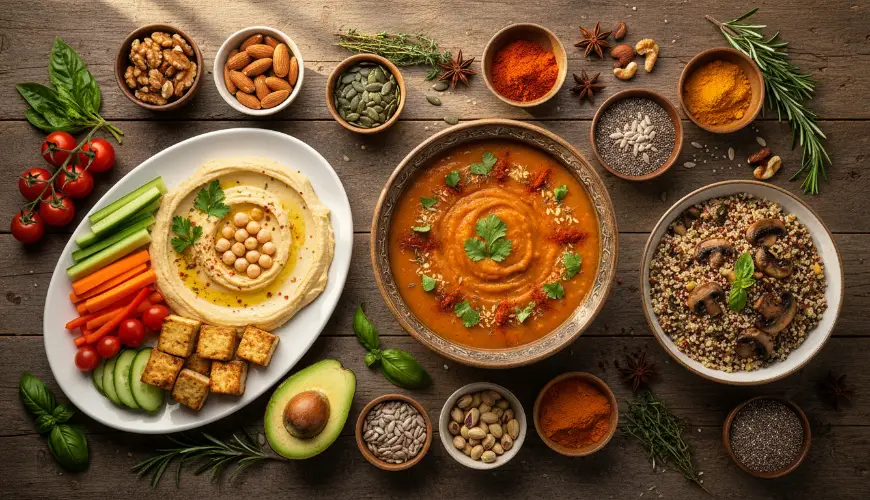
Reducing meat consumption is one of the most common resolutions among people who want to live more healthily or with a smaller environmental footprint. And yet many soon discover that something is missing – not necessarily meat itself, but the feeling of fullness, the depth of flavour, or simply the ingrained routine of dinners that have become second nature over the years. The good news is that cutting back on meat doesn't have to mean compromise or an empty feeling in your stomach. It's simply a matter of knowing how to go about it.
Czech cuisine is historically very meat-heavy – svíčková, goulash, schnitzel. These dishes are part of the cultural identity, and it's no wonder that abandoning or reducing them can feel like giving up a piece of yourself. But the world of cooking has changed significantly over the past twenty years, and the possibilities that plant-based ingredients offer today are genuinely unexpected. If someone has only recently started experimenting with meat-free food, it's very likely that their idea of what such a diet entails lags behind what actually exists.
Try our natural products


Why the feeling of emptiness after a meat-free meal arises in the first place
Before diving into specific tips, it's worth understanding where that sense of lack actually comes from. Meat is rich in protein and fat, and it is precisely the combination of these two macronutrients that provides a long-lasting feeling of fullness. If someone simply removes meat from their plate and replaces it with nothing – or replaces it with just a salad and boiled potatoes – they will logically be hungry again within an hour. The problem, therefore, is not the absence of meat as such, but the absence of the nutrients that meat typically provided.
Protein is the key. According to World Health Organization recommendations, protein should account for approximately 10–15% of total daily energy intake. And the plant-based world is surprisingly rich in it – legumes, tofu, tempeh, seitan, quinoa, hemp seeds, and even ordinary nuts can meet this requirement without a single bite of meat. The key is learning to work with these ingredients in a way that makes food not only nutritionally balanced, but also tasty and satisfying.
There is also an interesting psychological dimension to the whole matter. Research shows that the feeling of fullness is not purely physical – it also depends on how food looks, how it smells, and how satisfying it is in terms of taste. A meat-free meal therefore need not be less filling, provided it is properly seasoned, well cooked, and visually appealing. This is an area where many people go wrong in their first attempts – they prepare plain boiled lentils without any seasoning and wonder why they don't enjoy it. Yet those same lentils with cumin, garlic, smoked paprika, and a squeeze of lemon juice are a completely different experience.
Practical steps for gradually reducing meat consumption
One of the most effective approaches is so-called flexitarianism – a diet that is neither strictly vegetarian nor vegan, but consciously and deliberately keeps meat to a minimum. This approach is more sustainable for most people than a radical overnight switch, because it doesn't require giving up everything at once. Starting with just one or two meat-free days a week is enough, gradually increasing that number as both body and mind adapt.
A practical example is the experience of Markéta, a thirty-year-old from Brno, who decided to cut back on meat after reading a report about the impact of animal farming on the climate. She didn't start by throwing everything out of the fridge. Instead, she set herself a rule: Mondays and Wednesdays would be meat-free. At first she prepared meals that simply left out the meat but otherwise stayed the same – pasta without meat sauce, soups without chicken. She soon found, however, that such food didn't satisfy her, and she began to experiment. Today she makes a lentil bolognese that her partner – a committed meat-eater – says is better than the original with minced beef.
This story illustrates an important principle: the goal is not to remove, but to replace. And not just nutritionally, but in terms of flavour and texture too. Meat has a specific structure that contributes to the sensation of chewing and to the feeling of fullness. Mushrooms – particularly portobello or oyster mushrooms – can mimic this texture surprisingly faithfully. Tempeh or seitan, meanwhile, offer a density that legume-based dishes sometimes lack.
Another tried-and-tested step is to reconsider the role of meat in a meal. In traditional Czech cooking, meat is the centrepiece of the entire dish – everything else is merely a side. But in many of the world's cuisines – Mediterranean, Indian, Ethiopian, or Japanese – meat is either absent entirely or present only as a flavouring element, not as the star of the plate. Adopting this approach means beginning to see vegetables, legumes, and grains as fully-fledged ingredients rather than supporting cast.
Umami – that mysterious fifth taste we know so well from meat – also appears in a whole range of plant-based foods. Dried mushrooms, miso paste, soy sauce, tomato purée, nutritional yeast, and fermented foods in general are rich in glutamates that give food depth and body. It is precisely this depth of flavour that people miss most when they cut back on meat – and it can be replaced, you just need to know about it.
As the chef and writer Mark Bittman once said: "You don't have to be a vegetarian to eat like one – just think of meat as a side dish rather than the main course." This idea is perhaps the simplest and most practical way to get started.
What to buy so that a plant-based diet actually works
The transition to a diet with less meat is considerably easier if you have the right ingredients at home. A bare cupboard full of pasta and tinned tuna won't help much. A well-stocked kitchen with a variety of legumes, wholegrains, nuts, seeds, and quality spices, on the other hand, opens up an enormous range of possibilities.
A basic pantry for anyone wanting to reduce their meat consumption might look something like this:
- Legumes – red lentils, chickpeas, black beans, white beans (both tinned and dried)
- Wholegrains – quinoa, buckwheat, bulgur, oats, brown rice
- Plant-based proteins – tofu, tempeh, seitan, edamame
- Nuts and seeds – cashews, almonds, pumpkin seeds, hemp seeds, tahini
- Umami components – miso paste, soy sauce or tamari, nutritional yeast, dried mushrooms
- Spices and herbs – smoked paprika, cumin, turmeric, coriander, caraway, fresh herbs
With a foundation like this, hundreds of different meat-free meals can be prepared – and none of them need be dull or bland.
It is also important not to overlook the health aspect. When significantly reducing meat intake, it is advisable to monitor your intake of vitamin B12, iron, zinc, and omega-3 fatty acids, which are found in smaller quantities in plant-based diets or in forms that are less easily absorbed. This does not mean that plant-based food lacks these nutrients – but it is necessary to be mindful and, where appropriate, to reach for fortified foods or supplements. The Czech Nutrition Society and international nutrition organisations agree that a well-planned diet with minimal meat can be fully nutritious for people of all age groups.
Drawing inspiration from foreign cuisines can also be enormously helpful. Indian dal – a thick soup made from red lentils and spices – is one of the most filling and inexpensive dishes you can prepare in under twenty minutes. Mediterranean hummus with fresh vegetables and wholegrain bread is just as satisfying as a ham sandwich. Ethiopian injera with vegetables and legume-based stews is a dish that leaves you feeling thoroughly well-fed. The world is full of evidence that eating less meat does not mean eating less flavourfully or less substantially.
In the end, it may simply be a matter of shifting perspective. Instead of thinking about what you are taking away from your diet, try thinking about what you are adding to it – new flavours, new ingredients, new recipes, new culinary traditions from around the world. Reducing meat then ceases to be a sacrifice and becomes an adventure. And that is precisely the feeling people are looking for when they ask how to eat differently – without feeling as though they are losing something important.