
# Dishes Nobody Photographs But Everyone Loves
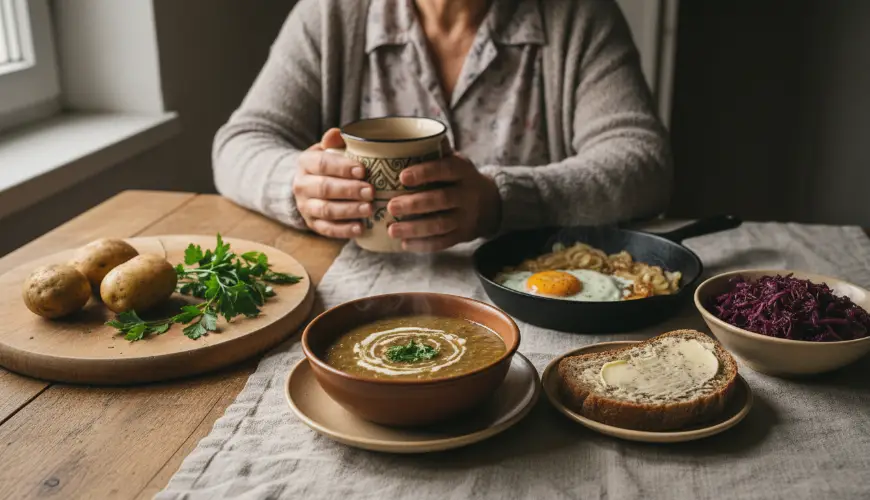
There is a peculiar paradox of modern times. Social media is full of carefully styled shots of avocado toasts, colourful acai bowls, and perfectly layered smoothie glasses. Yet when someone asks what you reach for when you're tired, happy, sad, or simply hungry – the answers tend to be surprisingly similar. Pasta with ketchup. Fried eggs. Yesterday's leftovers reheated in a pan. Bread and butter. Foods that nobody photographs for Instagram, but that everyone loves in a way that's difficult to explain.
These foods have no aesthetic. They have no story suitable for marketing. They don't fit into any wellness trend or the visual vocabulary of a healthy lifestyle. And yet these are precisely the foods that keep coming back – on the plate, in memory, in comfort. Is it even a coincidence, or are these "unphotographable" foods telling us something important about what we truly want from food?
Try our natural products




Why We Don't Photograph What We Actually Eat
The phenomenon of food photography has seen explosive growth over the past decade. According to data from Sprout Social, food photography has long been among the most shared types of content on platforms like Instagram or Pinterest. Yet there is a deep chasm between what people share and what they actually eat. We share aspiration. We eat reality.
Reality looks different. It looks like a pot full of lentil soup that simmers all afternoon and fills the entire flat with its aroma. Like a slice of bread soaked in the sauce left over from roasting. Like mashed potatoes with butter, so thick a spoon stands up in them. These foods are honest. They require no preparation, lighting, or filter. That is precisely why they are so difficult to photograph – and precisely why they are so deeply human.
Psychologists speak of so-called comfort food as food associated with emotional memory, safety, and a sense of home. Research published in Psychological Science showed that consuming so-called comfort food activates memories of social connection and reduces feelings of loneliness. In other words – these dishes are not just about taste. They are about who we are and where we come from.
Consider an example from everyday life. Jana, a thirty-year-old graphic designer from Brno, admits that her favourite food is pasta with butter and grated cheese. "I know it sounds like food for children. But when I'm stressed or ill, I don't want anything else. I associate it with my grandmother, who used to make it for me when I was little." No photograph, no recipe on a blog. Just quiet, reliable comfort in a bowl.
Humble Foods with a Rich History
Behind many "unphotographable" foods lies a rich cultural and historical layer that few people talk about. Potato soup was not invented as a side dish for a festive lunch – it emerged in times of scarcity as a way to feed a family from whatever little was at hand. Bread with lard, today ironically making a comeback in some gastropubs, was for centuries a staple of the working class. Bean soup, lentils with vinegar dressing, fried eggs with onion – all of these are foods that carry within them the history of everyday life.
These foods have survived for centuries not because they were fashionable, but because they work. They are nutritious, accessible, quick, and filling. They are recipes passed down orally from generation to generation, adapted according to whatever happened to be in the larder. It is precisely their variability and adaptability that makes them something living – unlike the perfectly standardised recipes from cooking shows.
Anthropologist Claude Lévi-Strauss argued in his work on culture and food that the way people prepare and consume food reflects their cultural identity more deeply than many other aspects of everyday life. If this is true, then our love for the simplest dishes is not a weakness or a lack of taste – it is an expression of who we are.
Bone broth that simmers overnight. A schnitzel frying in a pan that you can hear crackling from the next room. Bread dumplings with sauerkraut that fill the whole kitchen with their aroma. These foods are not inferior. They are authentic. And authenticity – whether in food, fashion, or lifestyle – has a value that no filter can replace.
It is sometimes said that the best food is that which is cooked with love. But perhaps it would be more accurate to say: the best food is what we cook without thinking, because we know it by heart, because someone we love taught us, and because it has never let us down.
Simple Foods and Their Place in a Sustainable Lifestyle
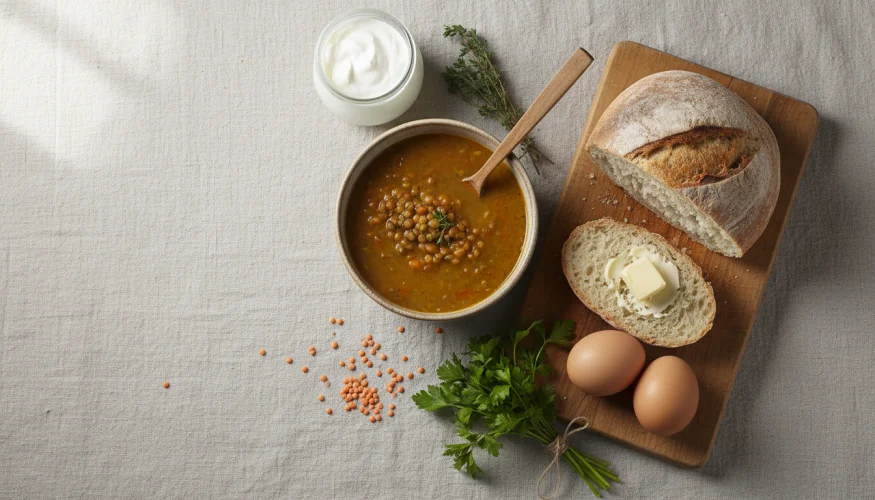
There is yet another dimension that is less often discussed in connection with these dishes. Foods that nobody photographs are very often also foods that are sustainable, economical, and environmentally friendly. Lentils, beans, cabbage, potatoes, eggs – these are ingredients with a low ecological footprint, available locally, seasonally, and at an affordable price.
While the superfood industry depends on importing chia seeds from South America or goji berries from China, a Czech grandmother's soup can get by with carrots from the garden, parsley from the allotment, and a bone from the butcher on the corner. This is not a step backwards – it is a step in the right direction. The FAO (Food and Agriculture Organization of the United Nations) has long pointed out that the transition to local, plant-based, and less processed foods is one of the key tools in the fight against climate change.
A sustainable lifestyle does not mean only buying bamboo toothbrushes or wearing clothes made from organic cotton. It also means reconsidering our relationship with food. It means cooking from whole ingredients, minimising waste, eating seasonally and locally. And it is precisely these "unphotographable" foods that do this naturally, without manifestos and without hashtags.
Try to imagine a week in which you only cook what you would actually photograph and post on Instagram. Colourful salads, grain bowls, baked salmon with quinoa. Now imagine a week in which you cook what you actually want to eat. Broth made from chicken bones. Sauerkraut soup. Fried potatoes with eggs. Bread with cottage cheese and chives. Which of these weeks was cheaper? Which was more nutritious? Which was less dependent on imported exotic ingredients?
The answer is obvious – and yet few people say it out loud, because simplicity, in an age when everything is about presentation, does not seem worthy of admiration.
And yet it is in simplicity that one of the greatest wisdoms food can offer us resides. We do not need complex recipes or expensive ingredients to eat well. We need time, attention, and a willingness to return to the basics. To ingredients that have real flavour. To techniques that work. To dishes that truly nourish us – not only physically, but emotionally as well.
Among the foods that deserve far more recognition than we give them are, for example:
- lentils with vinegar dressing – full of protein, fibre, and flavour, ready in less than half an hour
- potato soup – local, seasonal, and warming in every season of the year
- fried eggs with onion – quick, filling, and associated with genuine everyday life
- bread with lard or butter and salt – minimalist, yet satisfying in a way that surprises
- cabbage braised with caraway – probiotic, inexpensive, and a perfect accompaniment to anything
- buckwheat or millet porridge – forgotten grains that are slowly making their way back into kitchens
These foods have no PR agent. They have no influencer to promote them. And yet everyone knows them, and everyone keeps coming back to them.
Perhaps it is time to stop feeling a little ashamed of them. To stop excusing them with phrases like "it's just something simple" or "it's nothing special." Because simple foods are not a substitute for something better – they are better in their own right. They are honest, nutritious, accessible, and carry within them a cultural memory that transcends any gastronomic trend.
The world changes quickly. Food trends come and go even faster. Avocado toast was a novelty ten years ago; today it is a cliché. Who knows what the next ten years will bring. But lentils with vinegar dressing will still be here. Potato soup will still be here. And people will eat it – quietly, with pleasure, without photographing it – just as their parents, grandparents, and great-grandparents did before them.
That is a kind of continuity that no trend can offer. And that is perhaps the best reason why these foods deserve our attention, respect, and – yes – even a little pride. Next time you have a bowl of buttered pasta or a slice of bread soaked in soup, you don't need to photograph it. But you certainly don't need to apologise for it either.