

Exercise without proper technique does more harm than good to the body
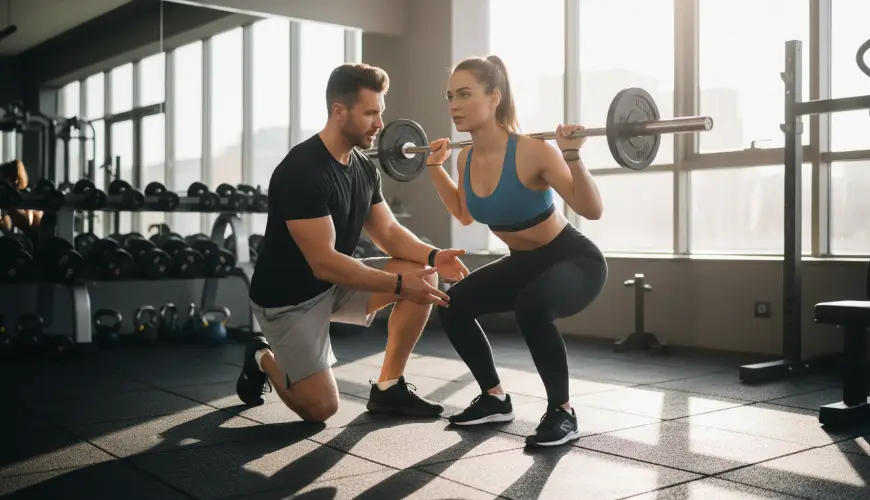
Most people exercise regularly—they go to the gym, run, or work out at home following videos on the internet. And yet, after months or even years of effort, disappointment sets in. Results fail to materialise, backs ache, knees protest, and motivation slowly fades. Very often, the problem lies neither in a lack of dedication nor in a poor diet. It hides in something that is surprisingly rarely discussed: the fact that a large portion of the exercises we take for granted are being performed with incorrect technique—and we have been doing them that way our entire lives.
This is nobody's fault. Movement habits are carried over from childhood, from school physical education classes, from friends at the gym, or from quick videos on social media. Few of us were lucky enough to have a qualified trainer explain from the very beginning how to properly perform a squat, press-ups, or even walking up stairs. The result is deeply ingrained errors that are repeated thousands of times, and the body gradually adapts to them—until the moment it begins to signal that something is wrong.
Try our natural products




The squat: king of exercises, but also king of mistakes
The squat is probably the most frequently mentioned exercise in any training plan. It is also the exercise in which the most mistakes are made—at all levels, from beginners to advanced athletes. The most widespread problem? The knees cave inward during the descent, the back collapses forward, and the heels lift off the floor. The result is enormous pressure on the knee joints and lumbar spine, while the muscles that should be working the hardest—the glutes and thighs—remain almost passive.
A correct squat begins with activating the feet. The entire foot must be pressed firmly into the ground, with weight evenly distributed. The knees follow the direction of the toes—not inward, but slightly outward. The back remains straight, the chest is upright, and the downward movement is slow and controlled. This sounds simple, but for most people it means a fundamental rebuilding of a movement pattern that has functioned differently for years. Physiotherapists repeatedly point out that a poor squat is one of the most common causes of knee and hip pain that troubles patients even without any injury.
Take the example of Martina, a thirty-four-year-old accountant from Brno, who started exercising at home during the pandemic. For a year and a half, she diligently squatted following instructional videos, added weights, and improved her fitness. Then knee pain arrived, putting her out of action for several weeks. Her physiotherapist told her something that surprised her: the problem was not the load, but the technique. Her knees were caving inward with every squat, repeatedly overloading the joint. All it took was going back to basics, working without weights and focusing on correct movement—and the pain disappeared.
Physiotherapists and personal trainers around the world are familiar with similar stories. These are not exceptions. This is the rule.
Press-ups, the plank, and the eternal problem with the spine
Press-ups are among the fundamental exercises that almost everyone can perform. Or rather—almost everyone thinks they can perform them. In reality, most people arch their backs downward during press-ups, raise their hips too high, or fail to complete the movement through its full range of motion. Each of these errors has its own consequences: an arched lumbar spine causes chronic back pain, an incomplete range of motion reduces the effectiveness of the exercise, and places excessive strain on the shoulder joints.
A correct press-up looks like a moving plank—the body forms one straight line from head to heels. The core is engaged, the glutes are active, and the elbows move at an angle of approximately 45 degrees from the body, not perpendicular to it. This small elbow correction significantly reduces the load on the shoulders and engages more chest muscles in the work. Research published in the Journal of Strength and Conditioning Research has repeatedly shown that the angle of arm position during a press-up fundamentally affects which muscles are primarily activated and how great the risk of injury is.
The plank—a static exercise that has become a symbol of modern fitness—suffers from similar problems. People hold it for a minute, two, sometimes even five minutes, but with an arched back and head drooping downward. Such a plank does not train the deep stabilisation system as it should—instead, it places strain on the lumbar spine and neck. A correct plank held for thirty seconds with perfect technique is many times more valuable than five minutes in an incorrect position. As Pavel Kolář, a leading Czech physiotherapist and founder of the Dynamic Neuromuscular Stabilisation concept, says: "Movement without correct activation of the deep stabilisation system is like building a house without foundations."
Running: a natural movement we have unlearned
Running seems to be the most natural movement in the world. Humans were made to run—their anatomy clearly suggests this. And yet most modern people run in a way that does more harm than good to their bodies. The key problem is heel striking. When running in modern footwear with thick cushioned soles, most recreational runners take a long stride and land on the heel, with the foot far ahead of the body's centre of gravity. This style of running creates a braking force with every step and transfers the impact directly to the knee joint and hip.
Natural, biomechanically correct running works with a shorter stride, landing on the forefoot or midfoot, and with the body's centre of gravity above the point of contact. The body is slightly inclined forward, the shoulders are relaxed, and the arms move along a natural axis. This style of running significantly reduces the risk of injury while also improving movement economy—that is, how much energy the body uses for each kilometre covered. A Harvard study led by Professor Daniel Lieberman showed that people who land on the forefoot generate significantly lower impact forces than those who land on the heel.
However, switching to a different running style is not straightforward and should definitely not be done all at once. The muscles and tendons that natural running relies upon—particularly the calves and Achilles tendon—are not accustomed to the increased load. The transition must be gradual, ideally under the guidance of an experienced trainer or physiotherapist.
Stretching: when, how, and why it matters
Another exercise that almost everyone does incorrectly is stretching. Specifically, static stretching before training—that is, stretching cold, unwarmed muscles in static positions. This practice, ingrained in physical education classes since primary school, is today considered by experts to be counterproductive and potentially harmful. A cold muscle does not want to be stretched—and if we force it to, we risk microtears in the muscle tissue and a reduction in performance during the training session itself.
Proper preparation of the body for movement looks different. It begins with dynamic warm-up—movements that mimic what the body will be doing during training, but at a lower intensity. Hip circles, lunges with trunk rotation, light jumps, arm movements. These movements warm the muscles, activate the neuromuscular connection, and prepare the joints for load. Static stretching then belongs at the end of the training session, when the muscles are warm and willing to be stretched.
This seemingly simple change in order can have a surprising effect on both performance and injury prevention. Sports scientists from the American College of Sports Medicine recommend dynamic warm-up as a standard part of every training session and include static stretching exclusively in the cool-down phase following exercise.
There is another widespread myth about stretching: that the more it hurts, the better. The opposite is true. Stretching should never be painful—it should bring a feeling of pleasant tension, not a sharp or burning sensation. Stretching a muscle beyond the pain threshold activates a protective reflex that causes the muscle to contract—and the stretching effect is zero or even negative.
Walking and sitting: movements we underestimate
It would be a mistake to focus solely on sporting activities. Movements we perform every day without thinking—walking, sitting, getting up from a chair—have just as great an impact on the body's health as regular exercise. And here, too, errors accumulate.
The modern person spends an average of eight to ten hours a day sitting. The way they sit typically corresponds to what physiotherapists describe as "spinal collapse"—the back is rounded, the head is pushed forward, the shoulders are drawn up towards the ears. This position chronically shortens the muscles on the front of the body and weakens the back muscles. The result is pain that many people attribute to age or overwork, even though its true cause is the way they sit.
Equally, walking—an apparently automatic movement—conceals a whole range of errors. Walking with the head bowed over a phone alters the natural curvature of the cervical spine and adds a load equivalent to tens of additional kilograms. Walking with feet turned outward or inward affects the biomechanics of the entire lower limb. Yet it is enough to consciously straighten the back, lift the gaze, and activate the glute muscles with every step—and walking becomes a genuine rehabilitative exercise.
Becoming aware of one's own movement patterns is the first step towards change. There is no need to immediately rebuild an entire training routine or invest in expensive equipment. It is enough to start observing—how we stand, how we sit, how we move. And then to ask: am I doing this correctly? Because the exercises we have been doing incorrectly our whole lives will sooner or later be billed to us by our bodies—and the bill tends to be a painful one. Fortunately, it is never too late to correct them.