

# How to Protect Bone Density in Women Over Thirty
Most women don't start thinking seriously about bone health until a doctor mentions the word osteoporosis – which typically happens sometime after fifty or after menopause. But this timing is, to put it mildly, a little late. Bones reach their maximum bone mass at around age thirty, and what hasn't been built by then is very difficult to make up for afterwards. Thirty is therefore not an age at which the topic of healthy bones can be put off until later – on the contrary, it is precisely the moment when prevention should begin in earnest.
This may sound surprising. Osteoporosis is commonly associated in popular awareness with older women, with hunched backs and with the frailty that comes with age. But behind this visible frailty lies decades of a silent process that began long before – one that could have been slowed down, or even significantly influenced, at a time when a woman felt full of energy and health.
Try our natural products

What happens to bones after thirty
The human skeleton is not a static structure. Bones are constantly being remodelled in a process that experts call bone remodelling – old bone tissue is broken down and replaced with new tissue. In our twenties, this process works in favour of formation: more new tissue is created than is broken down. But around the age of thirty, this balance begins to quietly tip. The breakdown of bone mass begins to slightly outpace its formation, and bone density slowly declines.
In women, this process is further significantly accelerated by the onset of menopause, which brings a sharp drop in oestrogen – a hormone that plays a key role in protecting bone tissue. According to data from the World Health Organization, approximately 200 million women worldwide suffer from osteoporosis, with the risk of hip, spine or wrist fractures increasing exponentially with age. The situation in the Czech Republic is similar: it is estimated that every third woman over fifty will suffer at least one fracture as a result of osteoporosis.
This is precisely why thirty is so important. The higher the so-called "peak bone mass" – that is, the maximum bone density achieved – the greater the buffer a woman has for the inevitable decline in later life. Simply put: the more bone mass that can be built and maintained by the age of thirty, the less likely it is that bones will reach critically low levels in old age.
Calcium and vitamin D are the most frequently mentioned nutrients in this context, and rightly so. Calcium forms the basic building block of bone tissue, while vitamin D is essential for its absorption in the intestine. Without sufficient levels of vitamin D, calcium intake can be as high as it likes, but the body simply cannot utilise it. According to the National Institutes of Health, women aged 19 to 50 should consume approximately 1,000 mg of calcium and 600 IU of vitamin D per day, with the recommended calcium intake increasing to 1,200 mg after the age of fifty.
Prevention that actually works
Preventing healthy bones doesn't rest on a single miracle supplement or a single specific exercise. It is more of a set of everyday decisions that accumulate over time and whose effects won't be seen until decades later. This is perhaps why so many women underestimate it – the results are not immediate, and an invisible problem doesn't feel urgent.
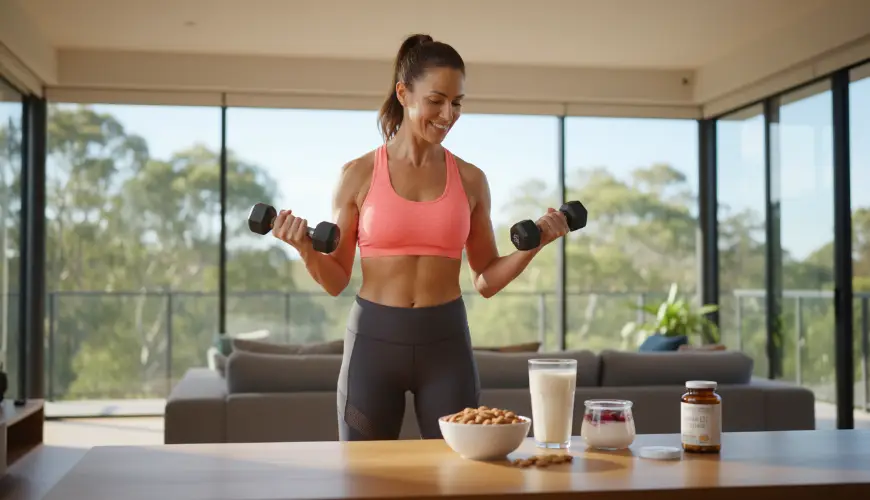
One of the most effective tools is exercise – specifically strength training and weight-bearing activities. Walking, running, dancing, tennis or skipping rope – all of these stimulate bone cells to produce new tissue. Bones respond to load in the same way as muscles: when they are put under stress, they become stronger. Conversely, a sedentary lifestyle and lack of exercise are among the main risk factors for bone mass loss. Research published in the Journal of Bone and Mineral Research repeatedly confirms that women who regularly engage in strength training have measurably higher bone density than their less active peers.
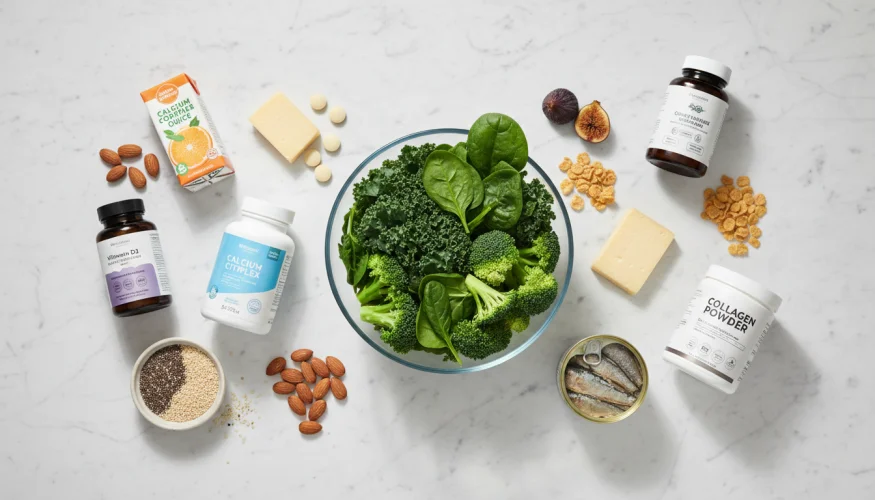
Alongside exercise, diet plays a crucial role. Dairy products are traditionally considered the best source of calcium, but they are far from the only option. Excellent plant-based sources include almonds, sesame seeds, tofu, kale and legumes. Women who, for various reasons, do not consume dairy products now have a wide range of fortified plant-based drinks available to them – almond, oat or soya milk enriched with calcium can be a fully adequate alternative.
Vitamin D is unique in that the body can synthesise it on its own when exposed to sunlight. However, in the Czech Republic's geographical latitudes, solar radiation during the winter months is too weak for synthesis to occur at a sufficient level. Supplementation with vitamin D3 is therefore recommended in our conditions practically year-round, especially during the period from October to April. Many doctors recommend combining vitamin D3 with vitamin K2, which helps direct calcium in the right direction – into bones rather than blood vessels.
Hormonal balance is also an important but less discussed factor. Oestrogen protects bones, which is why women with menstrual cycle disorders, anorexia or premature menopause have a significantly higher risk of bone mass loss. Similarly, excessive physical exertion combined with insufficient caloric intake – a phenomenon known as the "female athlete triad" – can lead to the paradoxical situation where an active sportswoman suffers from fragile bones.
It is also important not to forget the substances that actively damage bone health. Smoking, excessive alcohol consumption and high caffeine intake are factors that demonstrably reduce bone density. Smoking, for example, impairs calcium absorption and lowers oestrogen levels, which has a direct negative impact on bone tissue. A woman who smokes and exercises little is thus unknowingly laying the groundwork for problems that will fully manifest themselves twenty or thirty years from now.
Let's consider a specific example: thirty-four-year-old Lucie works in an office, gets very little exercise, eats irregularly and doesn't believe in dietary supplements. She feels healthy and has no symptoms troubling her. Yet at this very moment she may be in a process where her bones are slowly losing density without her knowing it – because osteoporosis is a so-called "silent disease" that causes no pain or other warning symptoms until a fracture occurs. If Lucie were to start today – adding strength training three times a week, adjusting her diet and beginning to supplement with vitamin D – she could fundamentally influence her bone age.
When and how to have bone density measured
Many women are unaware that bone density can be easily measured using a test called DEXA (dual-energy X-ray absorptiometry). It is a quick, painless and non-invasive examination that takes approximately ten to twenty minutes and reveals the actual condition of bone tissue. The result is a so-called T-score, which compares the bone density of the woman being examined with the average of healthy thirty-year-old women.
When should you have the examination done? DEXA is standardly recommended for women from the age of 65, or earlier if risk factors are present – such as a family history of osteoporosis, premature menopause, long-term use of corticosteroids or low body weight. However, a growing number of experts are inclined to the view that a baseline examination makes sense even at forty, so that a woman knows what starting position she is entering middle age from.
As American endocrinologist and bone metabolic disease specialist Dr. Felicia Cosman says: "The best time to start taking care of bone health was twenty years ago. The second best time is now." This idea holds true regardless of age – but the earlier a woman starts, the greater an influence she can have on her future condition.
A practical approach to prevention does not have to be complicated or financially demanding. A daily walk in the fresh air, a portion of yoghurt or a handful of almonds as a snack, a quality supplement with vitamin D3 and K2 – these are small steps that make sense both from a scientific perspective and from the perspective of everyday life. Today there are also high-quality products available on the market that combine calcium, magnesium, vitamin D3 and K2 in a single tablet, which greatly simplifies prevention.
Bone density in women after thirty is not a topic for the distant future. It is a topic for today's lunch, for today's workout, for today's trip to the pharmacy or to online health stores. Bones may not hurt or send warning signals – but they respond to every decision we make for them. And those decisions count now, not in thirty years' time.