
Buckwheat 6 ways worth trying
There is a food that has nourished entire generations for centuries, healed the sick, and fed farmers from Siberia to Moravia – and yet today most people don't even know how to cook it properly. Buckwheat is the quiet hero of Czech cuisine, a superfood that for a time was lost in the shadow of industrial cereals and quick pasta, but is now making a full comeback on the plates of those seeking truly nutritious, clean, and natural food. And no wonder – buckwheat is surprisingly capable of a great deal.
Our grandmothers knew this long ago. Buckwheat was cooked as porridge in Czech and Moravian cuisine, added to soups, used as a filling for dumplings, and baked into bread. It was not considered anything special – it simply belonged on the everyday table as naturally as potatoes or cabbage. Then came the era of white flour, instant foods, and the globalisation of the food industry, and buckwheat slowly disappeared from menus. Today, however, it is becoming clear that this "forgotten" crop is among the most valuable things our ancestors left us.
Try our natural products

Why buckwheat is a true superfood
Although the word "superfood" is bandied about on every corner these days, often concealing expensive exotic powders imported from the other side of the world, buckwheat is a superfood in the most natural sense of the word. It grows here, it is accessible, affordable, and its nutritional value surpasses most common grains. And yet it is not even a grain – botanically, buckwheat belongs among dicotyledonous plants related to rhubarb and sorrel. This also means it contains no gluten, making it naturally suitable for people with coeliac disease or gluten sensitivity.
What does buckwheat actually offer? Its seeds are rich in complete proteins with an excellent spectrum of essential amino acids, including lysine, which is absent or only minimally present in conventional grains. It also contains magnesium, zinc, copper, manganese, and B vitamins. Particularly notable is the presence of rutin – a flavonoid that strengthens blood vessels, reduces their permeability, and acts as an anti-inflammatory. Studies published in specialist databases such as PubMed have repeatedly confirmed that rutin contributes to cardiovascular health and may play a role in the prevention of vascular disease. Our grandmothers knew nothing about rutin, of course – but they knew that buckwheat "was good for the heart". They were right.
Buckwheat also has a low glycaemic index compared to white rice or wheat bread, meaning that eating it does not cause sharp fluctuations in blood sugar. For people with type 2 diabetes, or for those who want to stabilise their energy levels throughout the day, this is a very practical advantage. It keeps you full for a long time, does not burden digestion, and yet provides the body with everything it needs to function.
As British nutritional adviser and plant-based diet author Annabel Langbein once said: "The best foods are not the most expensive or the most exotic – they are the ones people have been eating for centuries and that have stood the test of time." Buckwheat has passed that test with ease.
Six ways buckwheat will enrich your table
It is precisely its versatility that makes buckwheat so exceptional. It is not a one-recipe food – it can be prepared in countless ways and will surprise you differently each time. Here are six approaches worth trying, whether you are a beginner or an experienced cook.
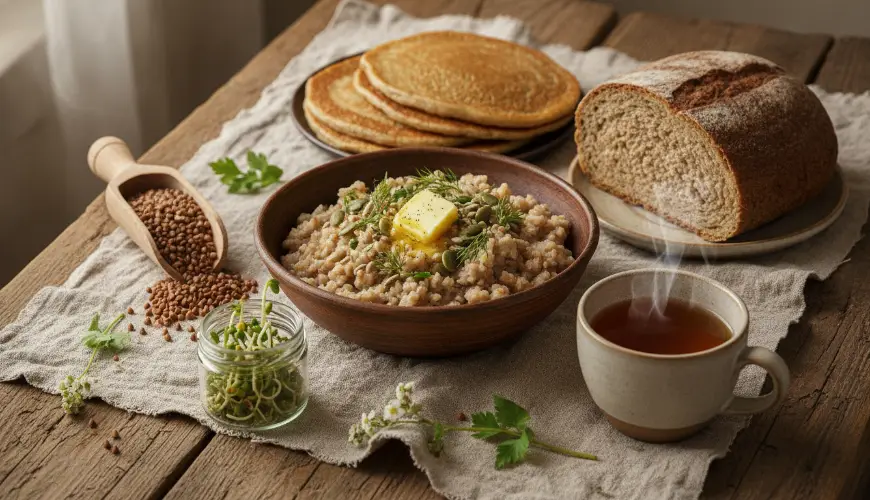
The best-known and simplest is buckwheat as a side dish or porridge. Cooked buckwheat has a nutty, earthy flavour that pairs beautifully with braised vegetables, legume stews, or simply with butter and salt. The secret to good buckwheat porridge lies in the water-to-buckwheat ratio – classically 2:1 – and in allowing the buckwheat to finish cooking off the heat, lid on, without stirring. The result is fluffy, separate grains full of flavour. Such porridge was for centuries a staple food of the rural population of Central and Eastern Europe, and to this day it is eaten in Russia, Ukraine, and Poland under the name "kasha" as an everyday dish.
A far less well-known but very interesting option is buckwheat as the basis for sourdough bread or flatbreads. Buckwheat flour can fully or partially replace wheat flour, resulting in darker, more aromatic baked goods with a distinctive flavour. Buckwheat pancakes, famous in France as "galettes bretonnes", are a national dish there, served filled with cheese, ham, or egg. Preparation at home is simple: mix buckwheat flour with water or plant-based milk, add a pinch of salt, and let the batter rest. The resulting pancakes are crispy, filling, and naturally gluten-free.
The third way buckwheat surprises is its use as a base for salads and cold dishes. Cooled cooked buckwheat behaves similarly to quinoa or bulgur – it absorbs dressings, combines with vegetables, herbs, and legumes, and forms an excellent base for nutritious dishes that can be prepared in advance and taken to work or on a trip. The classic combination of buckwheat–roasted beetroot–goat's cheese–walnuts is an example of how simple ingredients can create a sophisticated and exceptionally tasty dish.
The fourth option, which surprises many, is sprouted buckwheat. Raw buckwheat that has not been heat-treated (so-called "live" or "green" buckwheat) is capable of sprouting, and the sprouts are extraordinarily nutritious – full of enzymes, vitamins, and antioxidants. Sprouted buckwheat is added to smoothies and salads, or eaten directly as a snack. It is a method of preparation that preserves the maximum amount of nutrients while requiring no cooking whatsoever.
The fifth path is buckwheat as a base for desserts and sweet baking. Buckwheat biscuits, muffins, or even brownies are gaining ever more fans among those seeking alternatives to conventional sweet baking. Buckwheat starch and flour give desserts an interesting depth of flavour that pairs beautifully with chocolate, maple syrup, or dried fruit. For parents who want to offer their children something sweet without unnecessary empty calories, buckwheat baking is an excellent choice.
And finally, the sixth way buckwheat can enrich the diet is its use in the form of buckwheat tea or infusion. In Japan, buckwheat tea known as "sobacha" is prepared from roasted buckwheat grains – it has a delicate, nutty flavour, contains no caffeine, and is rich in antioxidants. In some Asian cultures, this drink is regarded as a means of supporting digestion and overall vitality. It is perhaps the least expected way buckwheat can enter everyday life, but it is certainly worth trying.
Buckwheat in everyday life: from theory to plate
Let us take a real-life example: Jana, a woman in her forties from Prague, began dealing with chronic fatigue and unstable energy levels two years ago. After consulting a nutritional adviser, she gradually replaced white rice and pasta with buckwheat and quinoa. The result? She says herself that she "finally feels full even three hours after lunch" and that she has stopped reaching for sweet snacks in the afternoon. This is no miracle – it is simply the fact that buckwheat satisfies hunger differently from fast carbohydrates and the body responds to it more steadily.
There are many such stories, and they are no coincidence. Buckwheat is a food that works – not because it is fashionable, but because it is nutritionally complex and the body is able to make good use of it. It is no coincidence that in countries with traditionally high consumption of buckwheat products, such as Japan or Russia, buckwheat is a firmly embedded part of cultural food identity.
When purchasing buckwheat products, it is worth paying attention to origin and processing method. Whole buckwheat or hulled buckwheat are nutritionally more valuable than pre-cooked instant varieties. Organically grown buckwheat, cultivated without pesticides, is moreover the ideal choice for those who care not only about their own health, but also about the health of the soil and the environment. Buckwheat is a plant that naturally thrives even without chemical inputs – it is resilient, undemanding, and beneficial for biodiversity, as its flowers are an excellent source of nectar for bees.
It is perhaps a little sad that we almost forgot about this unassuming crop for several decades. But perhaps it is also an opportunity – to rediscover it, to appreciate it differently from how it was seen as "peasant food", and to realise that what our grandmothers put on the table out of necessity, we today put on the table by free choice and with the knowledge that it is one of the best things we can do for our bodies. Buckwheat deserves it.