

How to turn ordinary porridge into a meal full of flavour
Porridge. For many people, a word that evokes a dull Monday morning, a grey mass in a bowl, and the feeling that healthy eating must necessarily be a matter of denial and compromise. And yet - just a few clever steps are all it takes to turn porridge into a meal you look forward to as much as Sunday lunch at grandma's. It's not magic or expensive ingredients. It's mostly about approach.
Porridge has thousands of years of history behind it. From Tibetan monks to North African nomads, from Scottish shepherds to Japanese Zen cooks - almost every culture in the world has its own version of this simple dish. And yet today, in many households, porridge is cooked as something that "has to be eaten", rather than something one actually wants to eat. Where did it go wrong?
The answer is surprisingly simple: porridge has become synonymous with the minimum. Minimum effort, minimum flavour, minimum pleasure. And yet its very simplicity is its greatest gift - it is a blank canvas waiting for colour.
Try our natural products



The base that decides everything
Before we get into toppings and seasoning, there is one fundamental thing to address: the base of the porridge determines the outcome more than most people realise. The choice of grain, liquid and method of preparation are the three pillars on which the entire flavour experience stands or falls.
Oats are a classic and deservedly so - they are rich in fibre, beta-glucans and provide long-lasting satiety, as confirmed by studies published by the Harvard T.H. Chan School of Public Health. But the world of porridges is much broader. Buckwheat, millet, amaranth, quinoa, proso millet or even red rice - each of these grains brings a different character, a different texture and a different nutritional profile. Buckwheat, for example, gives porridge a slightly nutty flavour and earthiness, while millet is naturally sweeter and creamier. Quinoa adds a slightly crunchy texture and an exceptional content of complete proteins.
Equally important is the liquid in which the porridge is cooked. Water is the most neutral option, but the result tends to be bland and one-dimensional. Plant-based milk - oat, almond, coconut or spelt - immediately adds depth of flavour and a gentle creaminess that simply cannot be achieved with water. Coconut milk, for example, transforms an ordinary rice porridge into something that vaguely resembles a Thai dessert. Oat milk, on the other hand, enhances the natural flavour of oats and creates a harmonious whole.
And then there is the method of preparation. A rushed porridge cooked on maximum heat, stirred three times and transferred straight into a bowl, will never be as good as a porridge that is given time. Slow cooking over a low flame, regular stirring and patience - these are the ingredients that no recipe lists, yet they are crucial. Try cooking oat porridge on the lowest setting of the hob for twenty minutes and compare it to the three-minute version. The difference will surprise you.
An interesting trick known to experienced cooks is adding a pinch of salt right at the beginning of cooking. Salt won't make the porridge salty - on the contrary, it will enhance the natural sweetness of the grain and bring all the flavours together. A similar function is served by a teaspoon of butter or coconut oil added at the end of cooking, which gives the porridge a silky texture and a feeling of fullness in the mouth.
Many people also swear by so-called overnight oats - that is, oats soaked overnight in liquid without cooking. This method has several advantages: it saves time in the morning, the fermentation processes during soaking improve digestibility, and the resulting texture is refreshing and different from cooked porridge. Simply mix oats with plant-based milk, yoghurt or kombucha in the evening, add a teaspoon of chia seeds to thicken, and just add the topping in the morning.
Topping as an art form - turn a bowl into an experience
If the base of porridge is its soul, then the topping is its personality. And this is precisely where most people make the biggest mistake - they either skip the topping entirely, or reach for one thing and leave it at that. Yet layering different textures, flavours and colours is what turns porridge into a meal you look forward to in the morning before you even get out of bed.
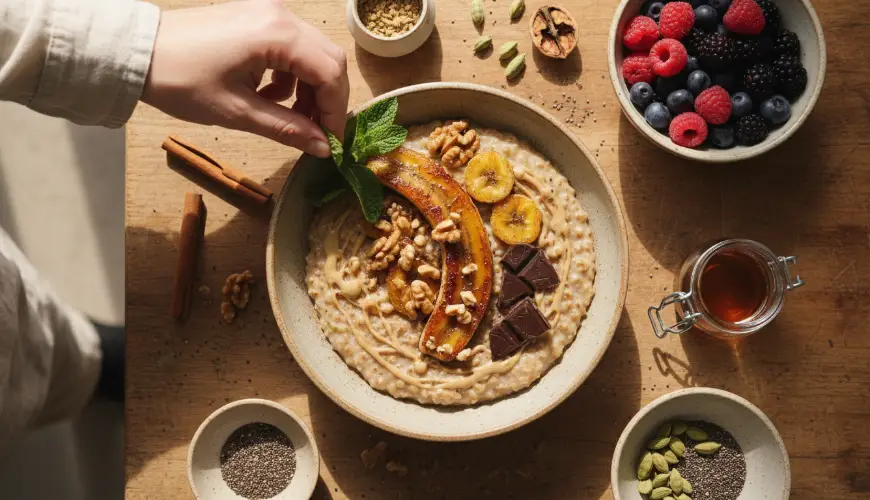
Imagine this combination: a base of buckwheat porridge cooked in coconut milk, topped with caramelised banana slices sautéed in a teaspoon of coconut oil with a little cinnamon, a handful of raw walnuts for crunch, a spoonful of tahini for creamy bitterness, and finally a thin strip of dark chocolate slowly melting in the warmth of the bowl. This isn't breakfast - it's a ritual.
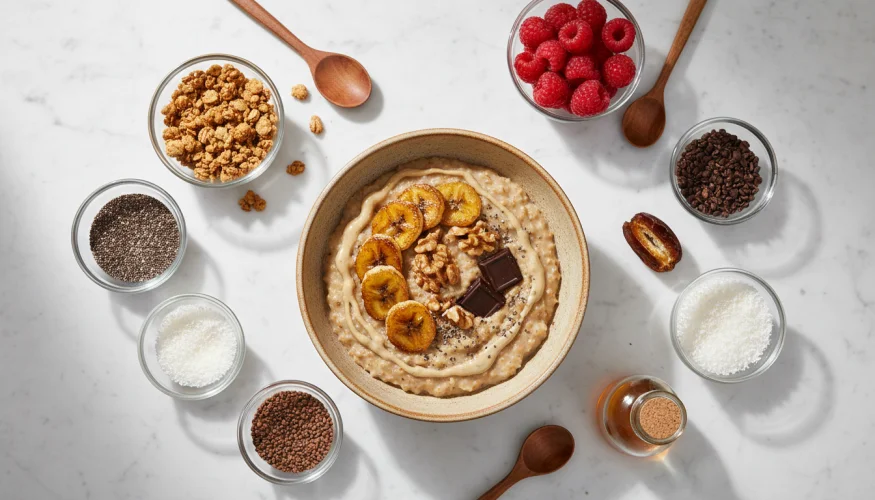
The key to a good topping is thinking in four categories: sweet, fatty, sour and crunchy. The sweet element can be provided by fresh or dried fruit, a drizzle of maple syrup, coconut sugar or date paste. The rich and satisfying element comes from nuts, seeds, nut butters or coconut flakes. Acidity is added by a little lemon zest, fresh raspberries, fermented yoghurt or even a drop of balsamic vinegar (it sounds crazy, but it works wonderfully with strawberries and vanilla porridge). And crunch? That is perhaps the most important of all - granola, cacao nibs, toasted seeds or finely chopped nuts.
Inspiration for seasonal combinations can be found at the Slow Food seasonal food database, which reminds us that the best topping is one that respects the time of year. In spring it might be strawberries and rhubarb, in summer peaches and raspberries, in autumn baked apples with ginger, and in winter pears with cardamom and dark chocolate.
A special chapter is devoted to savoury porridge, which in the Czech Republic is still a minority phenomenon, but is gaining more and more fans around the world. Rice porridge with miso paste, sesame oil, a boiled egg and chives is a perfectly ordinary breakfast in Japan. Oat porridge with avocado, cherry tomatoes and an egg on top can be a more nutritious and satisfying start to the day than many other options. Savoury porridge breaks down prejudices and opens up an entirely new world of possibilities for those who enjoy spicy or umami flavours first thing in the morning.
One real-life example: Jana, a nutritional consultant from Brno, admits that she used to hate porridge for years. "It always reminded me of hospital or childhood, when I had to eat tasteless, mushy oat porridge," she says. The turning point came when she tried buckwheat porridge with sautéed mushrooms, a dash of soy sauce and a fried egg. "Suddenly I understood that porridge is just a tool. It's all about what you do with it."
As the French gastronome Jean Anthelme Brillat-Savarin said: "Tell me what you eat, and I will tell you what you are." And a porridge that is thoughtfully prepared and lovingly adorned says far more about its creator than a hasty, characterless bowl of grey mass.
Seasoning that changes everything
Spices and aromatic ingredients are perhaps the most underrated aspect of porridge preparation. Yet they are capable of transforming an average bowl into something you remember. Cinnamon, cardamom, vanilla, ginger, turmeric, nutmeg - each of these spices adds a layer of complexity that would otherwise be missing.
Cinnamon is probably the best-known companion to oat porridge, but few people know that there is an important difference between Ceylon cinnamon and cassia cinnamon (the cheaper variety sold in most shops). Ceylon cinnamon has a more delicate, complex flavour and is also safer for regular consumption, as noted by the European Food Safety Authority (EFSA), for example. Cardamom, meanwhile, gives porridge a slightly mentholated, almost perfumed quality that is characteristic of Northern and Middle Eastern cuisines.
Turmeric combined with black pepper and coconut milk transforms rice porridge into an anti-inflammatory breakfast with a beautifully golden colour. Ginger - fresh or dried - adds energy and warmth that is especially welcome during the winter months. And vanilla, ideally a real vanilla pod or a quality extract, will make even the simplest oat porridge smell like a bakery.
Alongside spices, it is also worth mentioning adaptogens and functional ingredients that have become part of many people's morning routines in recent years. Ashwagandha, maca, reishi or lion's mane - these powders can easily be stirred into porridge and add benefits for the nervous system, energy or concentration. Of course, it is important to approach such ingredients thoughtfully and consult a specialist if necessary, but for healthy adults they represent an interesting way to further tailor morning porridge to one's own needs.
We must not forget naturally sweetening ingredients, which are a healthier alternative to refined sugar. Date paste, maple syrup, coconut nectar or blackstrap molasses - each of these options adds not only sweetness but also a specific flavour and minerals that white sugar lacks. Date paste is particularly interesting, as it provides a caramel depth while also delivering fibre that slows down sugar absorption.
The entire philosophy of making good porridge is actually similar to the philosophy of good cooking in general - it is about layering, about balance and about respect for ingredients. Porridge does not need to be complicated to be exceptional. It simply needs a little attention and a willingness to experiment. Try one new combination each day next week - a different grain, a different liquid, a different topping, a different spice. By the end of the week you will have five new recipes, at least one of which will become your new favourite. And perhaps you will discover that porridge is not just a healthy breakfast - it is a small daily adventure that begins before the day has properly got underway.