
# Cook with the Whole Celeriac – from Root to Leaves ## Využijte celý celer / Make the Most of the
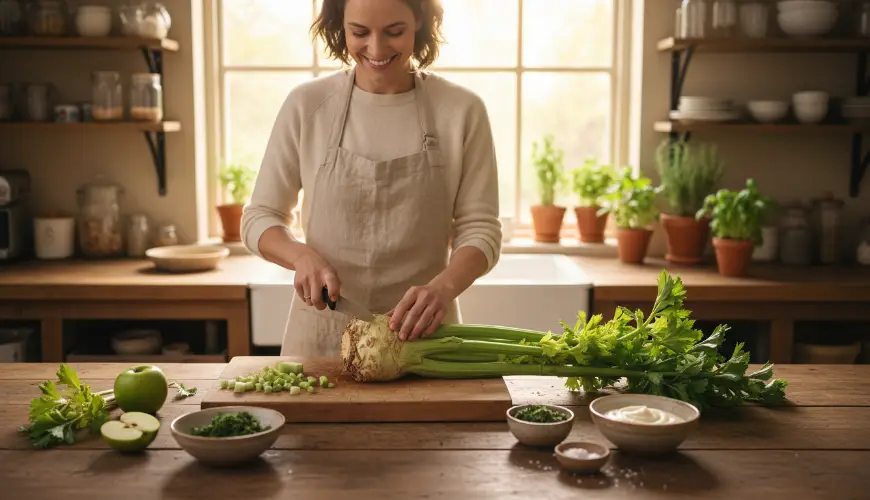
Celery is a vegetable that has held a firm place in Czech cuisine for generations. And yet most of us only use half of it – or rather a third. Buying a leafy bunch of celery with its tops, cutting off the green leaves and throwing them in the bin is a complete routine in many households. Yet it is precisely in those "scraps" that an incredible amount of flavour, nutrients and culinary potential lies hidden. Celery is, in fact, a vegetable that can be used in its entirety – from the firm bulb through the crunchy stalks to the fragrant leaves – and each part deserves a place on the plate.
Celery in general (botanically Apium graveolens) is grown in three basic forms: celeriac, or root celery, which we know as a round brown bulb; celery, whose light green stalks form the basis of many salads and soups; and leaf celery, grown primarily for its aromatic tops. In Czech shops and markets, we most commonly encounter celeriac, often sold with its tops as well – and this combination is a goldmine for anyone who wants to avoid food waste and get the most out of every ingredient.
Try our natural products



The bulb: a base that everyone knows
The celeriac bulb is undoubtedly the best-known part of this vegetable. Its earthy, slightly spicy flavour makes celery an indispensable base for soups, stocks and sauces. It is no coincidence that the classic Czech stock trio – carrot, parsley root, celery – is so deeply rooted in our gastronomic tradition. The celeriac bulb gives dishes depth and fullness that is hard to replace with any other ingredient.
The bulb can be prepared in countless ways. Grated raw into salads, it brings freshness and mild sharpness – the classic celeriac salad with mayonnaise and apple is the best proof of this. Boiled until soft, it is excellent for making a purée that can elegantly replace classic mashed potatoes. Celeriac purée with a little butter, cream and sea salt is not only delicious but also significantly lighter than the potato version. Roasted bulb, meanwhile, develops a caramelised sweetness and crispy texture – cut into cubes, seasoned with salt and roasted in the oven with olive oil and thyme, it becomes a side dish that will surprise even the greatest sceptics.
Celery is also nutritionally very valuable. According to data from the United States Department of Agriculture (USDA), the celeriac bulb contains vitamin K, vitamin C, phosphorus and fibre, while being relatively low in calories. One hundred grams of raw bulb contains approximately 42 calories, making it suitable for diets focused on lighter eating.
When preparing the bulb, it is important to peel it properly – the skin tends to be rough and has a stronger flavour. The easiest method is to use a sharp knife and cut away in layers, similar to peeling a pineapple. Once peeled, the bulb can be sliced, diced or grated – depending on the intended use. If preparing it raw for a salad, it is a good idea to drizzle it with lemon juice immediately after cutting to prevent browning.
Stalks and tops: forgotten treasures
While the bulb enjoys well-deserved attention, celery stalks and tops are still somewhat overlooked guests in Czech kitchens. This is a great shame, because these parts offer intense flavour and surprising versatility.
Stalk celery, sold as a separate vegetable in a bunch, is an absolute staple in English-speaking countries – minestrone soup, Waldorf salad or the famous Bloody Mary would be unthinkable without it. In the Czech Republic, however, it is only slowly making its way into the awareness of home cooks. Celery stalks are crunchy, juicy and have a distinctive, slightly bitter flavour that beautifully balances sweeter ingredients. Raw, they work well with fried dips, chopped into vegetable salads or as a snack stick with hummus. When cooked, they soften and their flavour mellows – braised with onion and garlic, they form an aromatic base for sauces and braised meats.
Celery tops – the green leaves at the top of the stalks or bulb – are a true aromatic powerhouse. In their intensity, they resemble parsley, but have a deeper, earthier tone. This is precisely why they can fully substitute parsley in recipes, or be combined with it. Chopped celery leaves will liven up any soup, risotto or sauce when added just before serving. They also work wonderfully as part of salad dressings or pesto – simply blend them with olive oil, garlic, parmesan and pine nuts to create an unexpectedly aromatic paste that pairs well with pasta, fish and grilled vegetables.
Celery tops can also be dried and stored as a spice – simply spread them on a baking tray and leave them in the oven at a low temperature (around 50°C) for several hours to dry out. The resulting spice then adds depth to soups, stewed dishes or even homemade meat products. This method allows you to use up tops that would otherwise end up in the compost – minimising food waste in the process.
The famous French chef Auguste Escoffier once said: "Good cooking starts with quality ingredients and respect for them." Celery is precisely the ingredient that deserves such respect – in its entirety, from root to leaf.
Recipes that use the whole celery
To ensure these tips don't remain purely theoretical, it is worth picturing a concrete situation. Take a Saturday trip to the farmers' market: you come home with a leafy bunch of celeriac complete with bulb, stalks and fresh tops. Rather than letting the tops end up in the bin, a single celery plant can yield several dishes for the whole week.
The bulb forms the base for a homemade vegetable stock – simmered slowly for an hour with carrot, parsley root and onion, the result is a golden liquid full of flavour that serves as the foundation for soups and sauces throughout the week. The remaining cooked pieces of bulb can be blended into a thick cream with a little cream and nutmeg and served as a delicate soup. The stalks, meanwhile, are cut into pieces and sautéed with olive oil, garlic and cherry tomatoes – a simple side dish ready in ten minutes. And from the tops, a pesto is prepared, stored in a jar in the fridge and kept for the whole week as a quick accompaniment to bread, pasta or grilled meat.
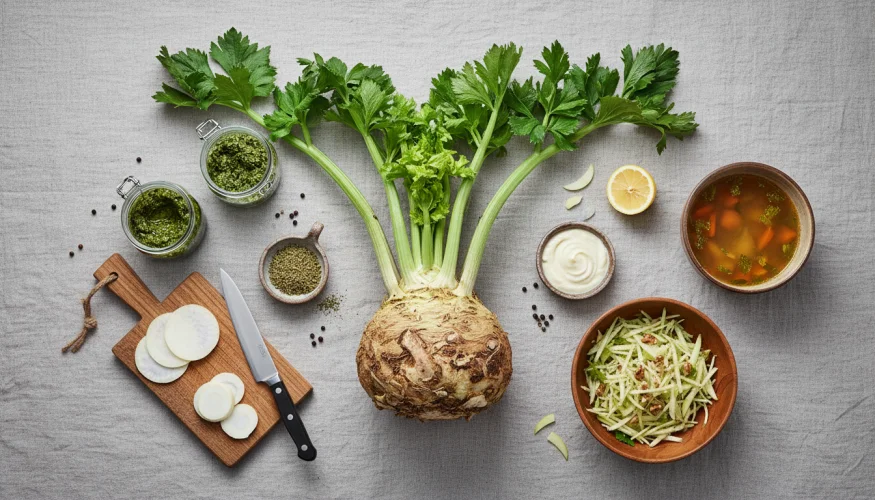
Celeriac purée is another recipe well worth trying. Cut the bulb into cubes, boil until soft in salted water, drain and blend with a knob of butter, a little cream and a pinch of nutmeg. The result is silky smooth, slightly nutty and surprisingly delicate – a wonderful accompaniment to roasted meat or fish. Those who want to experiment can add a little roasted garlic or a drop of truffle oil.
For salad lovers, the classic celeriac salad with apple is almost obligatory. Grate the raw bulb coarsely, add a chopped sweet-and-sour apple (the Granny Smith variety works brilliantly), a spoonful of mayonnaise or Greek yoghurt, a little lemon juice, salt and pepper. For those who wish, walnuts can be added for crunch or raisins for a touch of sweetness. The salad is best left in the fridge for an hour to allow the flavours to meld.
And what about leftovers? They have their place too. Celery peelings, trimmed stalk ends and older top leaves can go straight into a pot of water for stock – or into the freezer, where vegetable scraps are collected for making a base at any point in the future. This approach, known in the English-speaking world as "root-to-stem cooking", is one of the simplest ways to reduce food waste without great effort. The FAO estimates that approximately one third of all food produced in the world is wasted – and precisely these small steps in the home kitchen can help bring about change.
Celery is simply a vegetable that offers more than it appears at first glance. Its bulb, stalks and tops each have their own character, their own flavour and their own place in the kitchen. All it takes is overcoming the ingrained habit of reaching only for that brown bulb and trying to work with the whole plant. The result is not only richer and more varied cooking, but also the satisfaction of knowing that every last bit of an ingredient has been used – and that is a feeling worth having.