

# Why Women Over Fifty Grow Chin Hairs
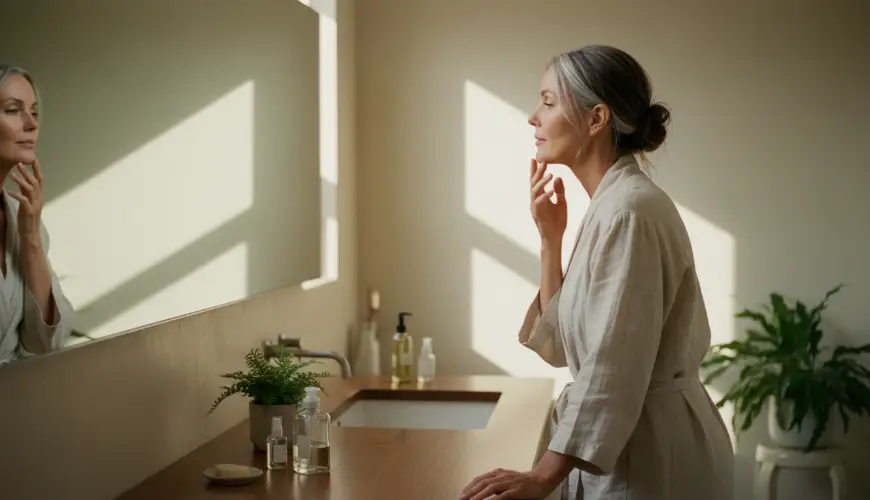
It probably happened inconspicuously. One morning, a woman looks in the mirror and sees something that wasn't there before – a fine but distinct hair on her chin. Or several, in fact. Reactions vary: surprise, amusement, sometimes mild panic. Yet this is an experience shared by a surprisingly large number of women over fifty, and it certainly deserves a serious explanation rather than awkward silence.
Chin hair growth in women over fifty is no curiosity or exception – it is a completely natural biological process with solid physiological roots. To understand why it happens, we need to look at what is occurring in a woman's body at this age on a hormonal level.
Try our natural products

What happens to hormones after fifty
The key to the whole process is menopause and the dramatic shift in hormonal balance that accompanies it. Throughout a woman's reproductive years, the body operates within a finely tuned system in which oestrogens – female sex hormones – significantly outweigh androgens, the male sex hormones. But after fifty, as the ovaries gradually reduce and eventually almost cease oestrogen production, this balance changes fundamentally.
Androgens, primarily testosterone, are present in a woman's body throughout her life. They are produced by the adrenal glands and partly by the ovaries, and their levels do not decline as dramatically as oestrogen levels do. The result is a relative predominance of androgens in the body – even though their absolute quantity remains the same or decreases only slightly. This shift in the hormonal ratio has a range of effects, one of which is precisely the stimulation of hair follicles in areas that are sensitive to androgens. The chin, upper lip, and sides of the face are among such areas.
Follicles in these areas respond to the relatively elevated androgen levels by beginning to produce stronger, darker, and more visible hairs – this phenomenon is technically known as hirsutism. More precisely, in postmenopausal women this is physiological hirsutism, meaning it is a natural part of ageing and is not a symptom of any serious disease. The World Health Organization and professional gynaecological societies regard this change as a normal part of female ageing, not a disorder.
Interestingly, while hairs increase on the chin and face, the hair on the head may thin in turn. This seems paradoxical, but the explanation is again hormonal. Hair follicles on the scalp respond to androgens in the opposite way – their presence suppresses hair production there, while stimulating it in facial follicles. These are different types of follicles with differing sensitivity to hormones, which is why one and the same hormonal change can produce two seemingly contradictory effects simultaneously.
Genetic predisposition also plays an important role. Women whose mothers or grandmothers had more pronounced facial hair after menopause have a statistically higher likelihood of encountering this phenomenon themselves. Genes determine how sensitive specific hair follicles are to androgenic signals. Some people have very sensitive follicles and respond strongly, others less so – and this is largely written into DNA.
Ethnic background also plays a role. Research shows that women of Mediterranean, Middle Eastern, or South Asian origin generally have a greater tendency towards more pronounced facial hair than women of Northern European origin. This is not a value judgement – it is simply biological variability among human populations, which manifests in this aspect of ageing as well.
When to see a doctor and when not to worry
Most women who notice chin hairs after fifty have no reason to be concerned about anything serious. Nevertheless, there are situations in which it is advisable to visit a gynaecologist or endocrinologist. If hair growth appears suddenly and very rapidly, or if it is accompanied by other symptoms such as acne, significant thinning of scalp hair, voice changes, or irregular menstrual cycles (in women who are still menstruating), it may be a sign of a hormonal disorder requiring professional attention.
Conditions that can cause excessive hair growth in women include, for example, polycystic ovary syndrome (PCOS), androgen-producing tumours of the adrenal glands or ovaries, or the side effects of certain medications. This is precisely why doctors recommend that women pay attention to how quickly and in what manner the change occurs. A slow, gradual increase in individual hairs over the course of years is almost always natural. A sudden and marked change warrants examination.
As endocrinologist and science communicator Dr Robert Lustig noted: "Hormones are like conductors of an orchestra – when one disappears, the others play louder." This metaphor aptly describes what happens in a woman's body after menopause. Oestrogen was for decades the quiet regulator keeping androgens in check. When its levels fall, androgens "sound out" more prominently – and the body signals this in various ways, chin hairs included.

For women who wish to understand their hormonal levels in greater detail, there is the option of having blood tests that measure levels of oestrogens, testosterone, FSH (follicle-stimulating hormone), and other relevant markers. A doctor can then interpret these results in the context of the patient's age and symptoms, and either recommend treatment or simply provide reassurance that everything is proceeding naturally. Detailed information about hormonal changes during menopause is available from sources such as the Mayo Clinic, one of the most trusted medical resources in the world.
When it comes to practical solutions, there are many options. Some women choose to simply remove the hairs – with tweezers, depilatory cream, an epilator, or laser treatment. Laser hair removal is currently considered the most effective long-term solution, although it does not guarantee permanent results for all hair and skin types. Other women choose to live with the hairs, as they are a natural part of their body and the ageing process. Both choices are entirely legitimate and depend solely on personal preference.
Hormone replacement therapy (HRT), which supplements oestrogen levels after menopause, can in some cases slow or reduce hair growth by restoring hormonal balance. However, this therapy has both benefits and risks and is certainly not suitable for every woman – individual consultation with a doctor is always necessary. The Czech Gynaecological Society provides current HRT recommendations that reflect the latest scientific findings.
An interesting real-life example was offered by British journalist and women's health author Christa D'Souza, who described in one of her pieces how the first chin hair prompted her to sit down and study everything happening in her body at fifty. The result was a deeper understanding of her own physiology and – as she admitted – greater calm and acceptance. Many women go through a similar journey: from initial surprise, through seeking information, to understanding and acceptance.
Society tends to speak about the ageing female body in whispers, or to shroud it in euphemism. Yet processes such as menopause, skin changes, fat redistribution, or indeed the growth of facial hair are as common as anything can be. One in every two women in the world will go through or is currently going through this process. Open and informed discussion of these topics contributes not only to better health awareness, but also to the greater psychological wellbeing of women who need not feel alone or abnormal.
Self-care during this stage of life does not mean only dealing with hair. A healthy lifestyle, a balanced diet rich in phytoestrogens – such as legumes, flaxseed, or whole grains – exercise, adequate sleep, and stress management have a demonstrable effect on how smoothly the body navigates hormonal changes. Research suggests that women with higher levels of physical activity and lower body weight tend to experience milder menopausal symptoms, although individual variability here is very high.
It is also worth knowing that natural skincare and body care products can support overall wellbeing during this period. Skin hydration, sun protection, and gentle approaches to hair removal – for example, using products free of harsh chemicals – are part of a holistic approach to health that increasing numbers of women over fifty are consciously choosing.
Chin hairs after fifty are not a problem to be shamefully hidden. They are a signal from the body that is undergoing a natural and inevitable transformation. Understanding what is happening and why is the first step towards ensuring that this transformation takes place not in fear or uncertainty, but with awareness, knowledge, and – why not – a certain degree of perspective.