
# Choose Second Hand Clothing According to These Principles
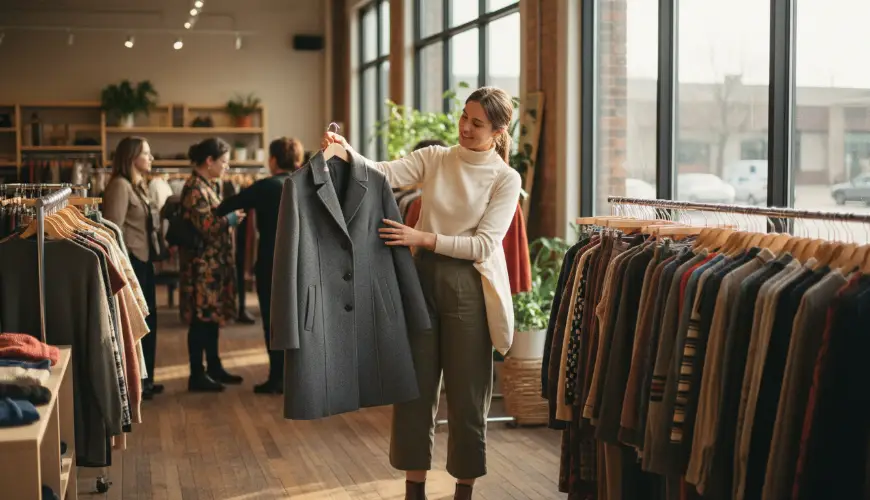
Shopping at second-hand stores has changed beyond recognition in recent years. Just a decade ago, for many people it was associated with the necessity of saving money or a certain degree of shame – today it is, on the contrary, a conscious choice that no one apologises for. Young people browse the shelves of vintage shops with enthusiasm they once reserved for shopping centres, and even older shoppers are coming around to the idea that clothing doesn't have to be new to be good. Yet there is one thing that puts many people off or disappoints them: how do you tell what's worth buying and what should stay on the hanger?
The question of quality is crucial in second-hand shopping, because unlike new goods, you have no guarantees, care labels describing the material are sometimes cut off, and the condition of a piece depends on how its previous owner treated it. Nevertheless, there are ways to navigate this – and once you develop basic habits, buying second-hand clothing becomes not only a sustainable but also an enjoyable routine.
Try our natural products


Why second-hand clothing is worth your attention at all
There can be multiple motivations at once. The environmental one is obvious: according to data from the European Environment Agency, the fashion industry is one of the world's biggest polluters – producing enormous amounts of wastewater, emissions and textile waste. Every piece of clothing that re-enters circulation instead of ending up in a landfill or incinerator is a small but real contribution to change. The financial argument is equally compelling: for the price of one new shirt from a fashion chain, you can put together an entire outfit at a well-stocked second-hand shop.
But there is a third reason that gets less attention – access to quality that would otherwise be financially out of reach. Brands that sew from durable materials and pay attention to craftsmanship simply last longer. A piece from such a brand bought second-hand for a fraction of the original price can last another ten years, while cheap fast fashion clothing bought new falls apart after the third wash. That is precisely why it pays to learn to tell the difference.
A good example is an experience many people will recognise – you walk into a second-hand shop with no particular plan, rummage through a few rails, and suddenly there hangs a wool coat that looks well-preserved at first glance. The question is: how do you know whether it's genuine value or a disappointment that only reveals itself at home?
How to select quality in a second-hand shop, step by step
The foundation is to slow down. A second-hand shop is not a place for quick purchases – it is a place for careful examination. Everyone should start with the material. If the label is intact, simply check the composition: natural fibres such as cotton, wool, linen or silk are generally more durable and kinder to the skin than synthetic substitutes. Polyester and acrylic pill more easily and lose their shape, though exceptions exist – quality technical materials or fleece made from recycled fibres have their value. If the label is missing, feel helps: quality fabric tends to be heavier, firmer and more pleasant to the touch.
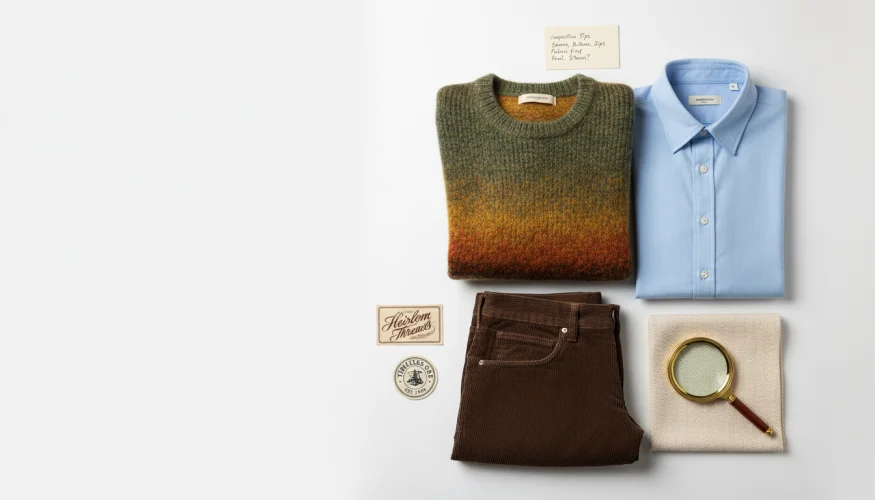
The next step is to examine the seams. Simple seams that fray or are uneven indicate cheap manufacturing – and this applies regardless of whether the clothing is new or used. Conversely, double or flat-felled seams, firmly attached buttons and even stitching are signs of careful craftsmanship. It is worth taking the piece in your hands, turning it inside out and really looking – this is a detail that few people check on new clothing in a shop, but in a second-hand context it is crucial.
Attention should also be paid to the areas that wear out most: the collar and cuffs on shirts, the underarms on T-shirts and jackets, the knees on trousers, the elbows on jumpers. These are the first places to show how heavily a piece has been worn. Mild wear does not necessarily have to be a reason to reject something, especially if the rest of the piece is in good condition – but heavy fraying or patching suggests that the clothing has had a truly demanding life and may not last much longer.
Jumpers and knitwear are a chapter unto themselves. Pilling – small balls of fibre on the surface – is one of the most common problems you will encounter. Mild pilling can be removed with a special fabric shaver and is no cause for panic, but if a jumper is literally covered in pills uniformly across its entire surface, this generally indicates a cheap material that will continue to pill regardless of care. Quality wool or cashmere, on the other hand, pills less and responds better to regular care.
The brand itself is not a guarantee, but it can be a guide. Some brands have historically been associated with quality manufacturing and durable materials – and if you come across such a piece in a second-hand shop, that is a good sign. At the same time, many lesser-known or local brands sew better than big names. The key is a combination: material, construction and the overall condition of the piece.
Smell is not to be overlooked either. It may sound strange, but lingering odours – mould, cigarette smoke or strong perfume – can be very difficult to remove, even after several washes. If a piece smells strongly and unpleasantly, it is better to leave it behind than to discover at home that the smell persists.
Where to look and how not to get overwhelmed
The world of second-hand shopping is divided into several types of venues, each with its own specifics. Classic brick-and-mortar second-hand shops offer the ability to physically examine and try on clothing – an advantage that online platforms cannot provide. On the other hand, online marketplaces such as Vinted or Depop allow you to filter by size, colour, brand and condition, saving the time spent rummaging through rails. When shopping online, it is important to read descriptions carefully and not hesitate to contact the seller with questions – a good seller responds willingly and will send additional photographs if needed.
Vintage shops are a category unto themselves: goods tend to be pre-selected, repaired and presented with greater emphasis on aesthetics, but the price reflects this accordingly. They are not necessarily the cheapest places, but for those looking for a specific era or style, they can be a goldmine.
Charity second-hand shops, such as those run by various non-profit organisations, have the advantage that a purchase simultaneously supports a good cause – and prices tend to be very favourable. The downside is less organisation and the need to spend more time browsing.
Fashion designer and sustainable fashion advocate Vivienne Westwood put it simply: "Buy less, choose well, make it last." This statement applies to second-hand shopping perhaps even more than to new clothing – because it is precisely in second-hand shops that the greatest temptation arises to buy something simply because it is cheap, even if you don't actually need it or it isn't in good condition.
A practical aid when choosing is a simple mental test: if this piece cost its full price in a shop, would I buy it? If the answer is no, then a low price in a second-hand shop is not sufficient reason. Clothing that isn't bought because you genuinely like it and it suits you will ultimately go unworn – and that is precisely the type of consumption that sustainable fashion is trying to move away from.
Caring for second-hand pieces is just as important as selecting them. Many pieces ended up in second-hand shops precisely because their previous owner didn't care for them properly – washing temperatures too high, inappropriate drying or storage. Before the first wash, it is worth checking what care method the label recommends, and if it is missing, it is better to choose a gentler cycle and lower temperature. Quality clothing made from natural materials deserves gentle care – and it will reward you by lasting much longer.
Shopping at second-hand stores therefore need not be limited to randomly browsing rails in the hope that something interesting will turn up. It is a skill that develops with each visit and with each piece that proves to be a great find or, conversely, a disappointment. The more attention you pay to materials, construction and the overall condition of clothing, the better you navigate – and the less money you waste on things that then hang in the wardrobe unused. Second-hand clothing carries a story, a history and the potential to continue further. You just need to know what to look for.