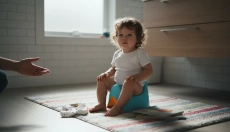

# Separation Anxiety in Toddlers and How to Handle It Calmly
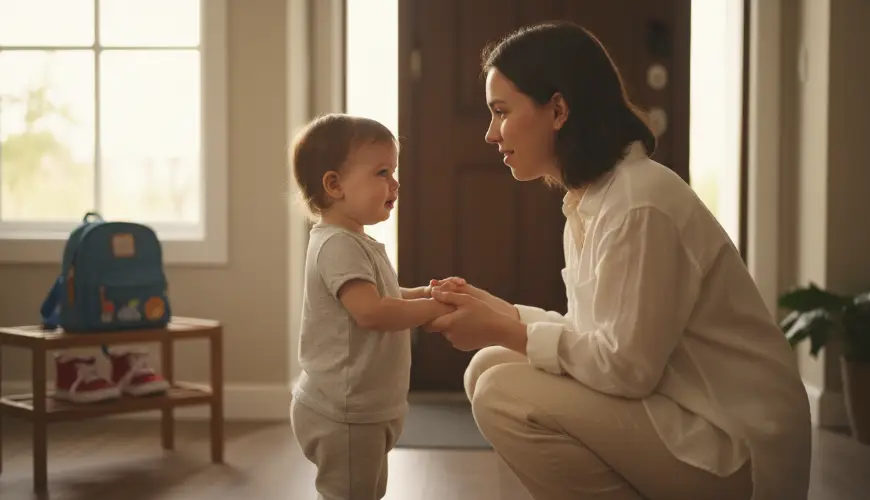
Every parent knows that moment. You just turn to the coat rack to grab your jacket, and the child immediately bursts into tears, clings to your leg, or desperately calls out "mummy, mummy, mummy" over and over again, as if the world were about to lose its axis. Separation anxiety in toddlers is one of the most challenging yet most natural developmental phases that children go through. And yet many parents experience it with feelings of guilt, helplessness, or even fear that they are doing something wrong.
They are not. And understanding why separation anxiety arises and how to handle it can make the whole situation significantly easier – for the child and for the parents themselves.
Try our natural products





What is actually happening in a toddler's little head
Separation anxiety is not a whim or the result of poor parenting. It is a neurologically conditioned response that is closely linked to the developmental stage the toddler is currently in. Around eight to twelve months of age, children begin to realise that their caregiver exists as a separate being – and yet they have not yet developed a sufficient concept of what is known as object permanence, that is, the ability to internally maintain the awareness that mummy or daddy exists even when they cannot be seen.
In other words: for a young child, a parent disappearing behind the bathroom door genuinely means, for a moment, that the parent has ceased to exist. No dramatisation, no manipulation – simply an immature brain that is still learning to work with the abstract concept of continuity. Research in developmental psychology, such as the work of Jean Piaget, shows that object permanence fully develops around the age of two, with individual children varying considerably in the pace of their development.
Separation anxiety is therefore not solely a matter of infancy. Many children experience its peak during the toddler years – that is, between one and three years of age – and it may reappear in a milder form when starting nursery or during other major life changes. What at first glance looks like a step backwards is in fact evidence of healthy emotional attachment.
A child who cries when a parent leaves is a child who has formed a secure bond. And that is good news.
What separation anxiety in toddlers looks like in practice
The manifestations of separation anxiety are varied and depend on the temperament of the individual child, their current state of health, their level of tiredness, and the scale of the change that awaits them. Sometimes it takes the form of intense crying at goodbye, other times it means clinging to the parent throughout the day, refusing strangers, or difficulties with sleep – particularly if the child wakes at night to find that the parent is not immediately nearby.
Take, for example, three-year-old Eliška, who started nursery. At home she functioned wonderfully, enjoyed playing, and was curious and communicative. Yet the first weeks at nursery were exhausting for the whole family: every morning the goodbye involved dramatic crying that lasted up to twenty minutes after her mother left. The teachers confirmed that Eliška calmed down fairly quickly and joined in with the morning activities without difficulty – but this picture did nothing to reassure her mother, who carried that crying with her throughout the entire day.
That is precisely what separation anxiety is. It affects both sides. And for parents it is often no less demanding than it is for the child.
How to weather separation anxiety – without unnecessary drama and without ignoring it
One of the most widespread mistakes parents make in good faith is trying to leave unnoticed – to "disappear" while the child is absorbed in play, in the hope of avoiding a scene. In the short term this may work, but in the long term this strategy tends to undermine trust rather than build it. The child learns that the parent can vanish at any moment and without warning, which in fact deepens their anxiety.
Experts in child psychology, such as the authors of publications issued by the American Academy of Pediatrics, recommend the opposite: make the goodbye a ritual. Brief, warm, and predictable. A hug, the words "I'll be back soon, I love you", and then leaving. Without lengthy explanations, without returning because of one's own guilt, and without transferring one's own anxiety onto the child – because children are surprisingly adept at reading their parents' emotions.
A goodbye ritual gives the child a sense of control over a situation that would otherwise be unpredictable. And predictability is crucial for young children – it is the foundation of their sense of security.
Alongside the goodbye ritual, the return ritual also plays an important role. When the parent comes back, it is worth giving the child a moment of full attention – not necessarily an hour of intensive play, but a few minutes of genuine contact, eye contact, a hug. This confirms what the child needs to know: you left and you came back. You always come back.
Gradual acclimatisation also helps. If a child has never been alone with another caregiver, it is unrealistic to expect them to accept starting nursery without difficulty. Short stays with grandparents, with a friend, or with a babysitter can help the child experience that separation from a parent is temporary and safe.
When a child's anxiety is too great
Separation anxiety is natural, but there are situations where it is worth consulting a specialist. If a child beyond the age of four continues to experience intense anxiety at every separation, refuses to sleep alone, or is unable to take part in any activity without a parent present, this may be a case of persistent separation anxiety disorder that deserves professional attention.
Similarly, it is advisable to seek help when separation anxiety significantly interferes with the everyday functioning of the whole family – when a parent cannot even step away to use the toilet, when the child refuses to eat or sleep, and when their distress is clearly excessive. A child psychologist or paediatrician can assess whether this represents a developmentally normal course or whether more targeted support is warranted.
As child psychologist D. W. Winnicott said: "There is no such thing as a baby – there is always a baby and someone." This thought serves as a reminder that a child's development never takes place in isolation. It is always part of a relationship, and the quality of that relationship is the most important factor in determining how the child manages separation anxiety.
What helps in everyday life
Beyond rituals and gradual acclimatisation, there are a number of small, everyday things that can ease the situation. A stable daily routine is one of them – children who know what comes after breakfast and what comes after lunch feel more secure and react less anxiously to changes.
Transitional objects – a favourite toy, scarf, or small pillow that smells of the parent – have their place in a toddler's life. This is not a crutch or an expression of unhealthy dependency. It is a natural way for the child to maintain a sense of closeness and security in the parent's absence.
Naming emotions can also be helpful. Instead of "don't cry, everything is fine", try "I can see you're sad because daddy is leaving. It's okay to be sad. Daddy will come back." This seemingly simple act of naming helps children understand what they are experiencing and gradually build a healthy relationship with their own emotions.
And then there is something that is spoken about less often, but is no less important: caring for the parents themselves. Experiencing your child's crying every morning and carrying it with you all day is exhausting. Talking about it with a partner, friends, or a parents' group is not weakness – it is a necessity. A parent who feels supported and understood is far better equipped to handle difficult moments with their child.
Separation anxiety in toddlers is one of those phases of parenthood that seems endless, but does come to an end. Children who pass through this period in a safe, loving environment carry with them a deep inner sense of security – the knowledge that even when someone leaves, they will return. And that is a gift parents give their children even in the most challenging morning moments at the nursery door.