
Proper care of a cast iron pan so it lasts for generations
Cast iron pan is not just a kitchen utensil. It is an investment, a legacy, an object that — with proper care — can be passed from grandmother to mother and from mother to daughter over decades without losing any of its properties. While modern non-stick pans last an average of three to five years before needing replacement, a quality cast iron pan, with proper handling, can literally serve an entire human lifetime. And that is precisely where its magic lies — the more it is used, the better it becomes.
Just look into the kitchen of an older generation. Many grandmothers in Czech households still have a pan on the stove that they received as a wedding gift or inherited from their own mothers. Such a pan has its history, its character, and — crucially — its perfectly developed surface layer known as patina or "seasoning." This layer forms gradually, with every meal cooked, every application of oil, and every heating. It is not a matter of chance or magic — it is chemistry and proper care.
Try our natural products
-1-m.jpg)
-1-m.jpg)
-1-m.jpg)
-1-m.jpg)
-1-m.jpg)
What seasoning is and why it is so essential for cast iron
To understand how to properly care for a cast iron pan, one must first understand what makes cast iron what it is. Cast iron is an alloy of iron and carbon that is extremely resistant to heat and mechanical damage, but at the same time susceptible to oxidation — that is, to rust. That is precisely why it needs a protective layer that shields it from atmospheric moisture and water.
This protective layer — seasoning — is created by the polymerization of fats at high temperatures. Simply put: when you apply a thin layer of oil to the pan and heat it to a sufficiently high temperature, the fat molecules chemically transform and form a solid, smooth, nearly non-stick layer directly on the metal surface. By repeating this process, the layer thickens and improves. As described by Lodge Cast Iron, one of the oldest and most reputable manufacturers of cast iron cookware in the world, a properly seasoned pan can rival even modern Teflon surfaces in its non-stick properties — and without any chemicals whatsoever.
The initial seasoning of the pan is therefore the first and perhaps most important step. A new cast iron pan — or an old one whose protective layer needs to be restored — is first thoroughly washed with hot water and soap to remove any dirt or residues from the manufacturing process. It is then carefully dried, ideally in an oven or over gentle heat, so that no moisture remains. This is followed by applying a very thin layer of oil with a high smoke point — rapeseed oil, linseed oil, or shortening are popular choices. The pan is then placed upside down in an oven at around 230–260 °C and left there for an hour. After cooling, the entire process is repeated two to three more times. The result is the foundation of a solid patina on which to continue building.
As French chef Auguste Escoffier used to say: "Good equipment is half the cook's success." And in the case of a cast iron pan, this is doubly true — but only when it is properly cared for.
Everyday care that determines longevity
The greatest enemy of a cast iron pan is water. Or rather — water left on the surface for too long. Washing cast iron is therefore one of the most debated topics among cookware enthusiasts. Until just a few years ago, it was dogma that cast iron must never come into contact with soap under any circumstances. Today, the view is somewhat more nuanced — a small amount of mild soap during occasional washing will not harm the pan, provided it is subsequently well dried and treated with oil. What remains absolutely true, however: a cast iron pan must never be left wet, must never be soaked in water, and certainly does not belong in a dishwasher.
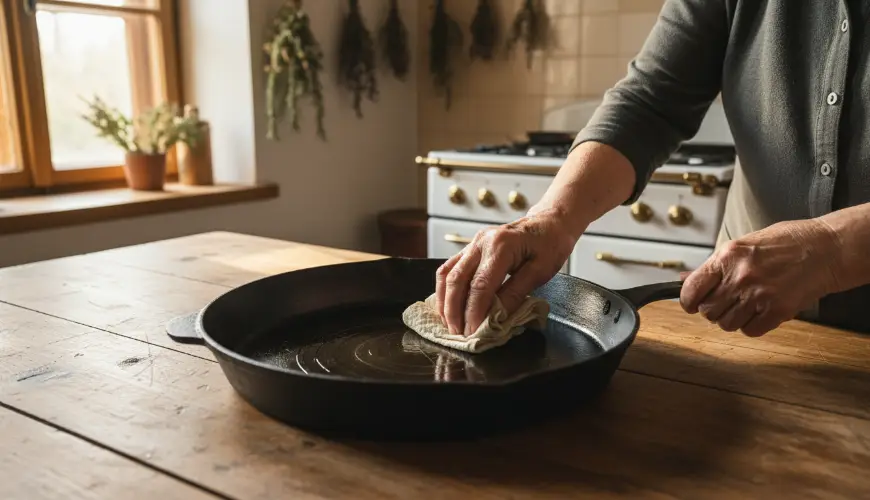
The best method of cleaning after everyday cooking is simple. While the pan is still warm, it is sufficient to wipe it with a paper towel or a coarse cloth, or to use a brush or coarse salt as an abrasive for burnt-on residue. If food residue is more stubborn, adding a little water and heating briefly will help — the burnt pieces will loosen on their own. After every washing, it is essential to immediately dry the pan on the stove over gentle heat and apply a very thin layer of oil, which is rubbed into the surface with a paper towel. This ritual takes literally a minute, but it is that minute which determines whether the pan lasts a year or generations.
Storing a cast iron pan also deserves attention. The ideal is to keep it in a dry place with adequate airflow. If pans are stacked on top of one another, it is advisable to place a paper towel or cloth between them to absorb any moisture while also protecting the surface from scratching. A damp environment — such as a poorly ventilated cabinet under the sink — is unsuitable for cast iron.
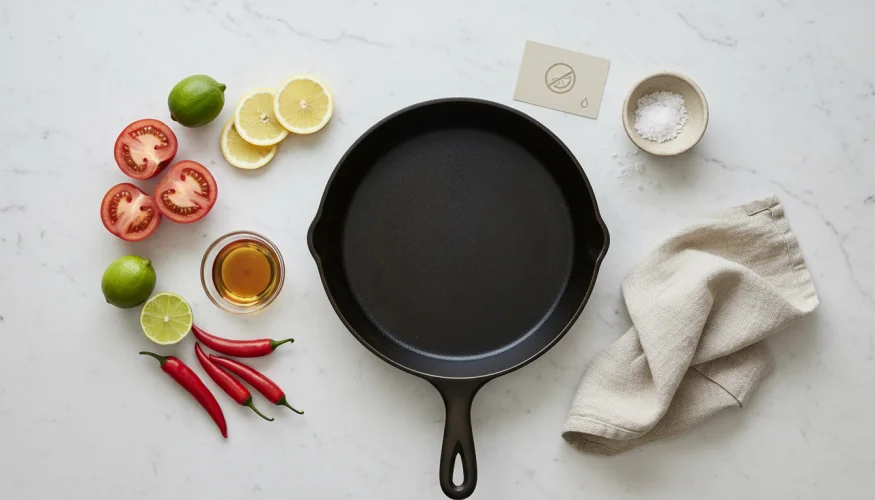
One of the most common mistakes people make is cooking acidic dishes in a freshly seasoned pan. Tomatoes, citrus juices, or vinegar can damage a young patina before it has had a chance to properly set. Acidic foods should be cooked in a cast iron pan only once the seasoning is well established — that is, after months of regular use. Experienced cook James Peterson, in his book on cooking techniques, notes that cast iron and acidity are a combination that requires careful consideration, especially in the early stages.
Rust is not a death sentence — how to rescue a pan
What should you do if rust does appear on a cast iron pan? Many people panic at such a moment and consider throwing the pan away. That would be a great shame — and unnecessary. Rust on cast iron cookware is entirely repairable, even in cases where the pan looks as though it spent the winter outdoors.
The restoration process is fairly straightforward. Rusted areas are first treated mechanically — coarse salt, a dish brush, or fine steel wool can help (be careful with overly aggressive abrasives that could scratch the metal). In the case of heavier rust, the pan can be briefly soaked in a solution of water and vinegar in a one-to-one ratio — but only for a short time, a maximum of one hour, because too long an exposure to an acidic environment could damage the metal itself. After mechanical cleaning, the pan is thoroughly washed, rinsed, and immediately dried. Then comes a complete re-seasoning — the same process as for a new pan, described above.
According to Serious Eats, one of the most respected culinary websites in the world, rust is nothing unusual or irreparable when it comes to cast iron. Even pans that have been neglected for years can be restored to their original condition and put back into service. Cast iron is simply a resilient material that forgives mistakes — as long as one addresses them in time.
An interesting example is provided by community projects in the USA, where volunteers rescue old cast iron pans from flea markets and estate sales. Pans that are perhaps eighty years old, full of rust and with darkened surfaces, go through a restoration process and after several weeks of care are once again in perfect condition — and often better than cheap new cookware. Such a story eloquently demonstrates that proper care of a cast iron pan truly pays off over a horizon of decades.
The choice of the right fat for everyday maintenance as well as for seasoning also has its effect on the outcome. Experts agree that the best results come from linseed oil due to its ability to polymerize quickly, but rapeseed oil, shortening, or lard also work well — the traditional choice of generations of Czech cooks. Olive oil or butter, on the other hand, are not particularly recommended for seasoning, as they have a lower smoke point and can result in a sticky or uneven surface.
Cooking in a cast iron pan itself contributes to its condition. Frying meat, sautéing vegetables, or baking cornbread directly in the pan — each of these uses adds another layer of patina and strengthens the seasoning. A pan that is used every day is paradoxically in better condition than one that sits in a cupboard. Regular use is simply the best form of care.
It is also worth mentioning that cast iron cookware is not just a matter of the kitchen — it is also a choice with an ecological dimension. While Teflon or ceramic pans end up in landfill after a few years, a cast iron pan with proper care never needs replacing. This is precisely the kind of sustainable approach to the household that makes sense not only economically but also in terms of environmental impact. Less waste, less consumption, more value from a single object — these are principles aligned with the idea of conscious and responsible purchasing.
A cast iron pan is thus not merely a kitchen tool. It is a symbol of a different relationship with objects — one that prioritizes quality over quantity, care over convenience, and long-term value over immediate savings. And that is precisely why, if properly cared for, this pan may one day sit on the stove of your children or grandchildren — and still cook just as well as it does today.