

What tracking basal temperature reveals about your cycle

Every morning, before you get out of bed, you take your temperature. It may sound like a strange ritual, but for thousands of women it is a daily habit that gives them something precious – an overview of their own body and its rhythm. Tracking basal body temperature is one of the oldest and yet still very relevant methods of understanding the female cycle, without a single pill or invasive procedure.
Basal body temperature (abbreviated as BBT) is the lowest temperature the body reaches at rest – that is, after at least four to five hours of uninterrupted sleep. This value, seemingly trivial, carries a surprisingly large amount of information about what is happening in a woman's body. The hormonal changes accompanying the menstrual cycle are directly reflected in body temperature, and those who learn to read these fluctuations gain a unique window into their health.
Try our natural products


How the hormonal cycle affects body temperature
The menstrual cycle is divided into two main phases: the follicular phase, which lasts from the first day of menstruation until ovulation, and the luteal phase, which begins after the egg is released and ends with the onset of the next menstruation. In the first phase, oestrogen dominates and body temperature tends to be relatively low – typically ranging between 36.1 and 36.4 °C. After ovulation, progesterone takes over – a hormone that prepares the body for a possible pregnancy – and it is this hormone that causes the characteristic temperature shift.
After ovulation, temperature rises by approximately 0.2 to 0.5 °C and remains at this elevated level throughout the luteal phase, usually ten to sixteen days. If fertilisation does not occur, progesterone levels drop, temperature returns to normal and menstruation begins. If a woman becomes pregnant, her temperature remains elevated – and this persistent rise is often one of the first indirect signs of pregnancy, even before a positive test.
This principle is well documented scientifically. The World Health Organization includes it in the so-called symptothermal method of family planning, which combines temperature tracking with observation of cervical mucus and other physical signs. Studies published in the scientific journal Human Reproduction confirm that, when used correctly and consistently, this method can achieve reliability comparable to hormonal contraception.
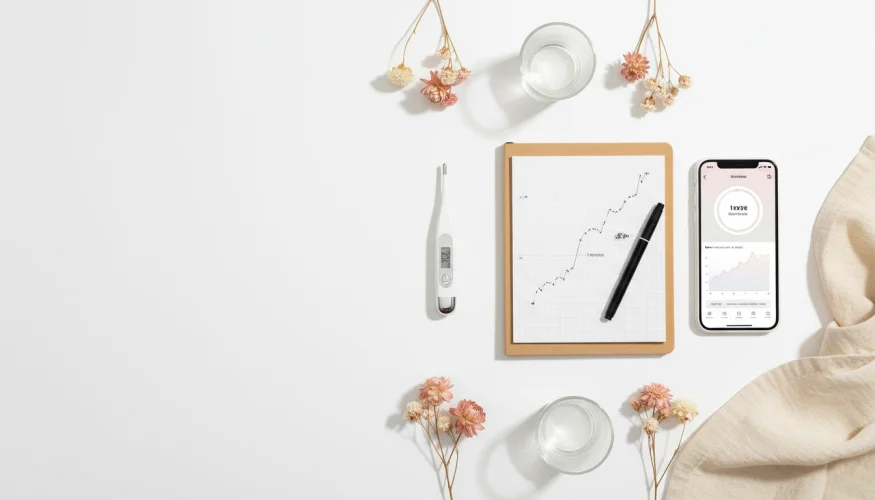
So how do you get started? The requirements are minimal: a reliable thermometer – ideally a digital one accurate to two decimal places – and a notebook or app for recording values. Measurements are taken every morning at approximately the same time, ideally before getting up, speaking or even reaching for your phone. Any activity will slightly affect body temperature and could skew the results. The thermometer is placed under the tongue, in the vagina or in the rectum – with vaginal and rectal measurements generally considered more accurate.
Let us consider a specific example: Jana, a thirty-year-old woman who has stopped taking contraception and wants to better understand her cycle, begins recording her temperature every morning. For the first two weeks she sees values around 36.2 °C. Then one day she records a marked drop – the so-called temperature dip, which sometimes precedes ovulation – and the very next day her temperature jumps to 36.7 °C. From this point, her temperature remains elevated. Jana is thus able to determine retrospectively when she approximately ovulated, and gradually learns to predict when ovulation will occur in her next cycle.
What basal temperature can reveal about your health
Tracking temperature is not just about planning or postponing pregnancy. Basal temperature charts are literally a mirror of hormonal health and can flag a whole range of conditions that might otherwise go unnoticed for a long time.
One of the most common signals is a luteal phase that is too short. If the elevated temperature lasts fewer than ten days, it may indicate insufficient progesterone production – a condition known as luteal insufficiency. This can be a cause of difficulty conceiving or recurrent early miscarriages. A gynaecologist who sees a basal temperature chart has a valuable diagnostic tool at hand, without the need to immediately proceed to costly investigations.
Another warning sign is the absence of a temperature rise. If temperature remains at the same level throughout the entire cycle without a significant increase, it may mean that ovulation did not occur at all – a condition called anovulation. Anovulatory cycles are not uncommon: they can be caused by stress, significant changes in body weight, intense physical exertion or various hormonal disorders such as polycystic ovary syndrome (PCOS). A woman who tracks her temperature can notice for herself that something is not right and seek professional help in time.
It is also interesting to consider what temperature can reveal about thyroid function. Chronically low basal temperatures – below 36 °C – can be one of the symptoms of hypothyroidism, i.e. insufficient function of this gland. Similarly, irregular and chaotic charts with no discernible pattern can reflect dysregulation of the hormonal system. Of course, a thermometer is not a diagnostic device and any suspicious finding should be discussed with a doctor – but it is precisely through regular records that a woman has concrete data she can show her doctor.
"Basal temperature charts are enormously valuable to me as a physician. I can see in them the history of the cycle, which I would otherwise have to painstakingly reconstruct from the patient's recollections," says gynaecological endocrinologist MUDr. Petra Horáčková in an interview for the magazine Zdraví.
Another aspect worthy of attention is the length and regularity of the cycle as a whole. The average cycle lasts 28 days, but the healthy range is 21 to 35 days. If a woman tracks her temperature month after month, she will soon discover whether her cycle is regular, when she approximately ovulates and how long her luteal phase is. This information is invaluable when planning a pregnancy, for example, because ovulation does not always occur on day 14 – in women with a longer or shorter cycle it may come significantly earlier or later.
Modern technology makes the whole process considerably easier. There are apps such as Natural Cycles, Kindara or the Czech Femometer, which allow temperatures to be recorded directly on a phone, automatically generate charts and some even use algorithms to predict fertile days. Natural Cycles is even certified as a contraceptive method in the European Union and the USA – which is testament to how far this seemingly simple method has come.
It is important, however, to also mention the limitations of the method. Basal temperature is sensitive to a whole range of factors: illness, alcohol consumed the previous evening, travelling across time zones, disrupted sleep or even stress can all cause deviations that distort the picture of the cycle. It is therefore recommended to record these circumstances in the chart and take them into account when interpreting results. A single atypical value is not yet cause for concern – it is only a recurring pattern that warrants closer attention.
For women who want an even more comprehensive overview, combining temperature tracking with observation of cervical mucus has proven effective. Mucus changes throughout the cycle: before ovulation it becomes clear, slippery and stretchy like raw egg white – this is when the body is most fertile. This combination, known as the symptothermal method, brings together two different biological indicators and significantly increases the accuracy of identifying fertile and infertile days. The organisation Justisse, which is dedicated to education in natural family planning methods, offers detailed materials and courses for women who want to learn this method properly.
Tracking basal temperature also has a dimension that is less often discussed – the psychological and emancipatory one. Many women describe how regularly monitoring their own body has given them a sense of control and a deeper connection with themselves. At a time when the debate around women's health and contraception is increasingly opening up, there is growing interest in methods that do not interfere with hormonal balance and allow the body to function naturally. This is not necessarily an ideological choice – for many women it is simply a practical decision stemming from a desire to better understand their own body.
Why should getting to know one's own cycle be the preserve only of those planning a pregnancy? The answer is simple: it should not be. Whether it is a woman who wants to conceive, one who is looking for natural methods of contraception, or one who simply wants to know why she feels different at a certain time each month, tracking basal temperature offers concrete, everyday answers. All it takes is a thermometer, a little patience and a willingness to listen to what the body is communicating – quietly, but regularly, every morning anew.