

# How Swimming Styles Backstroke and Breaststroke Affect Spinal Health Swimming is one of the most
Swimming has long been one of the most popular physical activities across all age groups. Water buoys the body, reduces joint stress, and enables movement even for people who would suffer pain on land. However, not all swimming strokes are equal - and if you struggle with back problems or want to protect your spine in the future, the choice between backstroke and breaststroke may be more significant than it first appears.
The debate about which stroke is gentler on the spine is conducted not only among recreational swimmers, but also among physiotherapists and sports physicians. The answer is not black and white. It depends on technique, the individual's health condition, training frequency, and whether the swimmer is even aware of what their body is doing while moving through the water. Let's take an honest, thorough look at both strokes.
Try our natural products





How Breaststroke Loads the Spine and Why Technique Matters More Than Anywhere Else
Breaststroke is the most widespread swimming stroke in the Czech Republic. We learned it at school, we swim it at the pool on weekends, and many people consider it a "safe foundation." The reality, however, is more complicated. Swimming breaststroke with poor technique is one of the greatest threats to the cervical and lumbar spine there is. The problem lies in the characteristic head movement - many recreational swimmers significantly tilt their head backward with each breath, while their lumbar spine simultaneously arches. This movement is repeated dozens, hundreds, sometimes thousands of times in a single session.
Physiotherapists are well acquainted with this pattern. As experts at Spine-health note, repeated hyperextension of the cervical spine can lead to pain, degenerative changes, or even worsening of existing disc problems in predisposed individuals. This does not mean that breaststroke is automatically a poor choice - but it does mean that without proper technique, a relaxing activity can become a source of chronic problems.
Properly swum breaststroke looks different from what we see in the average public pool. The head should be in line with the spine for most of the time, submerged in the water, with exhalation below the surface. Inhalation occurs quickly and with minimal head tilt. The torso should work as a unit, rather than bending at the hips. Breaststroke swum this way is much gentler on the spine - but it requires conscious practice and feedback, ideally from an experienced coach or physiotherapist.
Consider Martina, a forty-four-year-old accountant from Brno, who after years of sitting at a computer began swimming three times a week to relieve her back pain. She chose breaststroke because she didn't know any other stroke. After two months, her problems had not improved - on the contrary, she began experiencing pain in her cervical spine as well. Only after consulting a physiotherapist did she discover that she had been swimming the whole time with her head above water and with a pronounced arch in her back. Simply adjusting her technique was enough, and the pain gradually subsided. Martina's story is not exceptional - it is typical.
Backstroke as a Rehabilitation Tool and an Everyday Choice
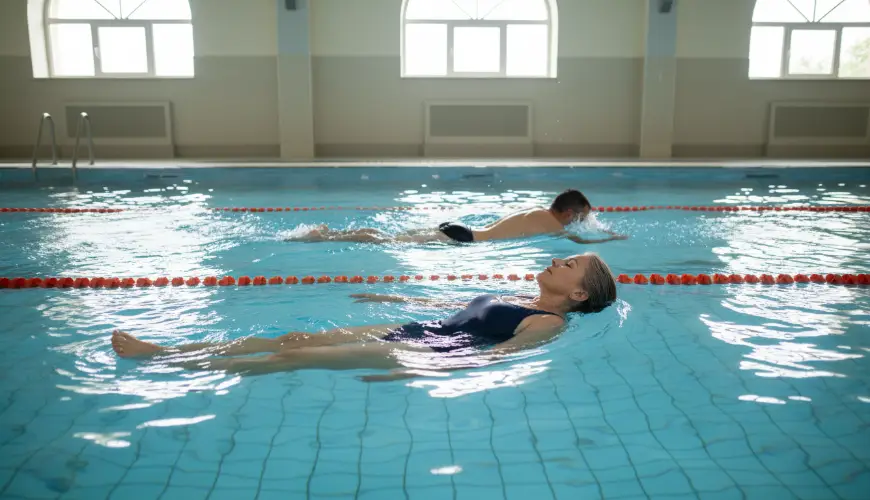
Backstroke is generally considered a more favourable alternative in terms of spinal loading, for several reasons. When swimming on the back, the spine rests in a more natural position, is not forced into repeated hyperextensions, and the head remains in a neutral position without needing to turn for a breath - the air is always above the surface. This very circumstance makes backstroke one of the few sporting movements in which the cervical spine is not systematically overloaded.
Backstroke is therefore widely used in rehabilitation. Patients recovering from spinal surgery, people with herniated discs, or those with chronic back pain receive it as part of movement therapy. Research published in journals such as the Journal of Back and Musculoskeletal Rehabilitation repeatedly shows that swimming on the back, when performed correctly, minimises compressive forces acting on the intervertebral discs while simultaneously activating the deep trunk stabilisers - precisely those muscles that protect the spine.
This does not mean, however, that backstroke is entirely problem-free. Here too, poor technique can cause damage. If a swimmer significantly arches the lumbar spine during backstroke - which occurs particularly when the abdominal muscles are weak or the swimmer poorly coordinates arm and leg movements - the lumbar region may become overloaded. Backstroke may also be unsuitable for people with certain types of shoulder problems, as the rotational arm movement places considerable demands on the shoulder joint.
Nevertheless, the consensus among experts is fairly clear. As physiotherapist Pavel Kolář, whose approaches to movement medicine are internationally recognised, puts it: "Movement in water is generally beneficial for the spine, but the choice of stroke and the quality of execution determine whether it constitutes therapy or damage." This thought captures the essence of the entire debate better than any general recommendation.

What Experts Say and How to Decide
The key comparison of both strokes from a spinal perspective can be summarised along several practical lines. In terms of the cervical spine, backstroke clearly comes out ahead - it eliminates the need for repeated head tilting, which is so problematic in breaststroke when technique is poor. In terms of the lumbar spine, both strokes are comparable when technique is correct, though poor execution of breaststroke carries greater risk due to the tendency toward hyperlordosis.
Breaststroke, when swum with good technique, is a fully valid activity even for people with mild spinal problems. The issue arises when a recreational swimmer receives no feedback and spends years repeating a movement pattern that systematically overloads the spine. Backstroke is generally more forgiving for beginners and for those who struggle with their spine - poor technique causes less damage here, though it is of course never ideal.
Interestingly, many people combine both strokes without giving it much thought. Alternating strokes can, however, be a deliberate strategy: different strokes engage different muscle groups, prevent one-sided overloading, and overall contribute to more balanced physical development. Physiotherapists therefore often recommend precisely this combination - with an emphasis on ensuring that each stroke is performed with technically correct form.
There is yet another aspect that tends to be overlooked in discussions about the spine and swimming: body position while resting between lengths. Many swimmers hold their body in a vertical position between laps with their head above water, unconsciously tensing the cervical muscles. A simple alternative - swimming to the wall and floating freely on one's back for a moment - can significantly reduce overall spinal tension during a training session.
When it comes to specific recommendations for different groups of swimmers, the situation looks roughly as follows. People with herniated discs or who have undergone spinal surgery should always first consult a physiotherapist about their exercise regimen - backstroke is typically the first step back into the water, with breaststroke following only after the condition has stabilised and correct technique has been practised. Seniors and beginners who swim recreationally benefit from backstroke for its simplicity and lower risk of error. Advanced swimmers with good technique can swim both without concern.
An important role is also played by how a person feels after swimming. If back or neck pain persists after every training session, this is a clear signal that something is wrong - whether it concerns technique, training duration, or an unsuitable stroke choice for the given health condition. Pain is never a normal part of physical activity, and ignoring it is a mistake that the spine remembers for a long time.
The environment in which a person swims also plays a role. An overcrowded public pool with short lanes forces swimmers into unnatural movements - sudden stops, turns, dodging others. In such an environment, technically correct swimming is more difficult and the risk of poor execution increases. A quiet lane, sufficient space, and focus on one's own movement are the conditions under which swimming truly fulfils its rehabilitative potential.
Finally, it is worth noting that swimming itself - regardless of stroke - offers the spine a benefit that few other sports can provide. The buoyancy of water reduces gravitational load on the spine by approximately 90 percent compared to movement on land, as the American Physical Therapy Association notes. This creates conditions under which movement patterns can be practised with far less risk of injury than on the ground. Water is therefore a natural ally of the spine - and choosing the right stroke, along with correct technique, only deepens this alliance.
Whatever stroke a person chooses, the most valuable investment remains dedicating time to learning proper technique. An hour with a qualified swimming coach or a physiotherapist specialising in aquatic movement can transform the entire character of a training session - and the spine will feel the difference sooner than one might expect.