

Broth has benefits that you will appreciate when you cook it properly at home.
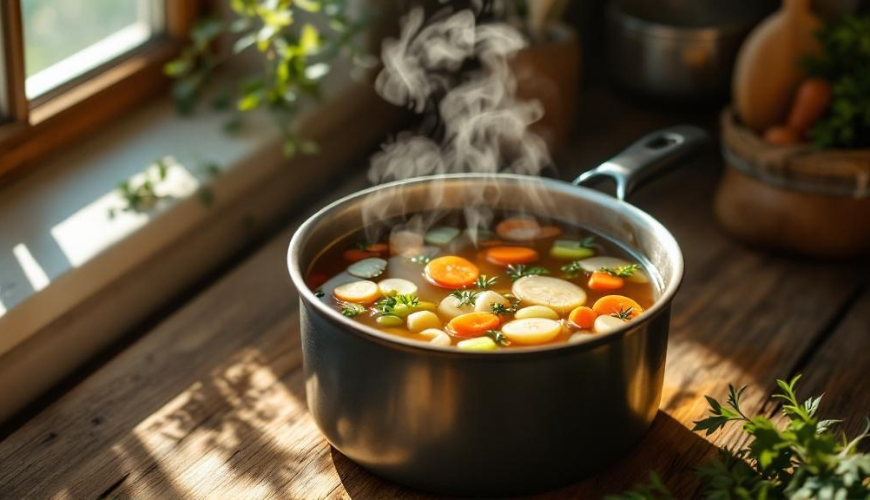
Broth holds a special place in Czech kitchens. It's not just "a soup to start with," but a quiet foundation that holds together a multitude of dishes – from sauces to risottos, and even the Sunday noodle soup. In recent years, broth has returned to the forefront due to its numerous benefits for the body when cooked properly. This is where the difference lies between what poses as broth in a cube and what simmers slowly on the stove for hours, wafting the aroma of vegetables, spices, and bones.
Try our natural products






Broth and Its Benefits: Why People Are Returning to It
When discussing the benefits of broth, it's often reduced to the simple statement "it's healthy." However, what's interesting about broth is that its strength doesn't lie in a single miraculous substance, but in its combination. Long, slow cooking can transfer flavors and nutrients from bones, meat, and vegetables into the liquid, creating a naturally full, round taste without the need for flavor enhancers that quick substitutes can't replicate.
The impact of strong broth on health is often mentioned in the context of it being an easily digestible yet nutritious meal. That's why people instinctively cook it when fighting a cold, after a challenging period, post-exercise, or when "there's a need to recover." Broth provides fluids, some energy, minerals, and proteins – and it's easy to consume even when one lacks the appetite or strength for complex cooking.
It's fair to add that broth isn't a cure and won't solve everything. However, it makes sense to talk about it as a meal that can support recovery. Bones and connective tissues release substances during long cooking that are commonly associated with collagen and gelatin; vegetables contribute their vitamins and aromatic compounds. If one selects ingredients wisely, the result can approach something akin to "a meal that is also care."
Interestingly, broth often helps soothe the stomach, warms the body, and, thanks to its strong flavor, can replace the need to over-salt or use industrial bouillons. This is perhaps its greatest everyday benefit – not as a promise but as a small change in habits that accumulates over time.
And if there's something truly universal about broth, it's its ability to adapt to whatever is available at home. Sometimes it becomes a gentle chicken broth, other times a heartier beef broth, or purely a vegetable broth that surprises with its depth when made patiently. As an old culinary rule aptly states: "A good broth can't be rushed, but it can be ruined by haste."
Strong Homemade Broth: The Right Steps for Flavor and Strength
Anyone who has ever tackled how to make the perfect strong homemade broth has usually encountered two questions: how to achieve a strong flavor and how to make the broth "stretch" and lightly gel when cooled. Both can be managed without complications, one just needs to adhere to a few principles. It’s not culinary alchemy – more about patience and good ingredients.
It starts with choosing the base. For a truly strong broth, a combination of bones and meat is suitable. For beef, marrow bones, joint bones, or ribs are great; for chicken, the skeleton, wings, necks, or even a whole chicken. For even deeper flavor, part of the bones and vegetables can be briefly roasted in the oven – the broth then gains a darker color and a more intense, "roasted" tone. It's not mandatory, but it's a simple trick that can make a big difference.
The second aspect is water and temperature. If the goal is not just soup but strong broth, it's worth starting with cold water and heating it slowly. At some point, foam will appear on the surface – these are proteins and impurities released from the meat. Some meticulously skim the foam, others less so; in any case, the result will be better if the broth doesn't boil wildly. Ideally, it should simmer gently, with that "pulling" effect. A too rapid boil will cloud the broth, and the flavor will be flatter.
Vegetables come into play when the base is underway. The classic lineup includes carrots, parsley, celery, onion (even with skins for color), and possibly a piece of leek. Spices are kept simple: bay leaf, allspice, pepper, a bit of thyme or lovage. It's better to add salt later – the broth reduces during cooking, and oversalting would be a shame. A crucial detail: vegetables shouldn't be cooked to complete disintegration. If simmered too long, they can impart a slightly "overcooked" taste to the broth. With long beef broth, it's common to add vegetables after about two hours and cook them for about an hour to an hour and a half.
And how long to actually cook it? Chicken broth is often excellent after 2–4 hours, while beef often requires 6–12 hours depending on the type of bones and quantity. Households today often use slow cookers, which maintain a stable temperature without supervision. The principle, however, remains the same: time and gentle simmering.
For better orientation, it's useful to have authoritative sources on the safety and storage of prepared foods. Practical and understandable information is offered, for example, by the USDA recommendations on rapid cooling and safe food storage, which can easily be applied to broth.
How to Make Broth: A Simple "Recipe" without Unnecessary Frills
When someone looks for "how to make broth – recipe," they often expect exact grams. But with broth, it's more about logic than mathematics. Still, there's a practical guideline to follow:
- For a large pot (about 4–5 liters), about 1.5–2.5 kg of bones and meat combined, 2–3 carrots, 2 parsnips, a piece of celery, 1–2 onions, a few peppercorns and allspice berries, 1–2 bay leaves are suitable.
The process is simple: cover bones and meat with cold water, heat slowly, skim the foam, turn down to a gentle simmer. After a while, add vegetables and spices, let it simmer. Taste towards the end, and add salt only when the broth is finished. Finally, strain the broth through a fine sieve or cloth. If it is to be used as a really strong base, it can be simmered a bit longer without a lid to slightly reduce.
And now, a detail that almost everyone deals with in practice: fat. Some love it, others don't want to see it. The simplest solution is to let the broth cool in the fridge and skim the solidified fat the next day. The advantage is that the broth remains clear, and the fat can be used separately – for example, for sautéing vegetables for a sauce or as a base for risotto.
Why Homemade Broth Is Better, When to Use It, and How to Store It Properly
The question of why homemade broth is better has several layers. The first is taste: a genuine broth has a depth that doesn't come from "adding aroma." The second is control: it's clear what's in it – how much salt, which meat, which vegetables. The third is practicality: once a large pot is cooked, it can be drawn upon for weeks in everyday cooking. And the fourth, often overlooked, is sustainability. Broth is a typical example of a kitchen that makes use of even parts that would otherwise end up as waste – bones, skeletons, vegetable scraps (of course, clean and in good condition). In a time when food waste is increasingly talked about, this is a small but concrete step in the right direction.
In real life, it looks something like this: on Sunday, a chicken is roasted, providing lunch and dinner, but the skeleton remains. Instead of ending up in the trash, it goes into a pot with an onion, carrot, and a few peppercorns. The broth is simmered during the afternoon, strained in the evening, and part of it is immediately used for noodle soup. The rest is divided into jars and containers. During the week, one portion is enough to pull out and within minutes, a quick meal is ready: a bowl of broth with rice and vegetables or a base for a sauce that would otherwise start with a bouillon cube. It's precisely the kind of kitchen "insurance" that saves time and nerves.
And where can broth be used? The possibilities are surprisingly numerous and often involve small touches that elevate a dish. When and where to use broth isn't just a question of soup. Broth is great for basting during braising, into legumes (lentils, chickpeas, and beans are more flavorful with broth), into risottos or barley dishes, into sauces, for enhancing roasted vegetables, into ramen or pho variations, and even into a "plain" potato soup that suddenly tastes fuller. In small amounts, it can also be added to fillings, such as in meatloaf or patties, to prevent them from being dry.
When the broth is really strong, it can even be used as a concentrate: a bit in the pan with drippings, let it reduce, and it becomes a quick gravy for meat. And if the broth is cooled and gels, it's essentially a natural kitchen "gel" that adds body to sauces without flour.
The last important part remains: how to store broth, so it stays safe and retains its flavor. The basic rule is simple: cool quickly and store cleanly. A large pot of hot broth isn’t ideal to place directly in the fridge – it would raise the temperature in the entire fridge. It's better to strain the broth into smaller containers, or place the pot in a sink with cold water (changing the water speeds up cooling). Once the broth is lukewarm, it can go into the fridge.
In the fridge, it usually lasts about 3–4 days depending on the cleanliness of the work and the temperature of the refrigerator. If it needs to be stored longer, the freezer is a safe bet. Portions are practical: some in half-liter containers for soup, some in smaller containers or ice cube trays for "broth cubes" for sauces. Those looking to save space can reduce the broth to a stronger concentrate before freezing and then dilute with water during cooking.
With jars, safety must be considered: pouring hot broth into a cold jar and closing the lid can be risky due to breakage and because homemade "canning" of broth has its own rules. For a typical household, the simplest and safest method is to cool the broth and place it in the fridge or freezer. If the broth is reheated, it's good to bring it to a boil, especially if it has been in the fridge for several days.
Perhaps it's this combination – flavor, simplicity, economy, and the feeling that something real is being created in the pot – that keeps broth returning to the table. In a time when everything can easily be sped up and simplified, a few hours of slow simmering seem almost like a small domestic ritual. And when, during the week, all it takes is to open the freezer, grab a portion, and within moments turn it into dinner, it becomes clear that homemade strong broth isn't nostalgia. It's a very practical foundation that makes good sense even today.