

When food becomes both a reward and punishment for our soul

Everyone knows it. A hard day at work, an argument with a partner, an unexpected piece of news that throws you off balance – and suddenly your hand reaches for chocolate, for leftovers from the fridge, for a bag of crisps hidden in a drawer. It's not about hunger. It's about something far more complex that most of us never name out loud: food as an emotional language through which we communicate with ourselves and with the world around us.
The human relationship with food is as old as humanity itself, but its psychological layer remains surprisingly overlooked. We eat because we're happy. We eat because we're sad. We eat to punish ourselves and to reward ourselves. And sometimes we eat to apologise – to ourselves and to others – for things we're unable to express in words. This hidden dimension of everyday eating is worth exploring, because it largely determines how we feel in our bodies and in our lives.
Try our natural products




When food stopped being just food
Psychologists and nutrition researchers draw attention to a phenomenon professionally known as emotional eating – the consumption of food as a response to emotions rather than physical hunger. According to research published in the journal Appetite, up to 75% of overeating is unrelated to physiological need but is instead driven by an individual's emotional state. Yet this topic is rarely discussed, because food is such an obvious part of life that few people subject it to critical reflection.
The roots of this relationship reach deep into childhood. Parents have always used food as a parenting tool: ice cream for good grades, no dessert for misbehaviour, chocolate as comfort after a fall in the playground. These seemingly innocent gestures, however, have long-term consequences. The brain learns to associate certain foods with certain emotions, and this connection then operates automatically throughout adult life. As psychologist and eating disorder specialist Dr. Susan Albers of the Cleveland Clinic explains: "Food is not just fuel. It's an experience, a memory, a relationship."
Consider a specific example: Jana works as a project manager, has a demanding schedule, and every evening when she gets home she automatically opens the fridge – not because she's hungry, but because it's the first moment of the day when she's alone and allows herself to "switch off". Food has become a transition ritual for her, a signal that work time is over and time for herself has begun. She probably wouldn't describe it as a problem, but after a year she noticed she was gaining weight, feeling more tired, and feeling overwhelmed rather than rested after evening meals. A mechanism that originally served as relief had begun to work against her.
Jana's story is not exceptional. It is the story of millions of people who have never labelled their relationship with food as problematic, because outwardly everything looks normal. They go to work, cook, eat – like everyone else. But inside, a quiet, unconscious negotiation between emotions and the dinner plate is taking place.
Reward, punishment and apology – three faces of one relationship
The most visible form of emotional eating is food as reward. "I've been careful all week, I deserve a cake." "I finished the project, I'll have a burger." This logic is culturally deeply ingrained – we celebrate with food, reward ourselves with food, express love with food. There's nothing inherently wrong with this. The problem arises when reward becomes the only way to allow oneself pleasure, or when the boundary between reward and escape gradually blurs.
At the other end of the spectrum lies food as punishment. This form is less visible, but all the more insidious. It manifests in two seemingly contradictory ways: either a person withholds food as a form of self-torment ("I didn't manage my workout, so I'm not eating anything extra today"), or conversely punishes themselves through overeating for having "failed" – and the overeating then triggers guilt, which sets the whole cycle in motion again. This pattern is the foundation of what specialists call the restriction-binge cycle, and it is one of the most common reasons why diets don't work in the long term.
The third, least discussed face of this relationship is food as apology – to oneself and to others. We bring a cake to a colleague whose birthday we forgot. We cook a partner's favourite meal after an argument instead of saying "I'm sorry". We treat ourselves to a lavish dinner as compensation for having neglected our own needs all week. Here, food substitutes for words, gestures, and emotions that we cannot or are afraid to express directly. It is a language without words – and that is precisely why it is so powerful and so difficult to decipher.
Who would have thought that a plate could carry such an emotional burden? And yet – it's enough to reflect on what we eat when we feel at our worst, and what we eat when we're happy. The answer reveals a great deal.
How to change the rules of the game
Becoming aware of one's own relationship with food is the first – and at the same time the most difficult – step. It's not about introducing a strict diet or putting together a perfect meal plan. It's about beginning to distinguish between physical hunger and emotional hunger. Physical hunger comes on gradually, is localised in the stomach, and subsides after any food. Emotional hunger comes on suddenly, is tied to a specific craving, and persists even after eating – because food was not what caused it.
One tool recommended by specialists is so-called mindful eating – an approach rooted in the Buddhist tradition of mindfulness that has been extensively studied in clinical settings over recent decades. Research published in the Journal of the Academy of Nutrition and Dietetics shows that people who practise mindful eating tend to eat less, enjoy their food more, and also display lower levels of emotional eating. It's not a diet, nor is it about restriction – it's about attention. About being present with every mouthful, noticing the taste, the texture, the feeling of fullness.
Another key step is naming emotions before reaching for food. It sounds simple, but in practice it requires training. It helps to ask oneself: "Am I hungry right now, or am I feeling something else?" If the answer is unclear, it's worth waiting five minutes, drinking some water, and asking again. This small pause can interrupt the automatic chain that leads from an emotional trigger to the fridge.
The quality of the food we choose also plays a significant role. Research in the field of nutritional psychiatry – such as the work of the Food and Mood Centre at Australia's Deakin University – repeatedly confirms that a diet rich in industrially processed foods, refined sugar and saturated fats negatively affects mood, increases levels of anxiety, and makes emotional regulation more difficult. In other words: the more we eat unhealthy foods for emotional reasons, the worse we then feel emotionally – and the greater the temptation to reach for more comfort food. The circle closes.
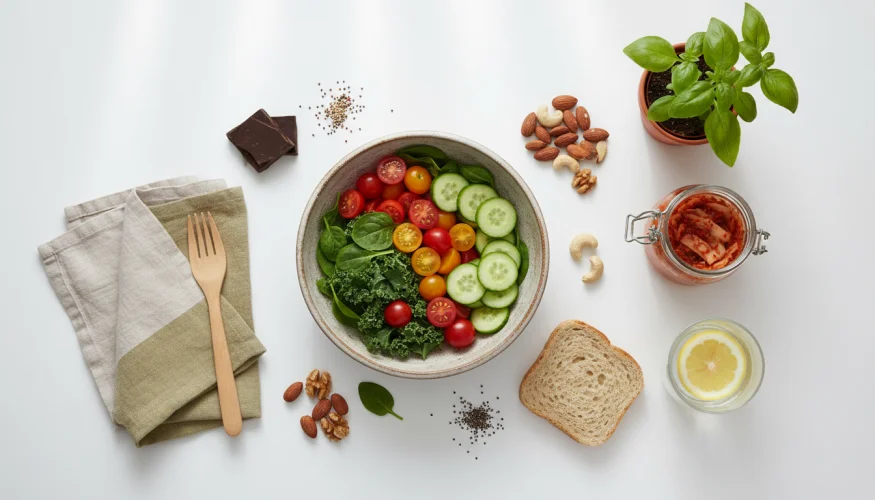
Shifting towards more natural, less industrially processed foods – wholegrains, fresh vegetables, quality proteins, fermented products – is therefore not merely a matter of physical health. It is also an investment in emotional resilience. A healthy gut and a balanced microbiome directly influence the production of serotonin, the hormone of wellbeing, up to 90% of which is produced in the digestive tract. Food genuinely affects how we feel – but not in the way most of us intuitively assume.
Alongside diet itself, it is important to build other sources of comfort and reward. Movement, contact with nature, creative activity, a deep conversation with someone close – these are all ways of meeting emotional needs without the dinner plate having to intervene. This does not mean food cannot be a joy. It can and should be. But it should not be the only joy, the only comfort, the only form of self-love we allow ourselves.
Environmental psychologists also point out that the environment in which we eat significantly influences how much and how we eat. Eating in front of a screen, in a hurry, standing at the kitchen counter – all of this suppresses the body's natural satiety signals and reinforces unconscious eating. By contrast, a laid table, quiet or pleasant music, the company of people we care about – these are conditions that restore eating to its original meaning: sharing, nourishment, pleasure.
Perhaps it is high time to stop perceiving food as a problem to be solved and to begin seeing it as a mirror – as a faithful reflection of what we are experiencing, what we fear, and what we long for. When we look into this mirror without judgement, with gentle curiosity, it can show us far more than just what is on our plate. It can show us what we truly need.