

What we cook just for ourselves reveals our true taste
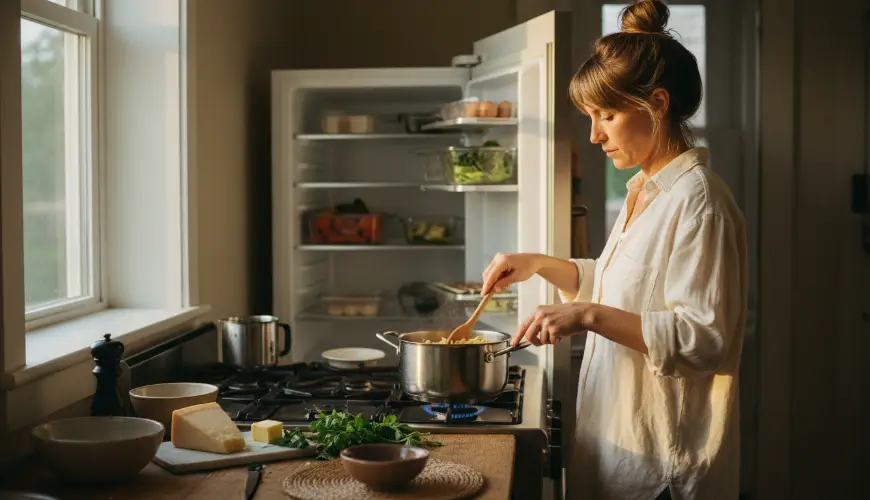
There is one culinary secret shared by almost everyone – whether it's a Michelin-starred chef or a busy mum returning from work. The food we prepare when we're alone looks completely different from what we serve to guests or share on social media. It is precisely in these private moments at the stove that we reveal what we truly eat, what we enjoy, and what our relationship with food really is.
Perhaps it's leftover rice drizzled with soy sauce, eaten straight from the pot. Perhaps a mashed avocado toast with an overfried egg and a pinch of garlic salt. Or just a slice of bread with butter, eaten standing over the sink because there's simply no time or inclination to think of anything more elaborate. These dishes are not visually impressive, but they are honest – and it is precisely that honesty that makes them most valuable.
Try our natural products




The truth about everyday cooking
The phenomenon of "food for oneself" is fascinating from both a sociological and psychological perspective. Research consistently shows that people eat significantly differently when alone than when eating in company. According to a study published in the journal Appetite, people in company consume up to 48% more food than when eating alone – and at the same time, they take care to ensure their choices appear "acceptable" in the eyes of others. But when social pressure disappears, so does the pretence.
And what remains? What remains is pure, unadorned taste. What remains is what we truly enjoy, what satisfies us, what pleases us regardless of how it looks on the plate or whether it would hold up on Instagram. What remains are dishes that are part of our identity – childhood recipes, fridge improvisations, combinations that others might shrug at, but which bring us genuine satisfaction.
Take Martina, a thirty-year-old graphic designer from Brno, as an example. She works from home, cooks for herself, and admits that her favourite "secret" dish is pasta with butter, Parmesan, and plenty of black pepper. Nothing more. "When someone sees me eating it, they say it's not food for an adult," she laughs. "But it's exactly what I need after a long day. It's quick, warm, and I've loved it since childhood." Martina's story is not exceptional – on the contrary, it is universal.
Italians even have their own expression for this category of dishes: cucina povera, meaning "poor kitchen". Originally, it described the way simple rural people cooked, who had to conjure tasty meals from few ingredients. Today, this approach is considered one of the most authentic expressions of Italian gastronomic culture. The best food does not have to be complex – it has to be honest.
Fridge improvisation as a form of freedom
One of the most interesting aspects of private cooking is the ability to improvise. When cooking for oneself with nothing to lose, one allows experiments that would never be risked when cooking for guests. It is precisely this freedom that serves as fertile ground for culinary discovery.
Combinations that initially sound absurd can be surprisingly excellent. Hummus with sliced cucumber and a dash of hot sauce as a quick snack. Porridge with a spoonful of peanut butter and banana. Fried eggs with kimchi and a drop of sesame oil. Leftover roasted vegetables added to instant soup to give it depth and nutrition. These dishes arise from necessity, curiosity, or simply from whatever happens to be at home – and that is precisely why they are so authentic.
Culinary writer Michael Pollan wrote in his book Cooked: "Cooking is one of the most fundamental things people do – and yet as a society we have drifted away from it in a way that has no historical precedent." This thought is all the more powerful in the context of private cooking. While public food culture increasingly tends towards performance and aesthetics, food prepared for oneself remains the last refuge of genuine, unpretentious cooking.
And this is precisely where sustainability enters the picture – a topic closely linked to how we cook when no one is watching. If we allow ourselves to be honest with ourselves, we will admit that a large part of food waste arises precisely when we are trying to impress others. We buy ingredients for ambitious recipes that we never finish. We cook large quantities that we don't eat. Conversely, improvised cooking from leftovers is naturally more ecological and economical.
How to cook better for yourself – while thinking of the planet
It is no secret that the food industry is one of the greatest burdens on the environment. According to data from the Food and Agriculture Organization of the United Nations (FAO), approximately one third of all food produced for human consumption is wasted globally. A large part of this waste originates in households. Changing this situation does not require a radical life transformation – it is enough to begin approaching what we cook when alone in a different way.
One of the most effective approaches is the so-called "fridge-to-table" method of cooking, meaning cooking from whatever is currently in the fridge, without a predetermined recipe. This approach naturally reduces waste, encourages creativity, and compels one to think about ingredients with greater attention. Instead of vegetables ending up in the bin, they become the basis of a soup, a side dish to eggs, or a filling for a tortilla.
A further step can be conscious ingredient selection – that is, prioritising local, seasonal, and ecologically grown products even when cooking just for oneself. It is easy to tell oneself that "it's not worth it for one person" and reach for the cheapest option. But it is precisely the everyday decisions we make in private that shape our habits and values. If we get into the habit of buying quality organic vegetables or pulses from sustainable farming even for our everyday lunch, this approach will become a natural part of our identity – not a performance for others.
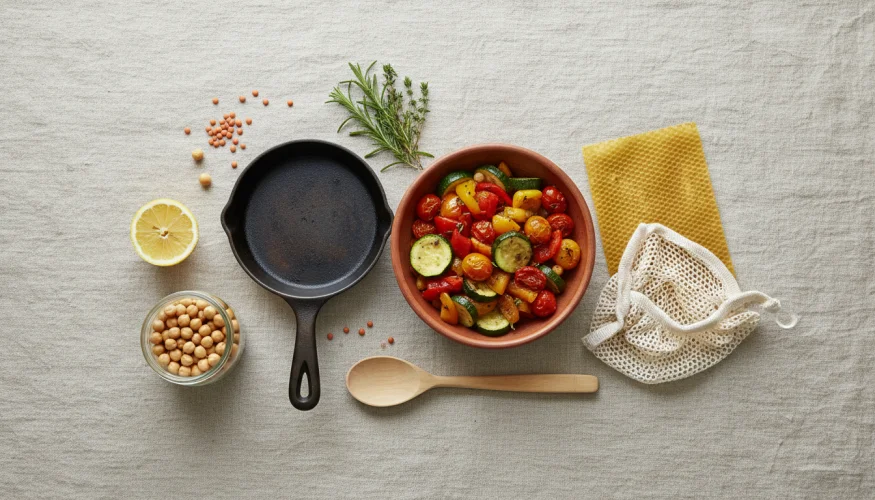
An excellent aid in this regard is eco-friendly kitchen equipment and cookware, which simplifies cooking while also reducing the ecological footprint of the household. For example, a quality cast iron pan lasts for decades, requires no chemical surface treatments, and distributes heat evenly – which is ideal for quick dinners for one. Similarly, beeswax as an alternative to plastic wrapping, or compostable food bags, are small steps that make sense precisely when no one is watching.
Private cooking is also an opportunity to try less conventional proteins and alternatives to meat. Pulses such as lentils, chickpeas, or beans are not only nutritious and affordable, but their production places significantly less strain on the planet than livestock farming. A simple lentil soup or chickpea salad with lemon and herbs is a dish you can prepare in twenty minutes, which will keep you full for hours, and is kind to the environment. And because you are preparing it just for yourself, there is no one to convince – simply cook it and taste it.
Interestingly, plant-based food is entering private kitchens faster than one might expect. Surveys show that people who do not publicly identify as vegetarian or vegan very often choose plant-based meals when cooking alone – because they are simple, quick, and naturally economical. This phenomenon is sometimes referred to as "flexitarianism in practice" and is one of the most promising trends in sustainable eating.
Perhaps it is high time to stop viewing private cooking as something inferior or embarrassing. The food we prepare for ourselves is not a compromise – it is an expression of who we truly are. It is a space where our taste preferences, our values, our creativity, and our relationship with the planet all come together. It does not need to be photogenic. It does not need to follow trends. It simply needs to be good – in the broadest sense of the word.
So next time you find yourself standing at the stove alone, with the fridge open and a vague idea of what to cook, remember that this very moment is the most culinarily honest one. There is no audience, no expectations, no pressure. Just you, the ingredients, and the chance to cook exactly what you enjoy – even if that means pasta with butter and Parmesan.