

Learning to tolerate stillness is a skill like any other
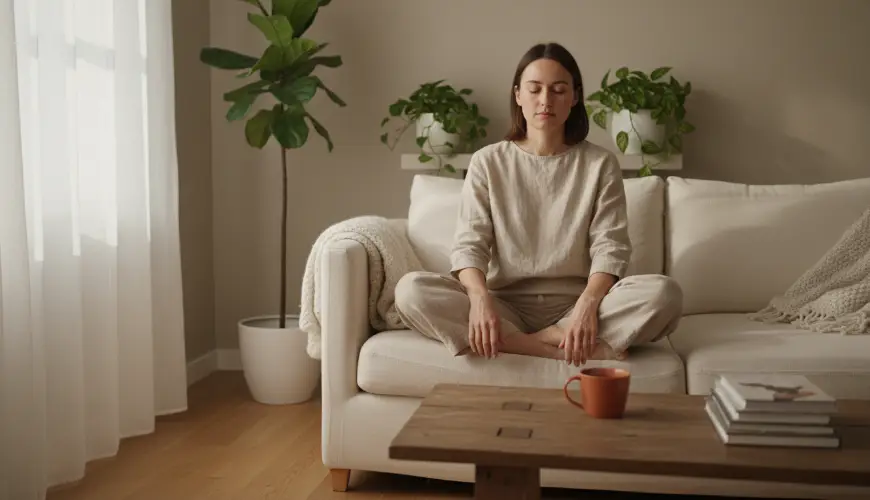
Modern humans are accustomed to being constantly busy. A full diary, the ping of notifications, a to-do list that never runs dry – all of this has become a kind of norm, without which many people cannot imagine an ordinary day. And then comes a moment when everything quiets down. The children have gone to summer camp, work is briefly under control, the house is tidy. Nothing is on fire. And instead of relief comes a strange, uncomfortable feeling – a silence that weighs heavily. A calm that, paradoxically, frightens.
This phenomenon is neither exceptional nor marginal. Millions of people around the world experience exactly this moment: they finally have space to rest, and yet they feel restless, empty, or even anxious. Why does the calm we long for end up unsettling us so much?
Try our natural products



A brain accustomed to chaos loses itself in silence
The human brain is an adaptable machine. If we expose it to a constant stream of stimuli, problems, and obligations for months, years, or even decades, it learns to function in this mode as if it were its natural environment. Stress becomes the baseline, not the exception. Neuroscientists describe this phenomenon as allostatic load – a state in which the body and mind adapt to chronic pressure so thoroughly that its absence begins to feel alien and dangerous.
Let us consider a specific situation: Jana works as a project manager at a mid-sized company. Every day she handles dozens of emails, coordinates a team, and monitors deadlines. In the evening she still cooks, helps the children with homework, and prepares things for the next day. Then the holiday arrives. For the first two days by the sea, Jana cannot relax – she keeps checking her phone, wondering whether she has forgotten something, and feels a vague anxiety without knowing why. Only on the third or fourth day does her body slowly begin to let go. Jana's story is not an exception – it is the rule.
This phenomenon was described by researchers at Harvard University as the relaxation paradox: the more accustomed we are to activating the stress axis, the harder we find it to switch it off. The brain at rest literally searches for a problem where none exists. It generates worries, replays old situations, plans scenarios that may never come to pass. Simply because it needs something to do.
The philosopher and essayist Blaise Pascal captured this as far back as the 17th century: "All of humanity's problems stem from man's inability to sit quietly in a room alone." These words perhaps sound even more relevant today than they did then.
Why we tell ourselves that rest must be earned
Beyond the neurobiological dimension, cultural conditioning also plays an enormous role. Particularly in the Central European context, where industriousness has deep historical roots, there exists an unspoken conviction: rest is a reward, not a right. Those who sit idle do not deserve it. Those who do nothing are wasting time. These beliefs are so deeply ingrained that many people are not even aware of them – they simply live by them.
The consequence is that in moments when nothing truly urgent is pressing, a feeling of guilt sets in. "I really ought to be doing something." "I must have forgotten something." "Others are being productive right now, and here I am just sitting." This inner criticism can destroy even the most beautiful moment of calm. And because it is unpleasant, people deal with it in their own way – they reach for their phone, put on a series, start cleaning even when the house is already tidy. Anything, just to fill that uncomfortable silence.
Psychologists refer to this mechanism as avoidance behaviour – the attempt to escape an unpleasant inner state through external activity. In the short term, it works wonderfully. In the long term, however, it deepens the inability to be alone with oneself and to be at peace with oneself.
What is interesting is that this inability to tolerate calm has a direct impact on physical health. Chronic activation of the stress axis raises cortisol levels, which, over prolonged periods, damages the immune system, impairs sleep, and contributes to the development of cardiovascular disease. The World Health Organization repeatedly emphasises that mental well-being and the capacity for regeneration are key pillars of overall health – and yet they remain undervalued in everyday life.
Silence as a mirror
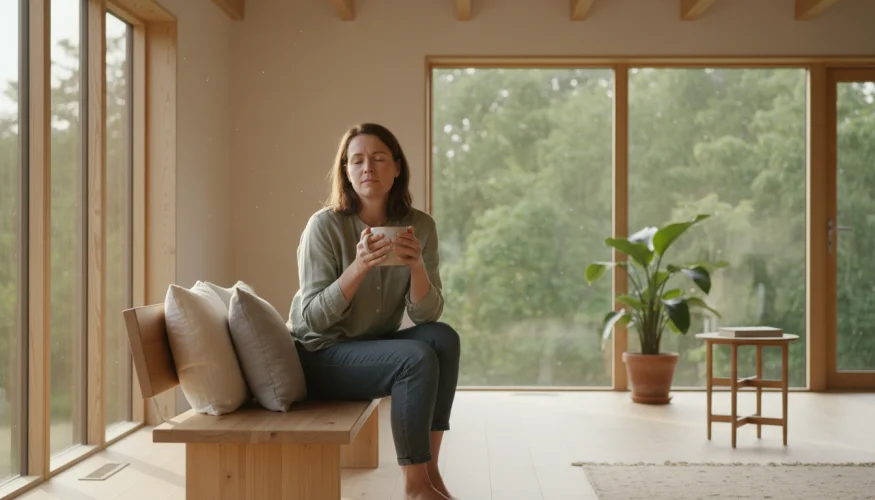
There is yet another reason why calm can frighten us, and it is perhaps the deepest of all. When external noise falls silent, it ceases to function as a screen for internal noise. Questions we have long postponed, thoughts we have driven away with work, feelings we have had no time to feel – all of it surfaces in the silence.
Calm is a mirror. And we do not always like what we see in it. Perhaps in the silence it becomes apparent that the relationship we are living in does not fulfil us. Perhaps an old pain surfaces, one that was never processed. Perhaps the question arises of whether the work to which we devote most of our waking hours truly makes sense. These are uncomfortable things. And busyness is an excellent way of avoiding them – at least temporarily.
Therapists and psychologists know this well. Many clients come to therapy precisely at the moment when their life has outwardly calmed down – the children have left home, a demanding project has ended, retirement has brought new freedom. Suddenly there is nothing to hide behind. And what has been suppressed for years begins to demand attention.
The good news is that this mirror, however uncomfortable, is in fact a gift. The calm that frightens us simultaneously invites us to finally look at the things that deserve attention. To hear ourselves. To ask the questions that matter: What truly fulfils me? What do I want? What kind of life do I actually want to live?
The ability to be in silence – real, unfilled silence – is, moreover, a skill that can be trained. Meditation practice, mindfulness, or simply regular moments without screens and without noise can gradually change the brain's relationship to calm. Research published in JAMA Internal Medicine showed that just eight weeks of regular meditation significantly reduces symptoms of anxiety and improves overall well-being. This is not mysticism – it is training the nervous system.
Conscious contact with nature works in a similar way. A walk in the forest, a moment by the water, gardening – these are all forms of calm that are more natural and more readily acceptable to the brain than absolute silence in an empty flat. Nature offers calm with stimuli – the rustle of wind, birdsong, the scent of soil – and in doing so helps the nervous system shift into a regenerative mode without the brain interpreting it as danger.
A conscious approach to rest also includes caring for the environment in which we live. An overcrowded, chaotic space keeps the brain on alert – visual clutter acts as a constant low-level stressor. By contrast, a simple, uncluttered environment with natural materials and calm colours helps the nervous system truly unwind. It is no coincidence that Scandinavian concepts such as hygge or the Japanese wabi-sabi place emphasis on simplicity, naturalness, and mindful presence – and that these principles resonate with people around the world ever more strongly.
Hand in hand with this goes what we nourish our bodies with and what we surround ourselves with. Products free of unnecessary chemicals, natural materials, conscious choices – these are all small steps that can help create an environment where calm is possible and where we feel safe even without constant movement and noise.
Learning to tolerate calm is neither weakness nor luxury. It is one of the most important skills a modern person can develop. Because the ability to stop, to be present, and not to fill every gap with activity is a prerequisite for genuine regeneration – both physical and mental. And genuine regeneration is what enables us to live fully, rather than merely surviving from one task to the next.
Perhaps it is high time to stop fearing silence and to begin – carefully, gradually – to perceive it as a space that belongs to us. A space where we need not prove ourselves to anyone, solve anything, or rush anywhere. A space where we can finally meet ourselves. And discover that this encounter need not be nearly as frightening as we imagined.