
What It Really Takes to Have a Potted Christmas Tree
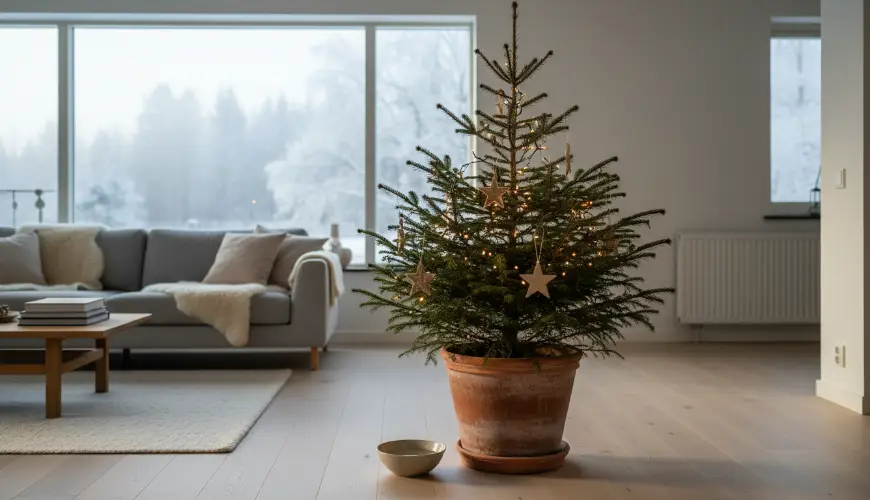
Every year, the arrival of Advent brings the same debate. Should you buy a real tree or opt for an artificial one? And what about the third option – a potted Christmas tree that survives the holidays and continues to grow as a living plant? There are plenty of half-truths, romantic notions and legitimate concerns surrounding this topic. Let’s take an honest look at them, without sugarcoating anything.
Interest in potted trees has grown considerably in recent years, especially among people who think about their environmental impact. The logic seems clear: instead of ending up in a dumpster after Epiphany, a spruce or fir will stand in the garden or on the balcony, contributing to a greener future. But the reality is rather more complicated – which is why it’s worth examining the most widespread myths one by one.
Try our natural products




Myth one: a potted tree is always the greener choice
This assumption is probably the most widespread and, at the same time, the least supported by evidence. Many people think that if they buy a tree with roots and plant it after Christmas, they have automatically done the best possible thing for the environment. The truth, however, is that it depends on the tree’s entire life cycle – from how it is grown and transported to what ultimately happens to it.
Potted trees are usually grown in a peat-based growing medium, and peat is a natural resource that regenerates very slowly. Peat extraction is also environmentally damaging because peatlands are important carbon stores. So, if you care about a genuinely sustainable approach, it’s worth finding out whether a particular grower uses peat or greener alternatives such as coconut coir or compost.
Another factor is transport. Living trees in heavy containers are more difficult to transport than cut trees, and if they come from distant nurseries, their carbon footprint can be surprisingly high. Ideally, then, look for a local grower, preferably one with environmental certification. That approach really does make sense – but it takes a little more research than simply saying, “I’ll buy a tree with roots and have a clear conscience.”
The environmental organization Friends of the Earth has long pointed out that the most sustainable choice is a tree that actually survives and is planted somewhere it has a chance to grow for decades. If that doesn’t happen – and trees kept in apartments quite often don’t survive – the environmental advantage quickly disappears.
Myth two: the tree will survive indoors without any problems
This is perhaps where the romantic notion clashes most sharply with botanical reality. Firs, spruces and pines are outdoor plants adapted to a cold climate, short winter days and outdoor humidity. Moving them into a heated apartment puts them under considerable stress.
Problems arise on several fronts. Central heating dries out the air in apartments to levels that are genuinely unfavorable for conifers. A room temperature that feels comfortable to us – say, 21–22 °C – is an almost tropical challenge for a spruce or fir. Add a lack of natural light, and you have a recipe for a tree that looks cheerfully decorated but is quietly struggling to survive inside.
Horticultural experts therefore recommend that the tree spend no more than 10 to 14 days indoors, ideally in the coolest possible spot – by a window, away from radiators, or perhaps in an unheated hallway or on an enclosed terrace. Before being brought inside, the tree should gradually adjust to a warmer environment, and after Christmas it should likewise be slowly reacclimatized to the cold. Sudden temperature changes are very harmful to conifers.
Take, for example, a family from Brno who bought a potted fir three years ago, intending to plant it in the garden after the holidays. The tree stood in the living room for three weeks, next to a radiator that was on every day. The result? In spring, the tree produced no new growth, gradually dried out and was practically dead by summer. Yet all it would have taken was following a simple rule – less time indoors and proper attention to moisture.
So how should you care for a potted tree during the holidays? The basic rules are fairly simple:
- Water regularly, but don’t overwater – the growing medium should be moist, not wet
- Place the tree as far away from direct heat sources as possible
- Increase the humidity around the tree – a bowl of water or a humidifier will do
- Limit its time indoors to the absolute minimum, ideally no more than two weeks
- Before planting, let the tree gradually readjust to cooler temperatures in a cooler room or in a shaded outdoor area
What happens after Christmas – and why it makes all the difference
The tree’s fate after the holidays is the crucial moment in the whole story. This is when it becomes clear whether buying a living tree in a pot was a truly meaningful decision or merely a well-intentioned gesture with a disappointing outcome.
If you have a garden or access to a suitable area where you can plant the tree, that’s the ideal scenario. Firs and spruces need plenty of space – they grow both tall and wide, and what looks like a cute one-meter tree today could be a majestic tree in twenty years, requiring several square meters of space. It’s therefore important to think about where to plant it in advance, rather than rushing to find a spot after Epiphany.
For people living in apartments without a garden, there are various alternatives – community planting projects, partnerships with local authorities or nonprofit organizations that accept trees and plant them in public spaces. In the Czech Republic, organizations such as Arnika and various local environmental groups work on these issues. Just look around and contact them in advance – interest in having trees taken in usually rises after the holidays.
There is another option that receives less attention: renting a Christmas tree. Abroad, particularly in the United Kingdom and Germany, this model is gradually gaining ground. A grower lends you a tree, collects it after Christmas and takes care of its continued cultivation or planting. In the Czech Republic, this service is still in its infancy, but the first pioneers are already emerging. It’s an elegant solution for those who want a living tree but don’t have the means to care for it afterward.
As landscape architect and environmentalist Karel Hník says: “The best tree isn’t necessarily the most beautiful or the most expensive – it’s the one that someone actually takes care of after the holidays.” And that idea holds true whether it’s a potted fir, a cut spruce or a carefully maintained artificial tree.
Myth three: an artificial tree is always the worse choice
The debate about potted trees inevitably involves a comparison with artificial alternatives. Here, a similarly simplistic view prevails: a plastic tree is bad, a real tree is good. But it’s not that simple either.
Research shows that an artificial tree is advantageous in terms of its carbon footprint if a family uses it for at least 7 to 10 years. Manufacturing an artificial tree is energy-intensive, and most come from China, which means a long journey in transit. On the other hand, if a tree really does last a decade or more, its overall environmental impact is spread out and may be lower than buying a real tree every year.
The key word here is “lasts”. Cheap artificial trees that fall apart after three seasons and end up in the trash do nothing for the environment. So, if you choose an artificial option, it’s worth investing in a quality tree that will last a really long time.
A real cut tree, on the other hand, has the advantage of being fully compostable. Christmas tree farms also act as temporary carbon stores, and their operations tend to have a lower environmental impact than is generally assumed – especially when they are certified farms. Research by the Carbon Trust, for example, found that a properly disposed-of cut tree – through composting or chipping – has a surprisingly favorable carbon footprint.
A potted tree therefore sits somewhere in the middle – potentially the best choice, but also the most demanding in terms of care and responsibility. It’s not a product you can buy and then stop caring about what happens to it. It’s a commitment that begins with choosing a suitable species and grower and doesn’t end when the presents are unwrapped.
So why do so many people still choose this path? The answer may be simpler than it seems. A living tree in a pot offers something that neither an artificial alternative nor a cut spruce can provide – a story that continues. There is something deeply human about the idea that the tree beside which children unwrapped their presents might one day grow in the garden and still be standing there thirty years later. And when that idea is accompanied by practical responsibility and proper care, a potted Christmas tree can be a truly beautiful and meaningful tradition – you just need to go into it with your eyes open and without illusions.