
How Sourdough Benefits Your Health and Gut
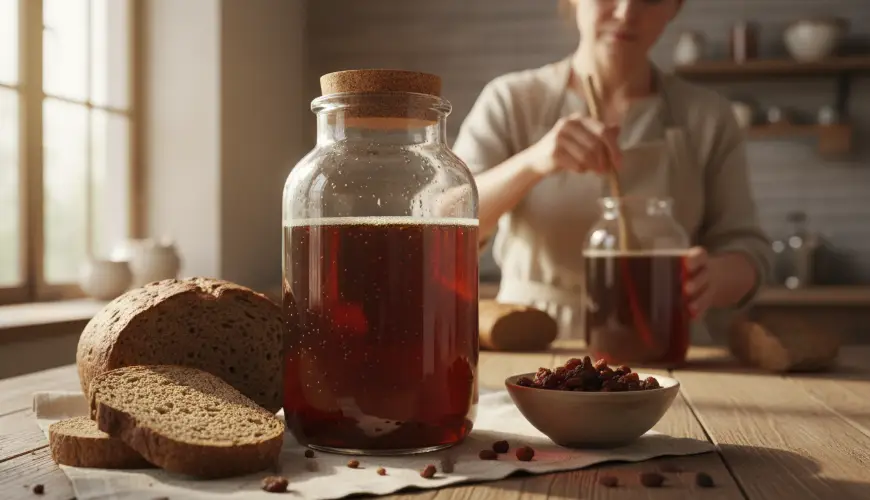
There are drinks that carry the entire history of a nation within them. Bread kvass is exactly that kind of story – a fermented drink made from stale bread that sustained Russian peasants for centuries, refreshed the tsar’s court and is now enjoying an unexpected renaissance across Europe. Yet making it is surprisingly simple: stale bread, water, a little sugar and time. Nothing more, nothing less.
Who would have thought that a slice of hardened rye bread could yield one of the world’s most interesting fermented drinks? And yet it can. Kvass – as it is called in Russian and other Slavic languages – is among the oldest fermented drinks of all, with roots reaching back at least to the 9th century, when it was mentioned in the earliest written sources from Kyivan Rus.
Try our natural products

What exactly is bread kvass and how is it made?
In the simplest terms, it is a drink made by fermenting toasted or dried bread, most often rye bread, in water in the presence of yeast and lactic acid bacteria. The result is a mildly fizzy, tangy and slightly sweet drink with a characteristic bread-like aroma, containing only a minimal amount of alcohol – usually less than one percent. As a result, kvass was historically considered a non-alcoholic drink and was served to children, the sick and working people as an everyday source of energy and hydration.
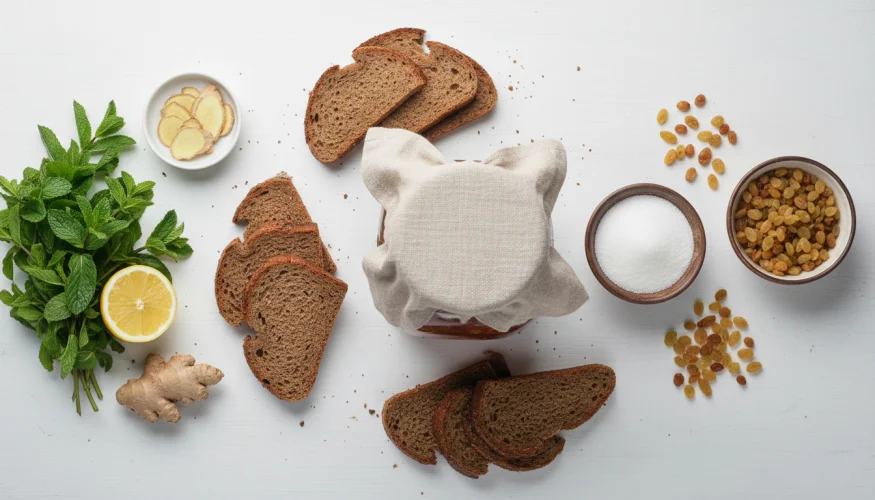
The process begins with the preparation of what is known as a bread infusion. Stale or deliberately dried bread is cut into cubes and toasted in the oven until golden brown – this stage is crucial because toasting creates the compounds responsible for kvass’s characteristic color and flavor – and then hot water is poured over it. Once it has cooled, yeast is added, sometimes along with raisins as a source of natural sugar, and the whole mixture is left to ferment at room temperature for one to three days. The longer fermentation continues, the more sour and complex the drink’s flavor becomes.
Making kvass at home is surprisingly easy. You do not need any special equipment – just a large glass container, a piece of cloth to cover it and patience. Many Russian grandmothers still swear by their own recipes handed down from generation to generation, with each family keeping its own secret proportions of bread and sugar and its preferred fermentation time.
Interestingly, two types of fermentation – alcoholic and lactic acid fermentation – take place in the container at the same time, and it is this combination that gives kvass its unique flavor profile, unlike anything else. It is not beer, it is not soda, and it is not kombucha, although it shares with the latter the principle of fermentation and a growing popularity among healthy-lifestyle enthusiasts.
A thousand-year-old tradition that has survived it all
It would be a mistake to regard kvass merely as a historical curiosity or a passing fad. This drink has accompanied Slavic peoples through the centuries as a faithful companion in good times and bad. In the Middle Ages, kvass was part of the daily diet of virtually every social class – from ordinary farmers to nobles. So much was consumed that the average Russian reportedly drank up to three liters a day, with kvass replacing water, which was often unsafe at the time. The fermentation process naturally eliminates a number of harmful microorganisms, so kvass was effectively safer than water from the local well.
The Russian writer Leo Tolstoy, famous for his fascination with peasant life and simplicity, wrote of kvass: “There is no drink more honest than kvass – it comes from the earth, nourishes the body and cleanses the soul.” Whether accurate or legendary, these words capture the deep cultural connection Russians have with this drink.
It is interesting to see how kvass survived even dramatic political changes. In tsarist Russia, street vendors known as kvass sellers sold it directly from large barrels on the streets of Moscow and St. Petersburg. The Bolshevik Revolution brought an end to these scenes, but it did not eradicate kvass – on the contrary, during the Soviet period it became a symbol of patriotism and a healthy alternative to Western sodas. When Coca-Cola flooded Russia in the 1990s, kvass paradoxically experienced a new wave of popularity as a proud response to globalization. Today, kvass is an industrially produced drink in Russia with sales in the billions, and the largest producers compete with international soft drink brands for customers.
Outside Russia, kvass also has a strong tradition in Ukraine, Belarus, the Baltic states, Poland and other countries in Central and Eastern Europe. The recipe varies slightly from country to country – mint is added in some places, horseradish or fruit in others – but the basic principle remains the same: a fermented bread drink with a refreshing character.
Consider Maria, a Czech blogger focused on fermented foods, who first encountered kvass on a trip to Vilnius. She tasted it from a plastic cup at a street stall and was immediately struck by its earthy, mildly sour flavor. After returning home, she spent weeks trying different recipes until she found her own version with rye bread and a little ginger. Today she regularly makes kvass for her whole family, and her friends vie for it. Stories just like this are behind the growing popularity of home fermentation in the Czech Republic.
Why is kvass attracting attention in an age of healthy living?
The answer is simple and fascinating at the same time: kvass is a naturally fermented drink rich in beneficial microorganisms, enzymes and B vitamins. Fermentation generally increases the bioavailability of nutrients and contributes to the diversity of the gut microbiome, a topic that has attracted growing scientific interest in recent years. Research published, for example, in the scientific journal Cell shows that a diet rich in fermented foods can have a beneficial effect on the composition of the gut microbiome and reduce markers of inflammation in the body.
Kvass also contains natural acids – primarily lactic acid – which support digestion and may help with digestive problems. Some nutrition experts compare it to liquid kefir or kombucha, with the advantage that it is considerably cheaper and its ingredients are readily available. Bread, water and yeast – these are ingredients that practically everyone has at home.
It is important, however, to distinguish between industrially produced kvass, which is often pasteurized and depleted of live cultures, and homemade or craft-produced kvass, where fermentation has occurred naturally and the drink retains all its biologically active substances. As with other fermented foods, the less industrial processing involved, the greater the potential health benefits.
Kvass also fits naturally into a sustainable lifestyle, because making it is an ideal way to use up stale or hardened bread instead of throwing it away. Food waste is a serious global problem – according to the Food and Agriculture Organization of the United Nations (FAO), approximately one third of all food produced for human consumption is lost or wasted. Making kvass from stale bread is a small but meaningful step toward improving that statistic in your own household.
Switching from industrially produced drinks to home fermentation need not be difficult or time-consuming. Even a complete beginner can manage a basic kvass recipe, and the total active preparation takes less than an hour – time and the natural fermentation process take care of the rest. The result is a drink that tastes better than anything from a store, costs a fraction of the price of commercial alternatives and offers the satisfaction of making something yourself.
For those who want to get started with kvass, it is useful to know that there are several basic varieties. The simplest is so-called white kvass made from wheat bread, which is lighter in color and milder in flavor. Classic dark kvass is made from rye or whole-grain bread and has a stronger, earthier character. More advanced makers experiment with additions of herbs, fruit or spices – popular combinations include lemon, ginger, mint or even horseradish, which gives kvass a pleasant spicy kick.
- Rye kvass – the most traditional variety, with a full, earthy flavor and dark brown color
- Wheat kvass – lighter and milder, suitable for beginners
- Fruit kvass – made with fresh or dried fruit for natural sweetness
- Herbal kvass – with added mint, lemon balm or ginger for a refreshing touch
Kvass can be enjoyed on its own as a refreshing drink, but in Russian and Ukrainian cuisine it also serves as the base for the traditional cold soup okroshka – a summer delicacy made with chopped vegetables, boiled eggs, meat and, of course, kvass. This combination may sound unusual, but the result is surprisingly harmonious and refreshing, especially in the summer months.
Bread kvass is therefore much more than just an old recipe from bygone days. It is a living symbol of the enduring value of simplicity and tradition, even at a time when store shelves are bursting with industrially produced drinks full of artificial additives. Perhaps that is why more and more people are returning to it – not out of sentiment, but because they find in kvass something authentic, healthy and sustainable all at once.