

Levantine cuisine is more than just hummus
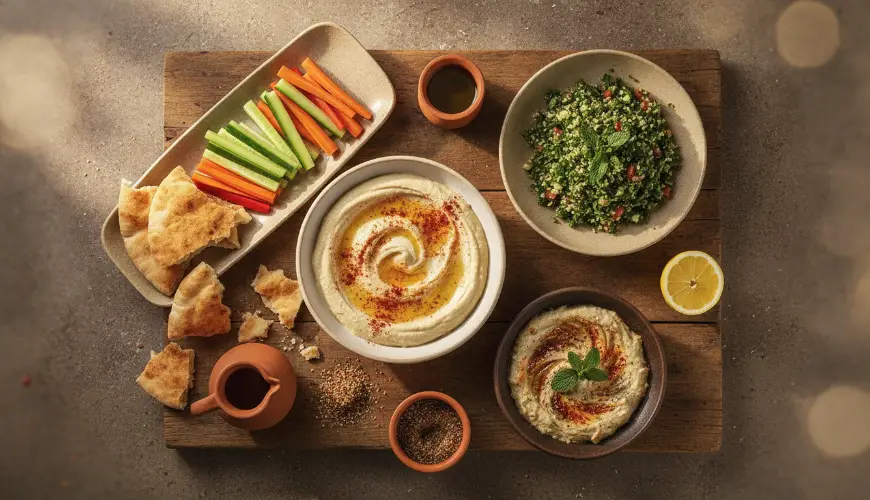
When someone mentions Mediterranean cuisine, most people immediately think of pizza, pasta, and perhaps a Greek salad. This is understandable – Italian and Greek gastronomy dominate the European perception of Mediterranean cooking to such an extent that an entire fascinating world of flavours remains hidden behind them. Levantine cuisine offers something that Italian gastronomy in its classical form cannot: depth of spices, layered textures, and stories reaching thousands of years into the past.
The Levant – a geographical and cultural region encompassing present-day Lebanon, Syria, Jordan, Israel, Palestine, and parts of Turkey – is the cradle of civilisation in the most literal sense. Some of the world's oldest agricultural communities emerged here, bread was cultivated and legumes processed here long before Rome built its first forum. This ancient tradition is still reflected in every plate of hummus, every bowl of fattoush, or every bite of stuffed vine leaves.
Try our natural products

What truly defines Levantine cuisine
The foundation of all Levantine gastronomy is vegetables, legumes, and grains – not as a side dish, but as the main protagonists. Lentils, chickpeas, bulgur, freekeh (roasted green wheat), and various types of beans form the backbone of the diet, around which everything else revolves. Meat – most commonly lamb or chicken – appears more as a complement than a centrepiece, which makes Levantine cuisine a naturally balanced and nutritious way of eating that modern dietitians admire.
The use of spices is equally crucial. While Italian cuisine builds on simplicity and the quality of basic ingredients, the Levantine tradition brings complex spices into play, such as za'atar (a blend of thyme, sumac, and sesame), baharat (a warm mixture of cinnamon, allspice, and pepper), sumac (a tart, deep-red spice from the fruit of the tanner's sumach), or turmeric and cumin in combinations that would seem like an exotic curiosity in Italian cooking. The result is neither overpowering nor overly sweet, but a layered, deep flavour that develops gradually – like a good book that doesn't want to be read too quickly.
The role of olive oil must not be overlooked, linking the Levant with the rest of the Mediterranean. It is used generously and without restraint – drizzled over hummus, mixed into dressings, used to braise vegetables. The olive tree is a sacred tree in this region in both the literal and figurative sense. According to the FAO, Lebanon and Syria are among the historically most significant olive-growing countries in the world, with a tradition of cultivation in this region stretching back more than four thousand years.
Another pillar of Levantine cuisine is acidity – though not the lemon-based acidity of the Italian tradition, but a multi-layered one. Yoghurt, ayran, fermented dairy products, sumac, and tamarind create an acidic component that lends dishes freshness and lightness. It is no coincidence that Levantine food does not feel heavy even after a substantial lunch – this natural acidity supports digestion and the balance of the entire meal.
The typical way of serving Levantine food is meze – a system of small plates and bowls shared at the table. Hummus, baba ghanoush (smoked aubergine caviar), tabbouleh (parsley salad with bulgur and tomatoes), fattoush (salad with toasted pita bread), kibbeh (croquettes of lamb and bulgur), labneh (thick yoghurt cheese drizzled with oil) – all of this arrives at once or in succession, transforming the meal into a social ritual rather than mere refuelling. Lebanese people say that one does not eat at the table out of hunger, but out of joy in company.
Hummus, tabbouleh, and other stars the world is only just discovering
Hummus has become a global phenomenon in recent years – you can find it in supermarkets from Prague to Tokyo. But industrially produced hummus is about as close to the original as frozen pizza is to its Neapolitan counterpart. Real Levantine hummus is made from quality chickpeas cooked until soft, tahini (sesame paste), fresh lemon, garlic, and olive oil – and the entire process requires patience and the right ratio of ingredients. There are Lebanese and Israeli restaurants where hummus constitutes the entire menu, served with nothing but fresh pita bread, vegetables, and perhaps a few falafels. You need nothing more.
Tabbouleh is another example of a dish the world knows but few people prepare correctly. The original Levantine version contains a large amount of fresh parsley and only a small amount of bulgur – not the other way around, as it is sometimes prepared in the West, where bulgur dominates and parsley serves merely as a garnish. Parsley is not only a flavour component, but also a nutritional powerhouse rich in vitamins C and K, chlorophyll, and antioxidants. The USDA nutritional database states that 100 grams of fresh parsley contains more vitamin C than an orange.
Then there is fattoush – a salad that is essentially the answer to the question of what to do with stale pita bread. Toasted pieces of bread are mixed with tomatoes, cucumber, radishes, mint, and a dressing of sumac and olive oil. The result is crunchy, fresh, and surprisingly filling – and yet it is a dish born out of the necessity not to waste. This "waste nothing" philosophy is, in fact, characteristic of Levantine cuisine and strikingly resonates with today's trends in sustainable eating.
A real-life example can be found in the experience of Tereza, a thirty-five-year-old woman from Prague who visited Beirut two years ago. "I was expecting kebab and pita. Instead, I received twelve different bowls and spent three hours at the table. It was the best meal of my life, and I didn't even know what half the things on the table were," she says. After returning home, she began cooking in the Levantine style – gradually stopped buying industrially produced hummus, started fermenting labneh at home, and began experimenting with za'atar. "It's a different philosophy of cooking. Less rushing, more layers."
Levantine bread is also fascinating – pita in various forms, markúk (thin as paper, baked on a domed pan), ka'ak (sesame bread rings), or manakish (flatbread with za'atar and oil). Bread is sacred in the Levant – it must not be thrown away, it must be shared, and its preparation is a family ritual passed down from generation to generation. The celebrated Lebanese writer and food journalist Anissa Helou, author of Feast: Food of the Islamic World, writes: "Food in the Arab world is the language of love – a way of saying you care without having to say a single word."
Why Levantine cuisine transcends a passing trend
It would be easy to dismiss the interest in Levantine cooking as yet another gastronomic trend – like fusion cuisine or raw food in their time. But Levantine gastronomy has one significant advantage over such fashions: it is rooted in millennia of practice and naturally fulfils everything that modern nutrition recommends. A plant-based foundation, fermented foods, healthy fats, minimal processing, seasonality, and locality – these are all principles that Levantine cuisine has practised from time immemorial, without needing to label them with fashionable English terms.
Scientific studies repeatedly confirm that the Mediterranean way of eating – of which the Levantine branch is one of the oldest and most authentic – is associated with a lower risk of heart disease, type 2 diabetes, and certain types of cancer. The Lancet, one of the world's most prestigious medical journals, published an extensive study in 2019 that identified a diet rich in legumes, whole grains, vegetables, and olive oil as one of the healthiest ways of eating on the planet – and this is precisely what an everyday Levantine plate looks like.
The ecological footprint of Levantine cuisine also merits attention. Food built around legumes, vegetables, and grains naturally has a lower carbon footprint than meat-oriented cuisines. Chickpeas, lentils, and bulgur are moreover ingredients that store well, require no refrigeration, and can be purchased in bulk – making them ideal candidates for zero-waste shopping and environmentally conscious cooking. Anyone looking for a way to cook more deliciously while caring for the planet will struggle to find better inspiration than the Levantine diet.
Ingredients such as tahini, za'atar, sumac, or freekeh are now available in the Czech Republic as well – in organic shops, specialist food stores, or online. They are worth trying not as an exotic curiosity, but as a natural extension of home cooking. A few spoonfuls of za'atar mixed with olive oil and spread on fresh bread – that is a breakfast that has survived thousands of years and needs no improvement.
Levantine cuisine is not just food. It is a way of thinking about what we eat, with whom we eat, and why. It is a reminder that the Mediterranean is larger, older, and richer than any cliché – and that the finest gastronomic discoveries do not always await in the Italian restaurant around the corner, but sometimes in a bowl of hummus drizzled with golden oil, sprinkled with paprika, and served with warm pita bread amid the friendly noise of a shared table.