
What grandfathers in active parenting lacked throughout their lives
There is a phenomenon that Czech families speak about only in whispers – or not at all. A generation of men who grew up in a time when fatherhood meant bringing home a paycheck and taking the kids to football on Sundays now stand before their grandchildren and ask themselves: Am I actually doing any of this right? Grandfathers in active parenting are not just a fashionable trend – they are men who are getting a second chance, and many of them are seizing it with surprising courage, with both hands.
Sociologists and psychologists are watching this phenomenon with growing interest. The generation of men born roughly between 1945 and 1965 – those who are today's grandparents – grew up in an environment where a father's emotional presence was not considered a necessity, but a luxury. Raising children was a woman's affair; men provided material security and spent their weekends in the garden or the garage. This generation is sometimes referred to as the "lost generation of men" – not because they failed, but because they were never given the tools to be any different.
Try our natural products





Why we speak of the lost generation of men
The term lost generation of men is not new. Psychologists and social scientists use it to describe men who were raised in a culture of emotional closure, where an unwritten rule prevailed: men don't cry, men don't talk about their feelings, men don't go to the doctor, and they certainly don't change nappies. The result was a paradox – men who loved their children but could only express that love through work and material provision. As American psychologist and therapist Terry Real noted in his book I Don't Want to Talk About It: "Depression in men doesn't look like sadness. It looks like anger, withdrawal, and workaholism."
This emotional detachment had a direct impact on entire families. Children who grew up with such fathers came to realise in adulthood what they had been missing – a present, engaged, emotionally available parent. Today those children are parents themselves and approach child-rearing consciously differently. And it is precisely this change that creates an interesting tension as well as an opportunity: their own fathers – today's grandfathers – watch their children doing things they themselves never knew how to do, and quietly learn.
Nor is this solely a Czech matter. Research from across Europe shows that grandparent involvement in grandchildren's care is growing significantly. According to Eurostat data, the proportion of grandparents who regularly look after their grandchildren has increased by tens of percentage points in most EU countries over the past two decades. The Czech Republic is no exception – and yet a gap remains between the degree to which grandmothers and grandfathers participate in that care.
Grandmothers traditionally take on caregiving naturally, without much deliberation. Grandfathers – especially those from the generation we are discussing – come to it more slowly, sometimes uncertainly, but all the more intensely for it. A man who never sat on the floor with his own children building blocks suddenly finds himself doing exactly that with his grandchild. And finds that it gives him something he had been missing his whole life.
The story of Karel, a sixty-seven-year-old mechanical engineer from Brno, is typical in this regard. He spent minimal time with his three children – he worked shifts, fixed the car at weekends, and the family spent most holidays without him. Today, when his daughter brings four-year-old Anička to him every Friday, he says it is the most important part of his week. "I didn't know how to do it with my own children. I didn't know how. But now... now it's different. I don't know why, but it is," he confided in an interview for a Czech family magazine. He is not alone. Similar stories repeat themselves in thousands of families across the country.
A second chance: What active grandfathers bring to families
Psychologists point to something important: the grandparent–grandchild relationship is inherently different from the parent–child relationship, and it is precisely this difference that can be healing – for both sides. A parent raises children under pressure – professional, financial, and time pressure. A grandparent, ideally, does not face that pressure. They can be present in a way that was not available to them in parenthood.
Research consistently confirms that grandfathers' involvement in caring for grandchildren has a measurable positive impact on children's development. A study published in the peer-reviewed journal Journal of Family Psychology showed that grandchildren who have a close relationship with their grandfather display higher levels of emotional resilience, better conflict-resolution skills, and a stronger sense of identity. A grandfather as a male role model – different from a father, without the daily pressures of upbringing – fulfils an irreplaceable role in the family ecosystem.
At the same time, active involvement in grandchildren's care brings demonstrable benefits to the grandfathers themselves. Research by Charles University focused on the quality of life of older adults found that men who regularly care for their grandchildren show lower levels of depressive symptoms, better cognitive function, and higher overall life satisfaction. Active parenting in the role of grandparent is therefore not merely a sentimental matter – it is a question of health and meaning.
A natural question arises here: how does one fulfil this role well when a role model and experience are lacking? Grandfathers from the lost generation of men deal with this problem in different ways. Some turn to their adult children and allow themselves to be guided – which in itself requires a humility that would not have come naturally to them in their younger years. Others read, observe, and watch. Many simply do what they feel – and discover that the instinct to care was present in them all along, but had no space to express itself.
The physical environment and activities through which the relationship is built also play an important role. Today's active grandfathers cook with their grandchildren, go out into nature, repair things, read fairy tales, and ride bicycles together. They share the everyday rhythm of life in a way their own fathers never shared with their children. And it is precisely this everydayness – not grand gestures, but small, present moments – that forms the foundation of a genuine relationship.
The ecological and healthy lifestyle that is today part of the value system of many young families naturally enters this intergenerational encounter as well. A grandfather who grows tomatoes on the balcony with his grandchild, makes wooden toys, or teaches that things should be repaired rather than thrown away, passes on values that have deep roots – while at the same time resonating with what today's young families are looking for. Sustainability, care for the natural world, looking after things – these are all themes through which generations can meet across the chasm of the very different worlds in which they grew up.
But it is not only about activities. It is about the transmission of experience and stories. Children who know their grandparents' stories – their hardships, their mistakes, their joys – have a markedly stronger sense of family identity and personal groundedness. The Search Institute, which has long been engaged in research on the development of children and adolescents, has identified intergenerational relationships as one of the key "developmental assets" that protect children from risk behaviour and strengthen their resilience.
The lost generation of men is therefore not definitively lost. It is a generation that arrives late – but arrives nonetheless. And perhaps precisely because it arrives late, it arrives with an awareness it did not previously possess. An awareness of what it missed, and a desire to make at least partial amends – not out of self-torment, but out of love that was waiting for its time.
This shift has consequences far beyond individual families. A society that is able to integrate older men into active intergenerational life is healthier in every respect. Grandfathers who are present, engaged, and emotionally available help to break a pattern of emotional closure that would otherwise be passed from generation to generation. They show their sons and grandsons that being a man and being sensitive, present, and caring – these are not opposites. They are two sides of the same coin.
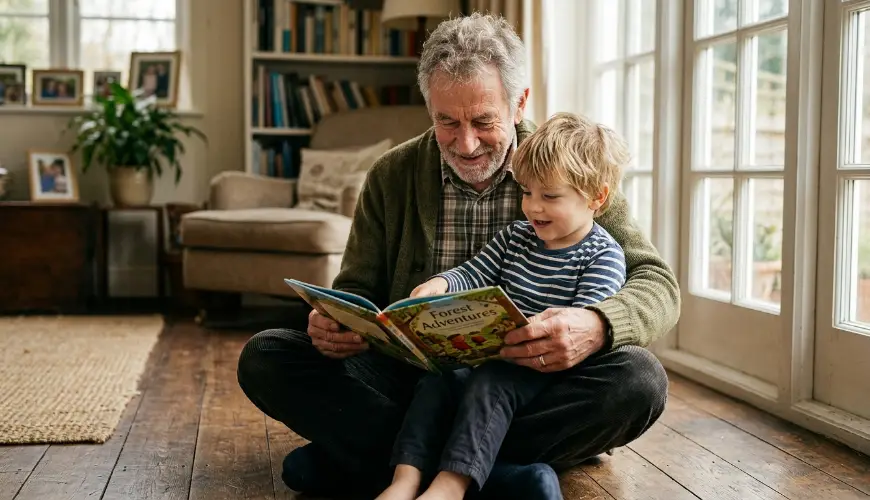
The change unfolding in today's Czech families is quiet and unassuming. It does not take place at conferences or in the media. It takes place in living rooms, gardens, and parks, where a sixty-seven-year-old man with a four-year-old child on his knee reads a book about dinosaurs and both of them are – at last, unexpectedly, simply – home.