
Natural dyeing of textiles at home is easier than you think
If someone had asked two centuries ago where the colour of fabric came from, the answer would almost always have been the same – from nature. From roots, peels, leaves, berries or minerals. Synthetic dyes came only with the Industrial Revolution and gradually displaced thousands of years of know-how that people had passed down from generation to generation. Today, this knowledge is slowly returning – not only to craftspeople's workshops, but also to ordinary households. Natural textile dyeing at home is experiencing a genuine renaissance – and it's no wonder.
Interest in sustainable fashion and eco-friendly living grows every year. According to a report by the Ellen MacArthur Foundation, the fashion industry is one of the world's biggest polluters, with chemical textile processing – including synthetic dyeing – representing one of the most significant sources of water pollution. Natural alternatives are therefore not only aesthetically interesting, but also have a real ecological impact.
Try our natural products



What does natural dyeing actually involve?
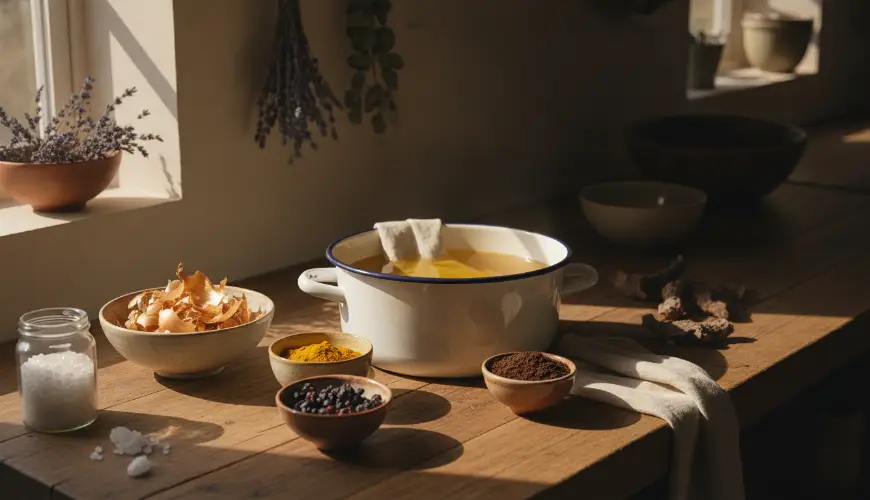
The essence of natural dyeing lies in using pigments found in plants, food waste or certain minerals. Onion skins, turmeric, red cabbage, blueberries, nettles, celandine, as well as coffee grounds or black tea – all of these are materials that can easily be found in a Czech household or at a market, and yet they are capable of dyeing fabric in surprisingly rich shades.
However, it is important to understand one thing that distinguishes natural dyeing from simply soaking fabric in coloured water. Without a so-called mordant – a substance that helps bind the colour to the fibres of the fabric – most natural pigments would simply disappear after the first wash. The mordant forms a chemical bridge between the dye and the fibre. The most commonly used mordant is alum (potassium aluminium sulphate), which is readily available at pharmacies or drugstores and is considered relatively environmentally friendly. Alternatively, one can work with vinegar, baking soda or even tannins from oak bark, but results vary depending on the type of textile and the dye used.
As British textile artist and natural dyeing pioneer John Marshall once noted: "Natural colours are not perfect – and it is precisely in that imperfection that their beauty lies." Every piece of fabric is slightly different, every result is an original.
Preparation and the dyeing process itself
Before you begin the actual dyeing, it pays to properly prepare both the material and your workspace. The ideal textile for beginners consists of natural fibres – wool, cotton, linen or silk. Synthetic materials barely accept natural pigments, as their fibres lack the necessary chemical properties. Cotton and linen are cellulose fibres that require longer preparation and a stronger mordant. Wool and silk, as protein fibres, accept colours more readily and the resulting shades tend to be richer.
The entire process can be divided into several phases that naturally follow one another. First, the textile needs to be pre-washed to remove any dirt and finishing agents that would prevent the dye from penetrating. Then comes mordanting – the textile is simmered in a mordant solution for approximately one hour, then left to cool and rinsed. Meanwhile, the dye bath is prepared: the plant material is left to soak in water ideally overnight, then boiled the next day and filtered. The dampened textile is then placed into this prepared solution and slowly heated to a temperature of approximately 70–90 degrees Celsius, where it remains for at least one hour. After cooling, the fabric is rinsed, wrung out and dried in the shade.
Let us consider a specific example: Markéta, a graphic designer from Brno, decided to dye an old linen bag using onion skins. She collected the skins for several weeks in a paper bag, then covered them with water and left them to soak overnight. In the morning, she boiled the solution for about an hour, filtered it through cloth and submerged the pre-mordanted bag in the golden-yellow liquid. The result surprised her – a warm golden-brown shade she would have searched for in vain in any shop. And the entire process cost her nothing more than a few hours of a free weekend.
Similar experiences are shared by a growing number of people in online communities dedicated to sustainable fashion and zero-waste lifestyles. Natural dyeing is becoming part of a broader slow fashion movement, where the emphasis lies not on rapid consumption but on one's relationship with the objects that surround us.
Tips on what to watch out for
Natural dyeing is a rewarding activity, but it has its own specifics that can catch beginners off guard. One of the most common disappointments is colour fading after exposure to sunlight or washing. This does not mean the process was done incorrectly – natural dyes are simply not as stable as synthetic ones, and this must be accepted as part of their character. Some pigments are naturally more stable than others: turmeric produces a beautifully intense colour but fades quickly in light, whereas dyes from onion skins or tannins are significantly more resistant.
Another factor that greatly influences the result is the pH of the water and the mordant used. Red cabbage, for example, changes colour depending on the acidity of the environment – in an acidic environment it produces pink to purple tones, while in an alkaline environment it shifts towards green or blue-green. This effect can be consciously used as a creative tool: by adding vinegar or baking soda, completely different shades can be obtained from a single dye.
Temperature is equally important. Overheating wool can cause it to felt or become damaged, so it is essential to heat it slowly and evenly rather than rapidly. Cotton tolerates higher temperatures better, but requires a longer mordanting time. Each material has its own rules and respecting them is the foundation of a good result.
For those who wish to delve deeper and systematically expand their knowledge, an excellent resource is, for example, Rebecca Desnos's book "Botanical Colour at Your Fingertips", which covers natural dyeing in an accessible way and contains dozens of recipes using various plants. In the Czech context, a growing community around natural textiles is forming through various ecological workshops and courses, where techniques can be practised under the guidance of experienced instructors.
Natural textile dyeing at home is therefore not merely a passing trend or a nostalgic return to the past. It is a conscious choice that connects creativity, ecological thinking and respect for materials. Every piece of fabric dyed by one's own hands carries a story – the story of the plant from which the colour came, and of the person who worked with it. And it is precisely this that makes it something no synthetic dye can ever offer.
Those who try natural dyeing once usually don't stop at a single attempt. Gathering plant material during walks, experimenting with different combinations of mordants and dyes, watching how colour develops throughout the process – all of this brings a particular kind of satisfaction that is rare in today's world of instant consumption. And the result? Fabric with character, truly one of a kind, whose creation placed no unnecessary chemical burden on the natural world.
For those seeking quality natural textiles suitable for further processing or eco-friendly products for a sustainable household, a good starting point might be, for example, the Ferwer offering, where ecological thinking is woven into everyday practice. Natural dyeing is, after all, just one of many steps on the path towards a more conscious way of life – and every such step counts.