

# Emotional Regulation in a Two-Year-Old Can Be Learned
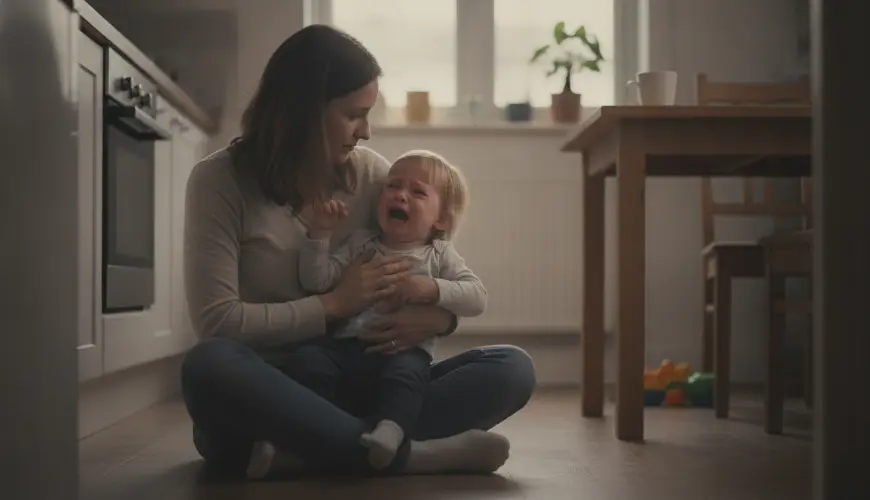
Every parent who has been through their child's second year of life knows that the words "terrible twos" are not just an empty phrase. Tantrums on the supermarket floor, tears over toast that's been cut the wrong way, or fury because a child can't put their own shoes on – all of this is part of the everyday reality of millions of families. And although these situations can push adults to the edge of their patience, something profound lies behind every such outburst: a brain that is still learning to work with emotions.
Emotional regulation in a two-year-old is not a luxury or an unnecessary pedagogical concept. It is a fundamental developmental skill that influences how a child will handle stress, build relationships, and respond to challenges throughout their entire life. And that is precisely why it is worth dedicating attention to – not just theoretically, but above all practically and realistically.
Try our natural products





Why are two-year-olds so emotionally overwhelmed?
Before we can talk about methods, it is important to first understand what is actually happening inside a two-year-old's mind. The prefrontal cortex – the part of the brain responsible for logical reasoning, self-control, and the ability to delay gratification – is still in its infancy at this age. According to neuroscientific research, this region of the brain continues developing until a person's early twenties – and in two-year-olds, its functionality is absolutely minimal.
This means that a two-year-old child cannot control themselves in the way an adult can. They cannot calm themselves down through sheer willpower, cannot logically assess a situation and decide to act differently. They react purely emotionally, because their brain does not yet have the tools to react any other way. This insight is crucial, because it changes the entire perspective: a tantrum is not defiance or manipulation – it is a neurological reality.
At the same time, two-year-olds find themselves in a paradoxical situation. On one hand, they are beginning to strongly feel their own will and desire for independence – they want to choose for themselves, make decisions, do things their own way. On the other hand, their language skills are not yet sufficient to express these needs in words. The result is frustration that has no outlet other than an emotional outburst. As developmental psychologist Janet Lansbury said: "Children don't need us to rescue them from their emotions. They need us to keep them company in those emotions."
Realistic methods of emotional regulation that parents can actually use
Theory is a fine thing, but parents at four o'clock in the afternoon, with their child lying on the kitchen floor screaming, don't need a lecture in developmental psychology. They need specific, workable tools. The following methods are grounded in scientifically supported approaches, but are also adapted to real life – with its fatigue, time pressure, and parents' own emotions.
Naming emotions – "emotion coaching"
One of the most effective tools available to a parent is the simple act of naming what a child is experiencing. Research by psychologist John Gottman, who called this approach "emotion coaching," shows that children whose parents regularly name emotions have better self-regulation skills in later life, fewer behavioural problems, and better social skills. The details of this approach are summarised, for example, by the John Gottman Institute.
In practice, it looks simple: instead of "stop crying" or "nothing happened," the parent says "I can see you're really angry right now because you wanted to take that toy yourself." This gives the child two things at once – the feeling of being seen and understood, and at the same time a vocabulary for their own inner world. A child who can say "I'm angry" doesn't need to express that anger by kicking the furniture.
It is important to note that naming emotions does not mean approving of the behaviour. A parent can simultaneously acknowledge the emotion and set a boundary: "I understand you're angry. But hitting is not okay." These two things are not in conflict – on the contrary, their combination forms the foundation of healthy emotional upbringing.
Regulation through the body and movement
Two-year-old children live in their bodies far more intensely than adults do. Emotions manifest physically in them – through tense muscles, quickened breathing, restlessness in their legs. And that is precisely why physical activities can serve as a natural outlet or calming tool.
If a child is escalating towards a tantrum, it can sometimes help to offer them movement: jumping on the spot, squeezing a pillow, a quick walk outside, or simply a hug that helps them "ground themselves." Deep pressure – such as a firm hug or pressing palms against a table – activates the proprioceptive system, which has a calming effect on the nervous system. This method is also used by occupational therapists working with children who have sensory sensitivities.
Introducing regular physical rituals into the daily routine can also help – a morning dance, afternoon running in the garden, or an evening massage before bed. These activities not only serve as prevention against nervous system overload, but also strengthen the relationship between parent and child, which is itself the most powerful regulatory tool a young child has.
Predictability and rituals as the foundation of security
Perhaps surprisingly, one of the most effective methods of emotional regulation in two-year-olds is not a technique for use "in the moment of crisis," but rather a preventive measure: a predictable daily rhythm. A child who knows what is coming next feels safe. And a child who feels safe has a much greater capacity to handle frustration and disappointment.
This does not mean a rigid schedule planned down to the minute. It is more about consistent sequences of events – breakfast, then play, then a walk, then lunch, then rest. Transitions between activities, which tend to be particularly challenging for two-year-olds, can be made easier with advance notice: "We'll be going home soon, you have five more minutes to play." This simple sentence gives the child time to prepare and significantly reduces the likelihood of an outburst at the actual moment of leaving.
Rituals around mealtimes, sleep, and saying goodbye serve a similar function. This is not a sentimental habit – it is a neurologically grounded strategy that helps the child's brain orient itself in the world and feel safe within it.
The parent's own regulation as a mirror
This is where the hardest part comes in. Because the truth is that the most effective tool for a child's emotional regulation is a regulated parent. Children learn to manage emotions primarily through imitation and through what is known as co-regulation – that is, by sharing emotional space with an adult who is calm and steady.
But how do you stay calm and steady when a child has been screaming for the third time in an hour, and you haven't slept, haven't had lunch, and have an important work call in an hour? It is important to be honest here: perfect parental regulation is not a realistic goal. Parents are human beings who also have nervous systems, who also become overwhelmed, and who also sometimes lose it.
Research in developmental psychology – such as the work of Ed Tronick and his "Still Face Experiment" – shows that what is key to a child's healthy development is not that the parent is always perfectly calm. What is key is that after moments of tension or relational disruption, there is a return to reconnection and repair. A child who experiences that a relationship can be repaired learns that emotions are manageable and that the world is a safe place.
In practical terms, this means: if a parent loses patience and reacts with irritation, it is not the end of the world. What matters is returning to the child, naming what happened, and restoring connection: "I'm sorry I raised my voice at you. I was tired. I love you."
When to seek professional help?
Tantrums are an entirely normal part of development in two-year-olds. However, there are situations in which it may be useful to consult a child's behaviour with a professional – a paediatrician, child psychologist, or developmental specialist. These include tantrums that last longer than 25 minutes, are very frequent and intense, involve self-harm, or significantly disrupt the family's everyday functioning.
It is equally advisable to seek support if a parent recognises that their own reactions to a child's emotions have become persistently unmanageable or are causing them significant anxiety. Taking care of one's own mental health is not selfishness – it is a prerequisite for the parent being able to serve as a safe base for their child.
Let us take a typical real-life example: four-year-old Tereza had begun having tantrums as a two-year-old, particularly during transitions between activities. Her parents began consistently using "five-minute warnings" and introduced a fixed evening routine. After a few weeks, the frequency of the tantrums decreased significantly – not because Tereza had stopped having emotions, but because she had learned what was coming next and felt safer.
Emotional regulation in a two-year-old is not about raising a child who never cries or misbehaves. It is about gradually and patiently building capacity – in both the child and the parent – to handle what life brings. Every moment in which a parent names an emotion, stays calm, or returns after an outburst to repair the relationship, is a small building block in the child's brain. And these blocks accumulate – quietly, imperceptibly, but with an impact that lasts a lifetime.