

# How to Make Homemade Ghee and Why It's Worth It
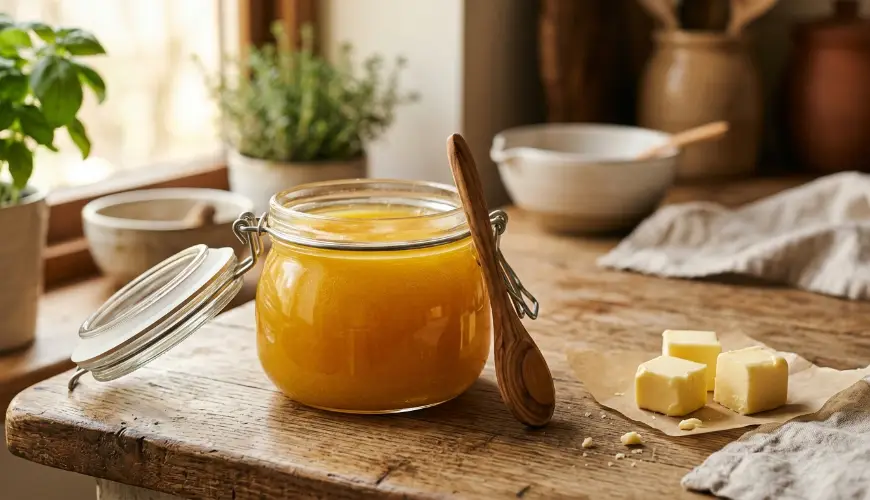
Ghee has in recent years become a term that appears increasingly often in the kitchens of people seeking a healthier way of eating. Although it is an ingredient with a thousand-year tradition, many people still do not know that they can easily prepare it at home – in just twenty minutes. Clarified butter, as ghee is also known in English, is no passing trend. It is a time-tested food that has earned its reputation in Ayurvedic medicine, Indian cuisine, and modern nutrition alike.
The entire process of preparing homemade ghee is surprisingly simple and requires no special equipment or culinary skills. Yet many people are put off because they do not know exactly what to expect. The result is unnecessary purchasing of industrially produced versions, which, while available, can hardly match homemade preparation in terms of quality.
Try our natural products


What ghee actually is and why people have come to love it
Ghee is made by slowly heating butter, during which water and milk proteins – casein and lactose – are separated from the fat. The result is a pure golden fat with a distinctly nutty taste and aroma that can withstand significantly higher temperatures than regular butter or most vegetable oils. Ghee's smoke point is around 250 °C, making it one of the most stable fats suitable for frying and sautéing.
This property is one of the reasons why ghee has gained fans beyond Indian cuisine. When regular butter is heated to too high a temperature, its milk components begin to burn and release harmful substances. With ghee, this problem does not occur, because these components were removed during production. The resulting fat is therefore not only tastier but also safer for cooking at higher temperatures.
Another reason for ghee's popularity is its composition. It contains short-chain fatty acids, such as butyric acid, which according to research supports the health of the intestinal lining and may contribute to the proper functioning of the digestive system. Studies published in the scientific journal Nutrients suggest that butyric acid plays a role in regulating inflammation in the body and may have a positive effect on the gut microbiome. Ghee also contains fat-soluble vitamins – A, D, E and K – which are more easily absorbed by the body precisely in fat form.
A notable advantage is also the fact that ghee contains neither lactose nor casein. For people with lactose intolerance or sensitivity to milk proteins, it can therefore be an excellent alternative to butter, without having to completely abandon the taste and functionality of animal fat in the kitchen.
How to make homemade clarified butter step by step
Making ghee at home is a matter of a single ingredient and a little patience. All that is needed is quality butter – ideally unsalted, organic butter from pasture-raised cows, because the quality of the source ingredient is directly reflected in the quality of the resulting ghee. The better the butter, the richer the flavour and the higher the content of beneficial substances in the ghee.
The procedure is straightforward. The butter is cut into smaller pieces and placed in a pot with a thicker base that distributes heat evenly. It is heated over medium heat, without any need to stir – it is enough simply to watch what happens. The butter first melts, then begins to bubble and foam. This initial foam is water vapour escaping from the fat. Gradually, a white foam composed of milk proteins forms on the surface, which can be skimmed off with a spoon as it appears, or left to sink to the bottom and then strained out.
After approximately fifteen to twenty minutes, the bubbling subsides, the liquid clears to a golden colour, and brownish milk solids settle at the bottom of the pot. That is the moment when the ghee is ready. The key to success is attentiveness – it must not overheat, otherwise the milk solids at the bottom would begin to burn and the ghee would acquire a bitter flavour. The resulting fat is strained through a fine sieve or cheesecloth into a glass jar and left to cool. At room temperature, it solidifies into a creamy golden mass.
Interestingly, homemade ghee does not require refrigeration. When properly prepared and stored in a sealed container, it keeps at room temperature for several months, because it contains no water or milk components that could spoil. This property was, incidentally, one of the reasons why ghee was prized for centuries in the hot regions of India, where refrigeration did not exist.
To achieve the best possible result, it is worth following a few practical guidelines. Water should never come into contact with ghee – not even a drop, as it would shorten its shelf life. The spoon or container used to scoop ghee must always be dry. And if a pinch of turmeric or other spice is added during cooking itself, rather than directly into the stored ghee, the fat will remain pure and keep longer.
A home cook from Brno who has been making ghee regularly for three years described it aptly: "The first time I was afraid I'd ruin it. But then I discovered that you just need to be present and not rush. Now it's a ritual for me – on Friday afternoon I make ghee for the whole month and I know what I'm eating."
Ghee in everyday cooking and beyond
Homemade ghee is a versatile ingredient that finds use far beyond frying. It is suitable for sautéing vegetables, preparing curries, seasoning rice, or as a substitute for butter in baking. Many health-conscious eaters add it to their morning coffee or tea instead of milk – this trend, known as the "bulletproof" approach to breakfast, promises a longer feeling of fullness and more stable energy levels thanks to the combination of caffeine and quality fat.
In Ayurveda, the traditional Indian system of medicine, ghee is considered one of the most precious healing substances. It is used not only in the kitchen but also externally – as a base for herbal ointments, for massage, or for skin care. The Ayurvedic tradition regards ghee as a food that "nourishes body and mind" and supports the balance of the three fundamental energies, or doshas. Whether or not one shares this worldview, it cannot be denied that ghee has thousands of years of practical use behind it.
From a sustainability perspective, making ghee at home also makes sense. Buying butter from local farmers or in organic quality and clarifying it at home means having full control over the origin of the ingredient, avoiding the unnecessary packaging of an industrial product, and reducing the carbon footprint associated with transporting a finished product. A jar of homemade ghee is, moreover, reusable again and again.
For those who want to start with higher-quality ingredients, it is worth looking for butter from grass-fed cows, labelled with the English term „grass-fed". Such butter contains a higher proportion of omega-3 fatty acids and conjugated linoleic acid (CLA), which will also have a beneficial effect on the resulting ghee. In the Czech Republic, such butters can be found from smaller farmers, at farmers' markets, or in health food stores.
Although ghee is an animal fat, and therefore unsuitable for vegans, for people who consume animal products and are looking for ways to eat more consciously and with greater quality, it represents an excellent choice. It is a food with a clear origin, simple production, and a rich history – the precise opposite of anonymous industrial fats whose composition few people can even imagine.
Twenty minutes at the stove, one ingredient, and a little attentiveness – that is all it takes to have a supply of golden fat at home that will enrich the flavour of dishes, serve as a healthier alternative to common cooking fats, and keep without refrigeration for months. It is no wonder that ghee is returning to kitchen shelves even in households where no one had heard of it just a few years ago.