

Try the exotic fruits kaki, feijoa and pitahaya
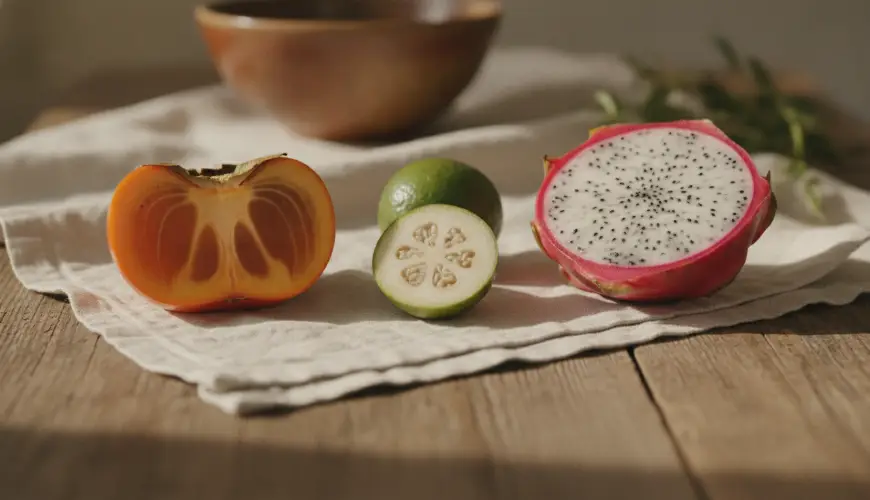
You're standing in front of a store shelf, holding a strangely shaped orange-colored fruit, wondering what on earth to do with it. You're not alone. Exotic fruit is slowly conquering Czech store shelves, but knowledge about how to eat it properly, prepare it, or even recognize ripeness lags significantly behind the available selection. Kaki, feijoa, pitahaya - these names still sound like words from a foreign language to many people, even though their flavor potential is truly exceptional. Let's take a look at what these fruits actually are, why they deserve attention, and how to stop fumbling around with them in the kitchen.
Try our natural products






Kaki: An Orange Treasure That Requires Patience
Kaki, also known as Japanese persimmon, originates from China and Japan, where it has been cultivated for more than two thousand years. It arrived in Europe relatively late, but today it can be found in markets around the world. In the Czech Republic, most people first encounter it either in a supermarket or on holiday in the Mediterranean, where it grows on trees like golden autumn ornaments.
The biggest challenge with kaki is its ripeness. Unripe kaki contains high levels of tannins - compounds that cause an astringent, unpleasant sensation in the mouth, as if you were chewing tree bark. This experience puts many people off for good. But fully ripe kaki is an entirely different story. A properly ripened fruit is as soft as pudding, as sweet as honey, and smells of cinnamon and vanilla. There are two main varieties: Hachiya, which must be completely soft before eating, and Fuyu, which is less astringent and can be eaten when firmer, much like an apple.
So how do you know when kaki is ready to eat? With the Hachiya variety, simply squeeze the fruit - it should feel almost gel-like, with no resistance whatsoever. If it's firm, leave it at room temperature for a few days to ripen. You can speed up the process by placing it in a bag together with a banana or apple, which release ethylene - a natural gas that accelerates fruit ripening. Ripe kaki tastes wonderful on its own, in fruit salads, smoothies, and also in combination with ricotta, honey, and walnuts as an elegant dessert.
From a nutritional standpoint, kaki is truly remarkable. It contains high levels of vitamin A, vitamin C, and antioxidants, particularly beta-carotene and flavonoids. According to data from the US National Library of Medicine, the tannins in kaki also have anti-inflammatory properties, so even that unpleasant component serves a health purpose - it just needs time to transform into a more palatable form during ripening.
One situation that repeats itself in many households: a mother buys kaki because it looked beautiful and was inexpensive. Nobody at home knows how to eat it, so it sits on the counter, hardens or over-ripens, and ends up in the bin. Yet all it takes is a little patience and basic knowledge of what the fruit needs. And the result? A dessert that surprises guests more than any store-bought cake.
Feijoa: A Green Mysterious Fruit with an Out-of-This-World Taste
Feijoa is a fruit that most Czechs have never heard of, even though it is slowly appearing in better health food shops and organic stores. This small, oval, green-colored fruit originates from South America, specifically from the region of present-day Brazil and Argentina. Today it is widely cultivated in New Zealand, Australia, Georgia, and parts of the Mediterranean. Botanically, it is related to guava, and this relationship is also reflected in its flavor.
The taste of feijoa is genuinely difficult to describe - it is often compared to a combination of pineapple, strawberry, guava, and mint, with a lingering slightly mentholated freshness. It is precisely this complexity that makes it interesting for chefs and culinary enthusiasts alike. How do you eat it? The simplest way is to cut it lengthwise in half and scoop out the flesh with a spoon, similar to kiwi. The skin is edible, but tends to be bitter and tough, so most people don't eat it.
When choosing feijoa in a shop, the same rule applies as with kaki - the fruit should yield slightly to finger pressure. A feijoa that is too firm has not yet ripened and will be bitter, while one that is too soft may be over-ripe. If you buy it unripe, leave it to ripen at room temperature. A ripe feijoa gives off an intense fragrance that is almost intoxicating in itself.
From a nutritional perspective, feijoa is rich in vitamin C, folic acid, and potassium. It also contains iodine, which is relatively rare among fruits and particularly valuable for people who limit their intake of seafood. Regular consumption of feijoa can therefore help support thyroid function. According to the World Health Organization, iodine deficiency is one of the most widespread nutritional deficiencies in the world, so every natural source of this mineral has its value.
Feijoa works wonderfully in smoothies, fruit salads, jams, or as an addition to yogurt. In New Zealand, where this fruit is practically a national institution, it is also used to make wine, liqueurs, and various sauces. An interesting combination is feijoa with avocado and lime as the base for a refreshing salsa that surprises with both its flavor and originality.
Pitahaya: A Dragon in the Kitchen That Can Both Disappoint and Astonish
Perhaps no exotic fruit provokes as much controversy as pitahaya, also known as dragon fruit. Its visual impact is absolutely unforgettable - bright pink or yellow skin with distinctive green scales looks like something straight out of a fantasy novel. The flesh can be white with black seeds or a vivid red-purple, depending on the variety.
And here comes what disappoints many consumers: the taste. Pitahaya with white flesh tends to be fairly mild, slightly sweet, with a texture reminiscent of kiwi. The red variety is somewhat more intense. The famous French chef and gastronomic writer Joël Robuchon once remarked that "the best fruit is the one that surprises you where you least expect it" - and pitahaya is exactly that kind of fruit. Its strength lies not in an explosive flavor, but in a delicate subtlety and an extraordinary visual effect that turns any dish into a small work of art.
Pitahaya originates from tropical America, but is now massively cultivated in Vietnam, Thailand, the Philippines, and other Asian countries. It reached the global market primarily through Asian exports. How do you eat it properly? Cut it lengthwise in half and, just as with feijoa, scoop out the flesh with a spoon or cut it into cubes. The skin is not eaten. You can tell ripeness by the skin yielding slightly and the color being even and deep.
The nutritional value of pitahaya is surprisingly high. It contains vitamin C, B vitamins, iron, magnesium, and antioxidants including betacyanin, which gives the red variety its characteristic color and also acts as a powerful antioxidant. Research published in the scientific journal Food Chemistry suggests that regular consumption of pitahaya may have a positive effect on blood sugar levels and support gut microbiota thanks to its prebiotic fiber content.
Pitahaya is ideal for fruit bowls, smoothie bowls, fruit salads, or as a decoration for cakes and desserts. It also works interestingly when frozen - frozen pitahaya retains its color and nutrients, and adds a creamy texture to smoothies without the addition of milk or yogurt.
Why It's Worth Trying Exotic Fruit
It's natural to hesitate in front of an unfamiliar fruit. Nobody wants to spend money on something they won't enjoy, or that will end up over-ripe on the kitchen counter. Nevertheless, there are several good reasons to push past that hesitation and reach for kaki, feijoa, or pitahaya.
First, dietary variety is a cornerstone of a healthy lifestyle. Each type of fruit brings a different spectrum of vitamins, minerals, antioxidants, and phytochemicals. The more diverse the diet, the better the body is supplied with different types of nutrients. Second, exotic fruit tends to be significantly richer in certain micronutrients than commonly available varieties - feijoa and iodine, kaki and beta-carotene, pitahaya and magnesium are good examples of this.
Third, and perhaps most importantly - food should be a joy, not a routine. Trying new flavors, textures, and aromas enriches everyday experience, broadens culinary horizons, and can be a wonderful opportunity for the whole family. Children who are encouraged from an early age to taste different types of fruit and vegetables develop healthier eating habits into adulthood, according to research by the British Nutrition Foundation.
There is also an ecological dimension. Buying seasonal and locally available exotic fruit - such as kaki, which is grown in southern Europe and therefore doesn't need to travel from the other side of the world to reach the Czech Republic - is a more sensible choice from a carbon footprint perspective. Feijoa and kaki are moreover increasingly being cultivated in Central European conditions, so their availability will grow.
Kaki ripening on a windowsill, feijoa halved over a bowl of yogurt, or pitahaya sliced into a morning smoothie - these are small, accessible ways to bring a touch of adventure into everyday eating. And who knows, perhaps that unfamiliar fruit you used to avert your eyes from will become your new favorite treat.