
Adoptive grandmothers and grandfathers benefit both children and seniors
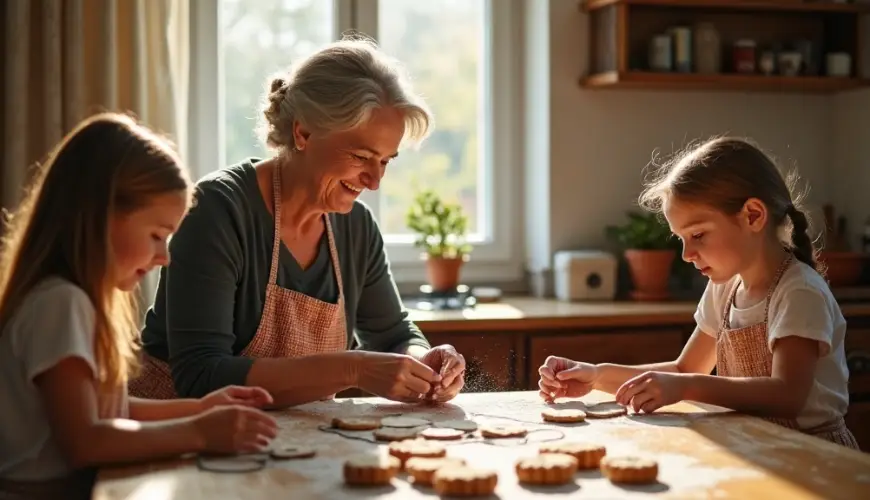
The modern family looks different from how it was depicted in fairy tales or old photographs on the sideboard. Parents live hundreds of kilometers from their own parents, grandparents are in another city or on another continent, and sometimes they simply aren't there at all. Children grow up without the distinctive smell of grandmother's gingerbread, without grandfather's stories from the workshop, without that special sense of security that only someone with a lifetime of experience can provide. And yet it is precisely this relationship — intergenerational, slow, unhurried — that shapes a person's character more than we often realize.
It is from this empty space that a phenomenon has emerged, one that sociologists and family therapists are watching with growing interest: the voluntary adoption of the role of surrogate grandparents — people who become grandmothers and grandfathers to children with whom they share no blood ties. They are called adoptive grandparents, neighborhood grandmothers, or grandfathers of the heart — and their numbers have been growing significantly in recent years.
Try our natural products


Why today's families need grandparents but don't have them close at hand
The demographic reality is straightforward. According to data from the Czech Statistical Office, the distance between the place of residence of parents and grandparents has increased significantly in recent decades. Young families move for work, for a partner, for better housing. Grandparents stay where they have lived their whole lives, or conversely move themselves to senior communities far from their grandchildren. Added to this are situations where grandparents died too young, where they are seriously ill, or where family relationships are so damaged that contact is neither possible nor desirable.
The result is a generation of children who have parents, friends, and teachers — but lack someone who stands outside the everyday pressures of upbringing and school obligations. Someone who simply sits down, tells stories, and doesn't rush. Grandparents traditionally fulfilled the role of a kind of emotional reserve — a place where a child could take shelter, be spoiled, and at the same time quietly learn what life truly involves. This role cannot be replaced by another adult in the same way — it is a relationship with a specific dynamic that has its own rhythm and depth.
Research shows that children who have a close relationship with grandparents display greater emotional resilience and a better capacity for empathy. A British study published in the Journal of Family Psychology found that a quality intergenerational relationship directly correlates with lower levels of anxiety in school-age children. This is not surprising — grandparents bring perspective, patience, and the ability to put problems in perspective, something that parents in the midst of daily life simply do not have the capacity to offer.
On the other side of the equation stand seniors. In modern society, they face their own form of isolation — their children are busy, their grandchildren are far away, and after retirement their social circle narrows dramatically. Loneliness among seniors is described in Europe as one of the greatest public health problems of our time. The World Health Organization even compares its health effects to smoking fifteen cigarettes a day. In this context, the idea of adoptive grandparents makes sense from both sides — it is a relationship that enriches and benefits everyone involved.
Consider Lenka, a thirty-three-year-old mother of two from Brno, whose parents live in Slovakia and whose husband's parents live in Canada. The grandchildren and grandparents see each other twice a year; video calls are regular but cannot replace physical presence. Two years ago, through a local community center, Lenka met Mrs. Věra, a seventy-two-year-old retiree whose own children are childless and live abroad. Today, Mrs. Věra picks the children up from nursery school every Friday, helps with cooking, and has become a firm part of family life. "I finally have grandchildren, and they finally have a grandmother," says Mrs. Věra simply — and in that sentence lies the entire essence of this phenomenon.
How adoptive grandparenting works in practice
The spontaneous emergence of relationships like the one between Lenka and Mrs. Věra is the most common form — but it is not the only one. In recent years, specialized programs have been emerging across Europe that connect families without grandparents with seniors seeking meaningful contact. In Germany, the Leihoma (literally "borrowed grandmother") project operates; in France, similar initiatives exist under the umbrella of community centers for seniors. In the Czech Republic, such connections are still happening rather informally — through neighborhood communities, religious congregations, local associations, or community centers.
The principle is not to create a substitute family in the legal sense, but to build a genuine, authentic relationship. The family and the senior gradually get to know each other, spend time together, and organically find their own rhythm. Some develop a fondness for cooking together or gardening, others read fairy tales to the children or go for walks. What matters is that the relationship is not built on obligation or a formal framework — it grows naturally, just like any genuine relationship.
For families considering such a connection, it is worth keeping a few practical aspects in mind:
- Start slowly — a first meeting in a neutral setting (a café, a park) reduces pressure on both sides
- Communicate openly — clear boundaries and expectations prevent misunderstandings
- Give the relationship time — trust is built gradually, especially with children
- Be flexible — the senior's health or the family situation may change
- Appreciate the small things — it is precisely in them that the value of these relationships lies
This seemingly simple project also carries sensitive dimensions. Parents must trust a person who is not their relative and entrust them with what is most precious — time spent with their child. Seniors, in turn, must be prepared for the fact that the relationship will have rules set primarily by the parents. The key is transparency and mutual respect — and a willingness to accept that this relationship is different from biological grandparenthood, but no less valuable.
What this trend tells us about the transformation of society
Behind the phenomenon of adoptive grandparents lies something deeper than a practical need for childcare or company. It is a symptom of a broader longing for community, for intergenerational cohesion that has faded from modern life. Urbanization, individualization, labor market mobility — these are all forces that have loosened traditional bonds. And people are seeking them again, this time consciously and actively.
Psychologists and sociologists speak of so-called chosen families — networks of close people who are not connected by blood but share values, time, and care for one another. This concept, originally associated primarily with LGBTQ+ communities, is today expanding into a much broader context. Families without grandparents, seniors without grandchildren, people without siblings — all are looking for ways to fill the relational spaces that modern society has left empty.
It is interesting to observe how this trend is also reflected in what people buy and how they live. Interest in a slow, mindful way of life — in activities that connect generations, in traditional skills such as baking, gardening, or handicrafts — is growing. These are precisely the activities that grandmothers and grandfathers traditionally passed on, and which many families today are consciously seeking as a way to slow down and deepen their relationships with one another. This is not merely nostalgia — it is a conscious choice of a different rhythm of life.
Research consistently shows that intergenerational contact benefits both sides — children and seniors alike — in areas ranging from cognitive development to physical health. Studies from Stanford University focused on aging repeatedly confirm that seniors with rich social lives and meaningful interpersonal relationships live longer and with greater quality of life. And for children, what applies is what generations before us knew intuitively: that growing up alongside a wise, patient older person is a gift that is difficult to replace.
Perhaps it is here that one answer lies to the question of how to reconnect what seems to have been torn apart forever — families scattered across the world, seniors shut away in their apartments, children searching for roots. Not through grand gestures or systemic solutions, but through simple, weekly gatherings at a table, in a garden, or while reading a bedtime story. Adoptive grandmothers and grandfathers are not a substitute for what is missing — they are proof that the human need for community is stronger than any distance or family structure.