

Farmer's carry or farmer's walk strengthens the whole body
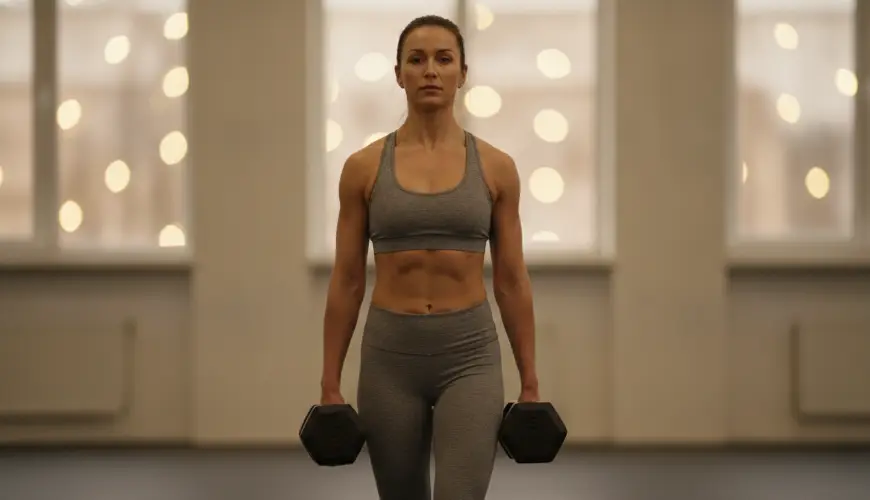
There is an exercise that looks so simple that most gym-goers overlook it. No complex movements, no special technique, no flashy execution — you simply pick up a weight and walk with it. And yet this very movement, known as the farmer's carry, is among the most complex and effective exercises there is. It is a paradox of the modern fitness world: the simpler an exercise looks, the less attention we pay to it.
The farmer's carry has its roots long before the first gyms ever existed. Farmers, construction workers, and dock porters performed this movement every day in a completely natural way: they lifted heavy buckets, sacks, or crates and carried them from place to place. It was about survival, about work, about everyday reality. Today we know that this seemingly primitive movement is one of the best tools for building functional strength that has real relevance to everyday life.
Try our natural products
What actually happens in the body when you carry a weight?
At first glance, the farmer's carry seems like just "walking with heavy things." But once you look more closely at what is happening inside the body, the picture changes radically. When performed correctly, practically the entire body engages simultaneously — in a way that other exercises can hardly replicate.
The core works continuously throughout the entire exercise. It must stabilize the spine, resist lateral trunk tilting, and maintain an upright posture even as the weight constantly "pulls" downward and to the sides. This kind of stabilization work is fundamentally different from exercising on a mat — the core works dynamically, in motion, exactly as we need it in everyday life.
At the same time, the hands and forearms are under enormous strain. Grip — the ability to firmly grasp and hold a weight — is one of the most frequently neglected components of physical fitness. And yet it is a quality that translates into almost everything: other exercises in the gym, athletic performance, and even mundane everyday situations such as carrying shopping bags or opening jars. Research repeatedly shows that grip strength is even a reliable predictor of overall health and longevity — a study published in The Lancet followed over 140,000 people in 17 countries and found that weaker grip strength is associated with a higher risk of cardiovascular disease and overall mortality.
The trapezius muscles, shoulders, and upper back are continuously active to keep the shoulder blades in a safe position and prevent rounded shoulders. The glutes and thigh muscles drive every step. The calves and feet work to stabilize the entire body with each ground contact. One could say that the farmer's carry is a complete full-body workout wrapped into a single movement.
It is no wonder that renowned strength coach Dan John, who has dedicated decades to athletic training, says: "If you could only do one exercise for the rest of your life, it should be the farmer's carry." This sounds like an exaggeration — until you realize everything this exercise truly entails.
Why so many people skip it
The answer is surprisingly psychological. People in gyms are drawn to movements that look complex or spectacular — Olympic weightlifting pulls, intricate kettlebell movements, acrobatic pull-up variations. The farmer's carry, by contrast, does not look like a "real" exercise. It lacks visual drama. Nobody stops to admiringly watch someone walk across the gym floor with dumbbells in hand.
Contributing to this is the fact that the farmer's carry is not easily found in traditional training programs focused on aesthetics. Programs built around hypertrophy — that is, building muscle volume — typically concentrate on isolation exercises and precisely defined sets and repetitions. The farmer's carry does not fit this framework: it cannot be easily quantified by rep count, it does not target one specific muscle, and its results are not immediately visible in the mirror.
And yet — precisely because it engages so many muscle groups simultaneously and places such high demands on the nervous system and cardiovascular system, the farmer's carry is an extraordinarily effective exercise for improving overall fitness. People who incorporate it regularly into their training notice improvements across a wide range of other areas: their deadlift improves thanks to a stronger grip, their squat stabilizes thanks to a stronger core, and their endurance increases because the farmer's carry is metabolically very demanding.
How to perform the farmer's carry correctly and where to include it
The technique of the farmer's carry appears simple, but here too, the details matter. The weight — whether dumbbells, kettlebells, specialized farmer's carry handles, or even shopping bags filled with books — should be heavy enough to present a challenge, but not so heavy that it compromises proper posture.
The basic rules are clear: straight back, shoulders pulled back and down, head in a neutral position, gaze directed forward. Steps should be short and controlled, not excessively large. Breathing should be steady — many beginners neglect breathing during a demanding exercise, which leads to rapid fatigue.
In terms of variations, the options are richer than they might appear:
- Symmetrical farmer's carry — weight in both hands, the classic variation, ideal for beginners
- Suitcase carry — weight in one hand only, significantly greater demands on lateral trunk stabilization
- Overhead carry — weight overhead, extreme demands on shoulder stability and the upper back
- Trap bar farmer's carry — using a specialized hexagonal bar that allows heavier loads with lower technical demands
- Farmer's carry uphill or on stairs — increasing cardiovascular intensity
For beginners, it is advisable to start with lighter weight and shorter distances — for example, 20 to 30 meters — and gradually increase both distance and load. Advanced athletes can incorporate the farmer's carry at the beginning of a session as an activation exercise, or conversely at the end as a finisher that thoroughly exhausts the body's remaining capacity.
Particular attention deserves the inclusion of the farmer's carry in the context of everyday life. Consider the example of a thirty-year-old woman who works in an office and regularly goes to the gym, but suffers from chronic lower back pain. Classic core exercises — planks, bird-dogs, various abdominal variations — help her somewhat, but progress is slow. Once she begins regularly incorporating the suitcase carry — that is, the farmer's carry with one hand — her core begins to adapt to dynamic stabilization that is much closer to the actual movement patterns of everyday life. The pain eases because the spine learns to better resist load in motion — not just in a static position on a mat.
This carryover into the real world is precisely what distinguishes functional training from training focused purely on aesthetics or gym performance. Functional training, as defined by Healthline for example, is training movements rather than isolated muscles — and the farmer's carry is in this regard a nearly perfect example.
It is also interesting how the farmer's carry resonates with principles close to people interested in a sustainable and natural lifestyle. No expensive equipment is needed, no complex machines, no special conditions. All it takes is two weights and space to walk — which can be a gym, a park, a garden, or a hallway in an apartment. This exercise naturally lends itself to the philosophy of minimalism and functionality that is permeating other areas of modern life as well: from food choices and household equipment to approaches to movement.
The farmer's carry also has a significant benefit for mental resilience. Carrying a heavy weight for a period that begins to feel uncomfortable but is not yet dangerous teaches both body and mind to endure discomfort. This ability transfers — people who regularly practice the farmer's carry often describe being more resilient in other demanding situations as well. This is no coincidence: a physical challenge that requires focus, proper breathing, and conscious body control is simultaneously a training in mental toughness.
Perhaps it is time to reconsider what we actually expect from training. Are we looking for exercises that look impressive, or exercises that truly work? The farmer's carry is the quiet workhorse of the fitness world — unassuming, unspectacular, but extraordinarily effective. And precisely for that reason, it deserves far more attention than most of us give it. Next time you stand in the gym wondering what to include in your workout, try reaching for the dumbbells, gripping them firmly, and simply — walking.