

Carrying children in a wrap and carrier without unnecessary myths
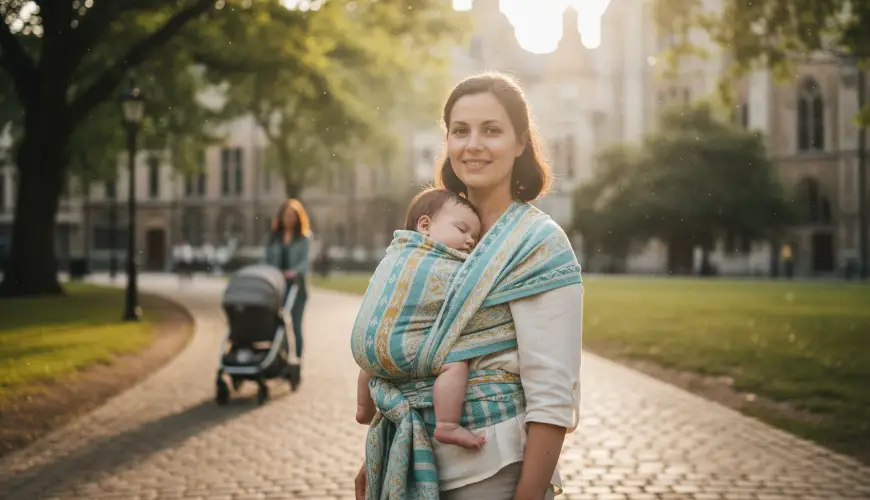
Few parenting trends in recent years have sparked as much discussion as carrying babies in a wrap or ergonomic carrier. On one side, enthusiastic advocates who swear by the closeness and comfort; on the other, skeptics warning about spoiling children or back pain. The truth is, as usual, somewhere in between – and most importantly, supported by surprisingly solid scientific evidence. Let's take a look at what babywearing actually offers, what myths surround it, and how to get started safely, even if you've never seen a wrap in your life.
Humans have been carrying their children since time immemorial. Literally. Anthropological findings suggest that carrying offspring in various types of slings and straps dates back thousands of years and remains the primary method of infant care in many cultures across Africa, Asia, and South America to this day. In the Western world, this practice was abandoned for several decades – the era of strollers, playpens, and baby seats brought a different kind of convenience. But over the past twenty years, babywearing has been making a comeback, not just as a fashion trend, but as a conscious choice by parents seeking a more natural way of connecting with their baby. And science backs them up more than many would expect.
Try our natural products

Why carry a baby in a wrap or carrier in the first place
The basic principle of babywearing is simple: the child is in close physical contact with the parent, hearing their heartbeat, feeling their warmth and movement. This "skin-to-skin" contact isn't just pleasant – it has measurable physiological effects. A study published in the journal Pediatrics back in 1986 showed that babies carried in a carrier cried on average 43% less than babies who were not carried. More recent research, such as work published in the Journal of Child Psychology and Psychiatry, confirms that regular physical contact in the first months of life promotes a secure bond between parent and child, with positive effects on emotional development far into the future.
But the benefits don't end with psychology. From an orthopedic perspective, proper carrying in a wrap or ergonomic carrier is very beneficial for the child. The so-called M-position – where the baby's legs are spread into an M-shape with knees higher than the bottom – supports healthy hip joint development. The International Hip Dysplasia Institute even lists recommended carriers that ensure this position. For parents whose children have immature or shallow hip joints, proper babywearing can actually be part of the therapy recommended by orthopedists.
And then there's the practical side, which anyone who has ever tried to maneuver a stroller on a broken sidewalk, in a crowded bus, or on a forest trail will appreciate. Carrying in a wrap simply frees up your hands. It allows you to shop, cook, walk while holding an older child's hand, travel by public transport – in short, live a normal life while the baby sleeps contentedly on your chest. One mother from Brno, who shared her experience on a parenting forum, put it aptly: "The wrap gave me back the feeling that I wasn't trapped at home. I could go anywhere and my son was calm because he was with me." This experience is repeated by thousands of parents around the world, and there's nothing surprising about it – for a newborn, closeness to a parent is the most natural environment.
Babywearing also benefits premature babies. Kangaroo care, meaning skin-to-skin contact with a prematurely born baby, is now a standard part of neonatal care worldwide. The World Health Organization (WHO) actively recommends it as a way to improve thermoregulation, stabilize heart rate, and support breastfeeding in premature infants. Home babywearing in a wrap is a natural continuation of this principle.
Myths that persist around babywearing
Despite the growing body of evidence about the benefits of babywearing, we still encounter a number of myths that can unnecessarily discourage parents. Let's break down the most common ones.
Probably the most widespread myth is the claim that carrying will spoil your child. This notion stems from a now-outdated parenting philosophy that held children should learn independence as early as possible and that too much physical contact hinders this. Modern developmental psychology says the exact opposite. As British psychologist and attachment theory expert Sir Richard Bowlby, son of attachment theory founder John Bowlby, points out: "A child whose need for closeness is met in the first months of life paradoxically becomes more independent and self-confident." The secure attachment that babywearing promotes is the foundation from which a child gradually and naturally explores the world – not an obstacle to their independence.
Another common argument is that carrying in a wrap harms the baby's spine. This claim is unfounded when carrying is done correctly. A newborn naturally has a rounded spine in a C-shape, and a wrap or quality carrier respects and supports this physiological position. Problems can only arise if the baby is carried in an unsuitable carrier – typically in so-called "dangling" carriers, where the child hangs from the crotch with legs hanging down. Such carriers are indeed not ideal for either the spine or the hips. That's why it's important to choose ergonomic carriers with a wide seat panel that ensure the proper M-position of the legs and a rounded back.
The third myth concerns the parents themselves – specifically the worry that babywearing causes back pain. It's true that an incorrectly tied wrap or poorly adjusted carrier can be uncomfortable. But when properly tied, with the baby high enough (so the parent can kiss the baby on the top of the head) and close to the body, the weight is distributed evenly and the strain on the back is minimal – often less than when carrying a child on one arm, which parents do instinctively anyway. Many midwives and physiotherapists now recommend carrying in a wrap as a way to prevent back pain because it eliminates asymmetric body loading.
There is also the belief that babywearing is suitable only for mothers. This is complete nonsense. A wrap or carrier can be used by anyone – fathers, grandparents, foster parents. For dads, babywearing is often one of the most valuable tools for building a strong bond with their newborn in the first weeks, especially when the mother is breastfeeding and the father is looking for his own way to be close to the baby. Many fathers describe that babywearing in a carrier helped them overcome their initial uncertainty and feel competent in their parenting role.
And what about the claim that babywearing is too complicated and a wrap is impossible to learn to tie? Here, we need to be honest – yes, the first attempts with a stretchy or woven wrap can be frustrating. Five meters of fabric and a crying baby aren't exactly a recipe for calm. But just as you learn to change diapers, bathe, or prepare solid foods, you can also learn to tie a wrap. Usually, mastering one or two basic ties is enough, and the rest comes with practice. Moreover, today there are buckle carriers that offer the ergonomics of a wrap with the simplicity of a backpack – just clip in and go.
How to get started with babywearing and what to watch out for
For complete beginners, the easiest route is a stretchy wrap. It's soft, forgiving of small mistakes in tying, and ideal for newborns up to approximately six to seven kilograms. The most well-known and most versatile tie is the so-called "front wrap cross carry," which holds the baby securely on the parent's chest. You can find dozens of video tutorials online, but the best investment is a visit to a babywearing consultant. In the Czech Republic, there is a network of certified consultants who, for a reasonable fee (often even free of charge at family centers), will help with choosing the right carrier, teach proper tying techniques, and check that the baby is in a safe position.
When the baby grows and gets heavier, the stretchy wrap will no longer suffice, and it's time for a woven wrap or an ergonomic buckle carrier, or possibly a mei-tai, which is a traditional Asian type of carrier combining the properties of a wrap and a structured carrier. Each of these options has its advantages, and the choice depends on personal preferences, the parent's body type, and the baby's temperament. Some babies love the snug embrace of a woven wrap, while others prefer the looser seat of a buckle carrier. Don't be afraid to experiment – many consultants offer carrier lending libraries where you can try out different types before deciding on a purchase.
When babywearing, it's essential to follow several safety rules. The baby should always have clear airways – the face must not be pressed against the fabric or the parent's body. The baby's chin should not be pressed against their chest, as this can restrict breathing. The baby should be visible and kissable – meaning high enough that the parent can see their face and easily kiss the top of their head. The carrier or wrap must be tight enough so the baby doesn't hang too low and press against the parent's abdomen. And of course, it's important to adjust clothing – in a carrier, the baby is warmer due to shared body heat, so in summer a thinner layer is sufficient, and in winter there's no need to bundle the baby in many layers under the carrier.
It's also worth mentioning that babywearing doesn't have to be an either/or matter. Most families combine babywearing with using a stroller depending on the situation. For a longer walk on flat terrain, a stroller may be more comfortable, while for shopping, public transport trips, or soothing a fussy baby to sleep, a wrap is invaluable. It's not about ideology but about a practical tool in the parenting arsenal that's worth having available.
As pediatrician William Sears, one of the pioneers of so-called attachment parenting, once said: "Worn babies are happier babies because they get exactly what they need – closeness." And even if you don't agree with everything Sears ever wrote, on this point both thousands of years of human experience and modern science prove him right.
If babywearing has caught your interest and you're wondering where to start, it doesn't take much. Get a basic stretchy wrap or borrow one from your nearest family center, find a consultant in your area, and give it a chance. You might discover that this piece of fabric changes your everyday parenting life more than you'd expect – and your baby will confirm it in the most beautiful way: peaceful sleep on your chest.