
Heating during transitional periods without unnecessary losses
Autumn arrives slowly but surely. Mornings are cold, afternoons warm up, and evenings see temperatures drop below a comfortable threshold again. It is precisely during these days, when the weather cannot decide whether it is still summer or already autumn, that most households make their biggest heating mistakes. They heat too early, too intensively, or conversely too late and then try to make up for heat loss at full power. The result is unnecessarily high energy bills and overheated or underheated rooms. Yet relatively little is needed to make the transitional period comfortable and economical.
The transitional period – that is, spring and autumn – is the most demanding phase of the year from a heating perspective. Is that not a paradox? In winter the situation is clear: you heat. In summer you do not heat at all. But during those in-between periods, when outdoor temperatures fluctuate between ten and twenty degrees Celsius, deciding whether and how to heat is genuinely complicated. And it is precisely this complexity that leads to waste.
Try our natural products




Why the transitional period undermines energy savings
To be clear about what we are discussing: transitional heating typically begins when the average daily outdoor temperature drops below 13 °C for several consecutive days. This is the traditional threshold at which most buildings start losing heat faster than they can naturally retain it. However, modern households vary considerably – an old uninsulated panel-block building behaves very differently from a new low-energy house with triple-glazed windows and controlled ventilation.
The problem with the transitional period is that people react to an immediate feeling rather than to an actual need for heat. You get up in the morning feeling cold, reach for the thermostat and turn it up to maximum. In the afternoon the sun comes out, the room overheats, you open a window and the heat quite literally flies out. Then in the evening you heat again. This cycle can repeat every day, and it is one of the most expensive ways to run a household.
According to data from the Energy Regulatory Office, inefficient heating is among the main causes of high energy consumption in Czech households. Yet savings achievable simply by changing habits and adjusting heating system settings amount to tens of percent of annual heating costs. These are figures worth paying attention to.
Another factor complicating the situation is the thermal inertia of buildings. Walls, floors and ceilings accumulate heat and then gradually release it. If you start heating too intensively, the building overheats and you then have to ventilate – wasting the energy you have just expended. Conversely, if you start heating too late, the building cools down and reheating it takes hours and costs significantly more than if you had maintained a stable temperature. The key to economical heating during the transitional period is therefore stability, not reacting to extremes.
Consider a specific example: a family living in a three-bedroom flat in a panel-block building in Prague. Every year in September they start heating at the first cold morning, set the thermostat to 24 °C and then complain that the flat is too hot and they have to open windows. Their neighbour in an identical flat has set the thermostatic valves on individual radiators to 20–21 °C, lets them work automatically, and their heating bills are a quarter lower. Yet both live in the same building, with the same insulation and the same heating system. The difference lies solely in their approach.
Practical ways to avoid waste during the transitional period
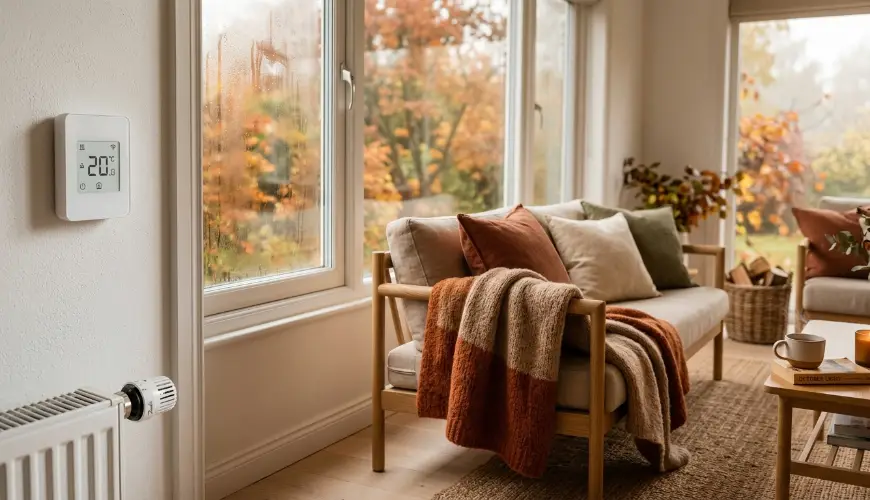
One of the most effective tools for economical heating is thermostatic valves on radiators. This is a relatively inexpensive investment that pays for itself within a single heating season. A thermostatic valve responds to the air temperature in the room and automatically regulates the flow of hot water to the radiator. You do not need to adjust anything manually – simply choose the desired temperature once and the valve takes care of the rest. During the transitional period, when outdoor temperatures fluctuate, this automatic regulation is absolutely crucial.
Smart thermostats go even further. They allow you to set different temperatures for different parts of the day – for example, 20 °C during the day, 18 °C at night, and 17 °C when nobody is home. According to the International Energy Agency (IEA), lowering the room temperature by just one degree Celsius reduces energy consumption for heating by approximately 5–7 %. This is a figure that makes a significant difference to the bill when calculated over a full year calculation.
Just as important as heating itself is how you manage heat inside the household. Ventilation is essential for air quality, but the method of ventilation has an enormous impact on energy consumption. Brief, intensive ventilation – so-called cross-ventilation lasting three to five minutes – is significantly more efficient than leaving a window slightly open all day. With cross-ventilation, the air in the room is exchanged while the walls, furniture and floor retain their heat. A slightly open window, on the other hand, causes a continuous loss of heat while failing to exchange the air sufficiently.
Another overlooked factor is curtains, drapes and blinds. During the transitional period they play an important role in both directions. During the day, when the sun is shining, windows on the south-facing side should be uncovered – solar radiation can naturally warm a room and reduce the need for heating. In the evening, drawn curtains act as an insulating layer that slows heat loss through the glass. This simple habit can reduce heat losses through windows by tens of percent.
We should not overlook sealing windows and doors. During the transitional period, when heating is less intensive, even small heat leaks are a relatively greater problem. Older windows and door frames tend to let in cold air, which then creates a feeling of coldness even when the temperature is correctly set. Replacing the seals costs a matter of tens of crowns and a few minutes of work – and the result is immediately noticeable.
A very practical step is also checking radiators before the start of the heating season. Bleeding radiators is a task that many households forget, yet trapped air in the heating system significantly reduces its efficiency. A radiator that is partly filled with air instead of hot water heats unevenly and consumes more energy than necessary. Bleeding can be done by anyone using a special key and a small container – the whole operation takes minutes.
As German physicist and energy expert Hermann Scheer once observed: "Energy you do not use is always cheaper than energy you have to produce." This thought perfectly captures the essence of economical heating – it is not about denying yourself thermal comfort, but about intelligently managing the energy you already have available.
Heating less frequently used rooms is a separate chapter. A bedroom, study or guest room does not need to be at the same temperature as the living room. In rooms where less time is spent, maintaining a temperature of around 16–18 °C is sufficient, which significantly reduces overall consumption. Thermostatic valves make this differentiation easy and require no complex installation.
Worth mentioning too is the role of floor coverings and rugs. A cold floor creates a feeling of coldness even when the air in the room is sufficiently warm. A rug or warm mat in front of the bed or sofa can significantly improve the subjective sense of thermal comfort – and thereby reduce the need to raise the thermostat temperature. This is an inexpensive solution that works with the physiology of human heat perception: our bodies perceive the temperature of surfaces we step on or touch just as intensely as the temperature of the surrounding air.
For those who want to go further, there are apps and smart home management systems that can monitor outdoor temperatures, forecast the weather and automatically adjust heating settings before a change in weather has even manifested indoors. These systems are becoming increasingly accessible and their purchase price is falling. The investment in smart home automation typically pays for itself within two to three years – which is a very attractive prospect at current energy prices.
The transitional period is also an ideal time for an overall assessment of the household's energy situation. It is worth going around the windows and checking the seals, looking at doors leading outside or to unheated spaces, and checking that radiators are freely accessible and not covered by furniture or curtains – a covered radiator heats the room significantly less efficiently because warm air cannot circulate freely.
Last but not least, it is important to mention the psychological dimension of the whole matter. Many people heat more than necessary simply because it gives them a feeling of security and comfort. Warmth is an emotional matter – we associate it with home, cosiness and certainty. That is understandable. But thermal comfort does not necessarily mean an overheated room. Research shows that people feel best at around 20–21 °C in living spaces and 16–18 °C in bedrooms. Higher temperatures, on the other hand, cause fatigue, dryness in the nose and throat, and deterioration in sleep quality.
The transitional period thus actually offers an opportunity – to reassess one's habits, set the heating system sensibly and begin the season with the awareness that energy is not being needlessly lost through the window. A household that manages the transitional period efficiently generally manages the entire winter season with lower costs and greater comfort. And that is precisely the outcome worth aiming for.