

# Cooking for One Without Waste and Boring Repetition
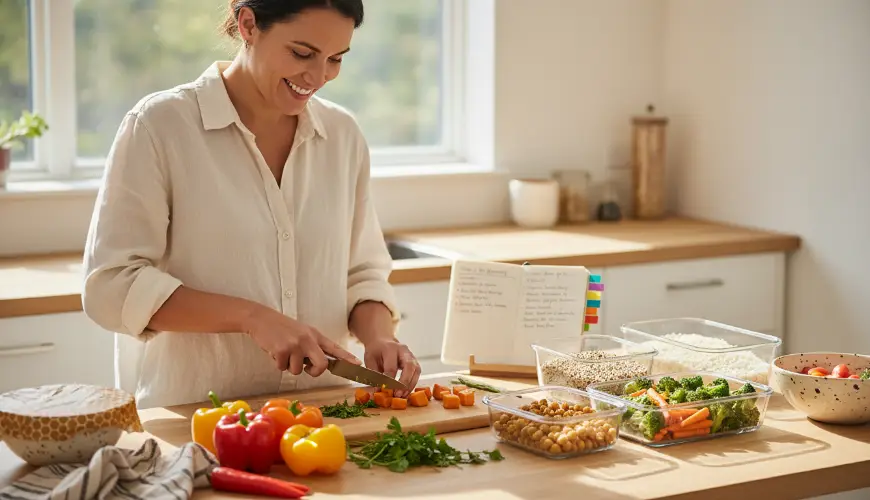
Living alone and eating well – it sounds like a simple task, but in practice it turns out to be quite a complex equation. Anyone who has ever stood in a supermarket in front of a shelf of peppers, wondering whether to buy a whole kilogram or just three pieces, knows exactly what this is about. Cooking for one person comes with specific challenges that differ fundamentally from cooking for a family or a couple – and yet they're rarely talked about.
The statistics speak clearly. According to data from the Czech Statistical Office, single-person households in the Czech Republic make up an ever-growing share of all households, with their numbers rising steadily over time. Behind this figure are millions of people who face the same question every evening: what to cook so it's not the same thing again, so nothing goes off, and so cooking feels worthwhile at all? The answer isn't complicated, but it requires a slightly different approach to planning, shopping, and cooking itself.
Try our natural products






Why cooking for one so easily descends into a boring cycle
The problem usually starts before the stove is even switched on. Most recipes are designed for four to six portions, because that's the quantity traditional kitchen logic works with. Anyone who dives into a classic cookbook without thinking will end up with a pot full of food they have to eat for several days in a row. And that's precisely where the feeling that cooking for one is boring comes from – not because the person can't cook, but because the system simply isn't set up for their situation.
Another pitfall is shopping. Vegetables are sold in bunches, meat in half-kilogram packs, yoghurts in multipacks. Buying exactly what one person will use without throwing anything away is an almost superhuman feat – unless you have a clear plan. And without a plan, exactly what you'd expect happens: half a celeriac, three soggy tomatoes, and the remains of some cream that nobody owns up to sit in the fridge. The result is stress, guilt, and dinner from a delivery service.
Yet there's a simple mental shift that changes the whole situation. It's not about cooking less or cutting back – it's about thinking of cooking as a system, not a series of random decisions. Once a person starts approaching food with a little foresight, the boring cycle naturally falls apart.
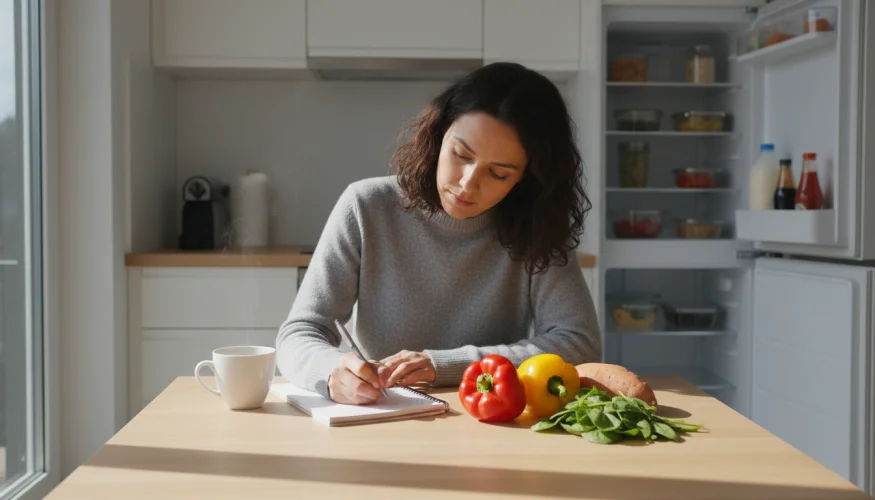
A good real-life example is Jana, a thirty-three-year-old graphic designer living alone in Brno. Just a year ago she shopped without a list, cooked intuitively, and threw away an average of two to three portions of food every week. Then she started planning just five meals ahead – not seven, just five, to leave room for spontaneity – and the result was surprising. Not only did she stop wasting food, but she found she was cooking more varied meals than before, because she had to think about how to connect different ingredients across the week.
How to plan smartly, cook varied meals, and avoid waste
The key to variety without waste is what's known as the core ingredients principle. Instead of buying ingredients for a specific recipe, you choose three or four versatile staple foods each week that can be combined in different ways. Chickpeas, for example, can serve as the base for hummus, be added to a soup, or roasted in a pan with spices as a crunchy salad topping. Sweet potatoes can be baked, mashed, or cut into chips. Eggs are perhaps the most versatile ingredient of all – and they're accessible, cheap, and easy to portion out one at a time.
This approach has another hidden advantage: it encourages creativity, which is the exact opposite of monotony. When you have a handful of spinach, half an onion, and an egg at home, you can make an omelette, scrambled eggs with spinach, or a simple egg in peeled tomato the Italian way – depending on your mood, not a strict recipe. Food writer Michael Pollan put it aptly: "Cook. Not too much. Mostly plants." This seemingly simple advice contains an entire philosophy of approaching food that makes particular sense for those who cook alone.
Another practical tool is batch cooking – that is, preparing certain components of meals in advance, but not complete finished dishes. The difference is crucial. Cooking a pot of rice or quinoa at the start of the week, roasting a tray of vegetables, and boiling some legumes doesn't mean eating the same thing all week – it means having building blocks on hand from which something different can be created each day. Quinoa with roasted vegetables and tahini becomes Monday's bowl. The same quinoa transforms into a warm soup with coconut milk on Tuesday. On Wednesday, the vegetables are added to eggs in a pan. No meal repeats itself, even though the basic ingredients are the same.
When it comes to waste specifically, it's worth knowing a few simple tricks that can save not only money but also a guilty conscience. The United Nations Food and Agriculture Organization (FAO) estimates that approximately one third of all food produced worldwide ends up as waste – and households are one of the biggest contributors to this figure. Yet much of what people throw away is still perfectly edible.
Herb stems can be used in stock. Carrot or celeriac peelings can be fried until golden and added to soup as a tasty garnish. Overripe tomatoes make an ideal base for a quick sauce. Bread that's starting to go stale transforms into croutons or eggy French toast. Food waste is largely a matter of habit and attention, not necessarily bad intentions – and small changes in thinking have a surprisingly large impact.
In practical terms, these simple rules also work well for cooking for one:
- Shop with a specific plan, but leave yourself flexibility for two meals based on whatever is on offer or whatever is left over.
- Invest in quality storage containers – properly stored food keeps longer, and leftovers from dinner become the next day's lunch.
- Freeze strategically – portions of sauce, soup, or cooked meat can be frozen and taken out when there's no time or inclination to cook.
- Buy less, but more often – fresh vegetables bought twice a week are better than one big shop, after which half of it turns black in the drawer.
The joy of cooking for yourself
There's one more thing that rarely gets talked about when it comes to cooking for one, yet it may be the most important: cooking for yourself can be joyful. It's not a compromise or a substitute for "real" cooking for family or friends. It's an opportunity to cook exactly what you want, regardless of others' preferences, allergies, or tastes.
Someone who cooks alone can afford to experiment without the risk of an entire family being unhappy. They can have just a bowl of miso soup with tofu for lunch because they feel like it. They can try a new cuisine – Ethiopian, Georgian, Peruvian – without having to convince anyone else. This freedom is actually a gift that many people living alone don't appreciate enough.
Cooking for one also naturally leads to a deeper understanding of ingredients and flavours. Anyone who prepares their own meals every day very quickly discovers what they genuinely enjoy, what satisfies them, and what doesn't agree with them. This self-knowledge is the foundation not only of good eating, but of a healthy relationship with food in general. And that's a value that goes beyond any specific recipe.
The key to making cooking for one feel neither like a punishment nor a tedious obligation doesn't lie in any complicated system. All it takes is a little planning, a willingness to combine ingredients creatively, an awareness of what's in the fridge and how to use it – and above all, an attitude that takes cooking for yourself seriously. Because food prepared with care and attention always tastes better than food made out of habit or necessity. And that holds true regardless of how many plates are set at the table.