

Sorting your wardrobe sustainably can be done without stress when you know what to do with the cloth
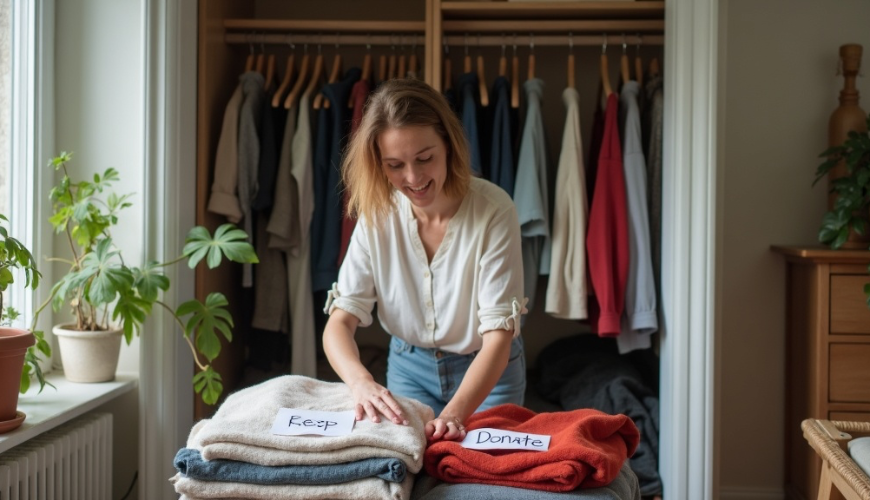
Sorting through your wardrobe has a unique ability to reveal more than just forgotten sweaters. Suddenly, it becomes clear how many items are worn repeatedly, what looks great only on the hanger, and how easily clothing turns into a quiet home stash of "maybe someday." That's why it makes sense to sort your wardrobe sustainably – not just for the sake of tidiness, but also because of the footprint fashion leaves behind. Clothing is one of the most visible parts of daily consumption and simultaneously one of those where habits can be changed relatively easily without great sacrifices.
When discussing sorting, it often devolves into quick advice like "only keep what brings you joy." But reality tends to be more complicated: some people deal with a work dress code, some with size changes, some with emotional attachment to items, and others with the fear that discarded clothing will end up in a landfill. The good news is that sustainable sorting is not about perfection. It's more about giving the items you no longer wear the best possible next life – and ensuring future purchases arise from real need, not chaos.
Try our natural products




Why to regularly sort your wardrobe – and why it's not just about space
There are more reasons to sort your wardrobe regularly than just having a neat closet. The most practical one is simple: when the wardrobe is overcrowded, it loses function. Clothing becomes harder to combine, items get wrinkled, some pieces "get lost," and paradoxically, new ones are bought because the old ones are out of sight. It creates a cycle where more items accumulate, but the joy of dressing diminishes.
Regular sorting also acts as a gentle inventory of lifestyle. Has work changed, commuting, seasons, leisure time, the body after illness or childbirth? Sometimes the wardrobe remains stuck in the past, and then one dresses in the morning into a role that is no longer theirs. Sustainability in this context is not an abstract concept – the most sustainable piece is the one already at home and actually worn.
There's also a broader context. The textile industry is considered one of the environmentally demanding sectors; for basic context, materials from the European Environment Agency on the impacts of textiles in Europe are useful. It's not about making one feel guilty after reading. Rather, it's about understanding that every extension of clothing's lifespan – through repair, donation, sale, or recycling – makes sense.
And then there's another often overlooked effect: sorting reduces impulsive purchases. When it's clear what truly works in the closet, it's easier to resist an "on-sale" T-shirt that matches nothing. One sentence captures it well: "The cheapest and most ecological purchase is the one that doesn't have to happen."
How to sort your wardrobe sustainably so it's not a one-time action
Sustainable wardrobe sorting is based on two pillars: fair decision-making and a good "exit plan" for items that no longer serve. And also on not sorting in a panic. The ideal is to choose a time when there's enough time for at least the basic steps – and especially when there's no need to deal with a big new clothing purchase the next day just because too much was thrown out.
A practical start is surprisingly simple: set aside everything that is really worn and fits. This is the "core" of the wardrobe. Then deal with the rest. For each piece, a few discreet questions can help: Was it worn in the last year? Is it comfortable? Does it match items already in the wardrobe? Is it not just a "pretty thing" that requires a special occasion that never comes?
Sustainability shows in detail: instead of a quick "away," look for the "how further" option. Often, the problem isn't in the clothing but in a small detail – a missing button, a broken zipper, a loose seam, a pill that a fabric shaver could fix. Repair can be surprisingly cheap and quick, and mainly it prolongs the lifespan of a piece already made. If one tries to live more frugally, sorting makes the most sense right here.
A good rule is also to distinguish between "I don't want" and "I don't wear." Sometimes an item isn’t worn just because it’s hard to combine. A typical example: a dress that looks great but lacks the right layer, tights, or sweater. And this is where sustainable sorting differs from the quick kind: instead of discarding, find a simple solution that turns the item into a realistically wearable piece.
It's worth incorporating a small check of materials and quality into sorting. Not because of snobbery, but because some fabrics and cuts last longer and are easier to repair. When the wardrobe is sorted, it often reveals that a few "workhorses" are worn the most – quality T-shirts, comfortable pants, one good sweatshirt. This is valuable information for future purchases: fewer pieces, but ones that don't turn into waste after just a few washes.
To ensure it doesn’t remain just good intentions, a simple real example helps. Imagine a typical situation: on a Saturday afternoon, the contents of one shelf are pulled out – just one, not the entire closet – and sorting begins. Three categories are found: items that are worn; items that need minor repair; and items that no longer have a place in the current life. In an hour, it’s done, and the result isn't an empty closet, but a clearer picture. Items for repair are immediately placed in a fabric bag and taken along the next time passing by a tailor. And items for donation are immediately set aside in a box by the door, so they don’t remain "for someday." This is exactly the type of sustainable change that is small but works in the long term.
Tips to make wardrobe sorting easier (and avoid losing your nerves)
Sought-after tips to make sorting easier are often not about discipline, but about setting the process up to be bearable. It helps, for instance, not to sort according to an idealized version of life ("when I start going to the theater"), but according to the reality of the past few months. Likewise, it's good not to sort at a time when one doesn’t feel good in their body – decisions then tend to be unnecessarily harsh.
If sorting is to be truly sustainable, it pays to adhere to a few simple rules:
- Sort in smaller parts (one shelf, one drawer, one category like T-shirts) so the process can be completed without exhaustion.
- Create a "trial box" for pieces one is unsure about. Close it, mark it with a date, and open it in 2–3 months; what hasn't been missed can often go.
- Set a rule for new purchases: until the box of discarded items is resolved (sale/donation/recycling), don't buy a replacement "just like that."
- Think in complete outfits: for items that aren't worn, try asking if a key element is missing (like a tank top under a sweater, a belt, a basic T-shirt). Sometimes a small addition can make an item functional.
- Allow time for repairs and maintenance: pills, loose threads, or stains are often reasons for discarding, but can usually be resolved.
If all this sounds like too many rules, a simple question helps: will this item really be taken out of the closet in the next few weeks, or is it just "insurance" against the feeling it might be needed someday?
Where to take sorted clothing: sale, donation, recycling, and dignified final use
The most sensitive part of the entire action is often the question of where to take sorted clothing. Sustainable sorting doesn’t end with a bag in the corner. Ideally, decide right while sorting what the next step will be, and immediately divide items according to their condition.
If the clothing is in good condition, selling or donating are options. Selling makes sense especially for higher-quality brands, coats, shoes, or items that are barely worn. Donating is suitable for regular clothing that can continue to serve without complicated photography and communication. In both cases, a simple rule of consideration applies: only donate what is clean, functional, and in such a state that it wouldn’t offend another person. "Donating" a destroyed T-shirt with a stretched collar is often not help, but passing the problem along.
Another option includes charity shops, collections, and local initiatives. In the Czech Republic, various forms of material assistance operate; orientation can be provided by, for example, Czech Red Cross or local social services, which often state specific needs (and also what they do not accept). It pays to verify conditions in advance, as some organizations accept only certain types of clothing or only during certain periods.
And what about clothing that is no longer "for public" but still usable? Here, a dignified final use is possible: at home as work clothes, for the garden, for sleeping, or as an "extra layer" at the cottage. This too is sustainability if it delays the purchase of new items. Just watch out that it doesn’t become a fourth category "for home," which clutters the closet again.
When clothing is truly at the end of its life, textile collection and recycling come into play. Many cities have textile containers, and some brands and stores have collection boxes. It makes sense especially when donating dry and clean textiles without mold. At the same time, it's fair to say that textile recycling isn’t omnipotent, and not everything can be processed into new clothing. That’s why the order of steps is important: first, prolong the lifespan (wearing, repair), then pass it on (sale, donation), and only finally address recycling.
With shoes and accessories, it’s worth proceeding similarly. Leather shoes often manage a new life after repair by a cobbler, and bags sometimes only need cleaning and care. Conversely, with items that are hygienically problematic (heavily soiled, musty, moldy), it's better to be cautious and not try to "pass them on" at all costs.
A simple division helps in decision-making:
Wearable and nice → sale / donation.
Wearable but unsellable → donate where it makes sense, or domestic final use.
Damaged → repair, or textile collection.
Destroyed and unhygienic → responsible disposal according to municipal options.
And one more small detail that has a big impact: when sending clothing on, it’s good to add a brief note about the material and care, or to point out a defect. A sustainable approach isn't just about items but also fairness.
Regular wardrobe sorting ultimately isn't a contest in minimalism. It's a way to keep track, reduce pressure for new purchases, and give clothing a chance to serve as long as possible – whether at home, with someone else, or as material for further use. When sorting is done thoughtfully and with a plan, it stops being an unpleasant obligation and starts functioning as a quiet but effective tool for a more sustainable everyday life. And isn't it a relief when you open the closet in the morning and it's clear that everything hanging has its place in your life?