

Try sweet recipes made from beans and you won't regret it
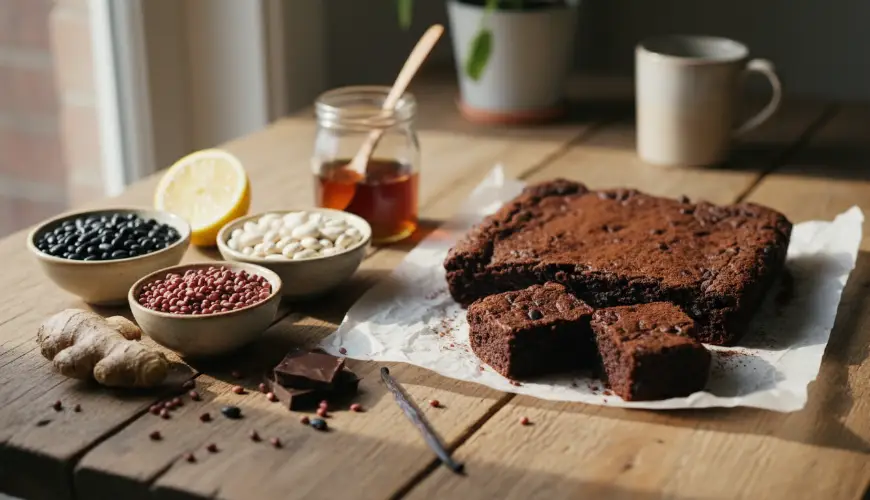
Beans and dessert – two words that seemingly don't belong in the same sentence. Yet there is an entire world of sweet dishes where beans play the leading role so inconspicuously that no one would detect them in the finished result. If you think that beans belong exclusively in soup, chilli, or a Mexican burrito, that notion is about to be turned on its head.
The trend of using legumes in sweet baking and cooking comes from various corners of the world – from Japanese cuisine, where sweet bean pastes are literally a cultural heritage, and from modern health-oriented kitchens in Europe and North America. And the results? Surprisingly delicious, nutritious, and incomparably more beneficial for the body than traditional desserts full of white flour and refined sugar.
Try our natural products


Why beans actually belong in sweet recipes
Before we get to specific recipes, it's worth understanding why beans make sense in desserts not only in terms of flavour, but also nutritionally. Beans are one of the richest plant-based sources of protein and fibre, while also containing iron, magnesium, potassium, and a range of B vitamins. One cup of cooked beans provides approximately 15 grams of protein and nearly 13 grams of fibre – values that most desserts don't come anywhere close to achieving.
The World Health Organization and numerous nutritional studies repeatedly confirm that regular consumption of legumes contributes to reducing the risk of cardiovascular disease, stabilising blood sugar levels, and supporting healthy digestion. The Harvard T.H. Chan School of Public Health ranks legumes among the most valuable foods within a balanced diet. Adding them to sweet baking is therefore no eccentricity – it is a smart way to increase the nutritional value of food without significantly changing the flavour.
Technically speaking, beans in recipes function as a binding agent and a substitute for flour or fat. Their fine, creamy texture after blending gives dough or cream density and moistness without introducing a pronounced bean aroma. Light varieties in particular, such as white beans or chickpeas, have a very neutral flavour after cooking that easily adapts to other ingredients – chocolate, vanilla, cinnamon, or citrus.
Take Martina, a thirty-year-old mother of two from Brno, who decided to reduce the amount of white flour in her whole family's diet. She prepared brownies from black beans for the first time with great scepticism and without revealing the main ingredient. The result? Both children ate their portion down to the last bite, and not a word was said about beans. Only after the empty plate did Martina confess – and was met with disbelieving looks.
This scenario is not an exception. It is precisely the ability of beans to "disappear" in a finished dessert that is the reason these recipes are gaining ever more fans, even among people who would otherwise dismiss the phrase "healthy baking" with a sigh.
Specific sweet recipes worth trying
Let's start with the most famous representative of bean desserts – black bean brownies. This recipe originates from American health-conscious cuisine and has spread around the world over the past decade. The base is a tin or a cup of cooked black beans, blended until smooth with eggs, cocoa, a little honey or maple syrup, vanilla extract, and a pinch of salt. The resulting batter – thick, glossy, intensely chocolatey – is baked for approximately 25 minutes at 175 degrees. The finished brownies are moist, almost fudgy in consistency, and indistinguishable in flavour from the classic version. Yet they contain not a gram of flour, and their glycaemic index is significantly lower.
Japanese cuisine offers us an even deeper tradition of sweet bean preparations. Anko – a thick paste made from adzuki beans sweetened with sugar – is the foundation of dozens of traditional Japanese sweets known as wagashi. These delicate confections, traditionally served at the tea ceremony, have existed in Japanese culture for centuries. Anko can also be made at home: simply cook red adzuki beans until soft, add sugar or another sweetener, and stir continuously until thickened to the desired consistency. This paste then serves as a filling for mochi rice cakes, for filled pancakes called dorayaki, or simply as a spread on wholegrain toast.
Less exotic but equally surprising is chocolate cream made from chickpeas. Chickpeas blended with cocoa, almond butter, a little maple syrup, and vanilla produce a thick, silky cream that tastes reminiscent of Nutella, yet contains a fraction of the sugar and many times more protein. This cream can be spread on fruit, added to smoothies, used as a cake filling, or simply eaten by the spoonful – without any guilty conscience.
Another surprising candidate is white bean cookies with lemon and ginger. White beans have an almost neutral flavour after blending, with a mildly creamy undertone that pairs beautifully with citrus and spicy notes. Dough made from cold-blended beans, oat flakes, lemon zest, fresh ginger, coconut oil, and a touch of honey produces crisp, slightly chewy cookies that are gluten-free and at the same time satisfying thanks to their high protein content.
Also worth mentioning is bean cheesecake – a dessert that at first glance looks like a classic creamy cake, but whose base consists of blended white beans mixed with quark or cashew cream, lemon, vanilla, and a little agave syrup. Such a cheesecake is either baked in a water bath or left to set in the fridge without baking. The result is delicate, mildly tangy, and surprisingly fresh – and no one at the table would guess that the secret ingredient is beans.
If you are looking for an even simpler way to incorporate beans into your sweet diet, try bean energy balls. Simply place cooked chickpeas or white beans in a blender, add oat flakes, a tablespoon of peanut butter, a little honey, cocoa, and a handful of chocolate chips. The resulting mixture just needs to be shaped into balls and left to set in the fridge. It makes an ideal quick snack that satisfies, provides energy, and contains no added preservatives or industrial sugars.
Tips for working with beans in sweet cooking
For sweet bean recipes to turn out well, it helps to know a few basic rules. Beans must always be thoroughly cooked and blended until completely smooth – any lumps or undercooked pieces would disrupt the texture of the finished dessert. If you are using tinned beans, they must be rinsed under cold water to remove excess salt and preserving liquid.
The choice of bean variety plays a key role. As a general rule:
- Black beans are suited to chocolate desserts – their dark colour is lost in the cocoa, and their flavour is mildly earthy, complementing dark chocolate well.
- White beans and chickpeas are the most versatile – they have a neutral flavour and a light colour, making them suitable for light creams, cookies, and cakes alike.
- Adzuki beans are naturally sweeter and ideal for Japanese-inspired desserts.
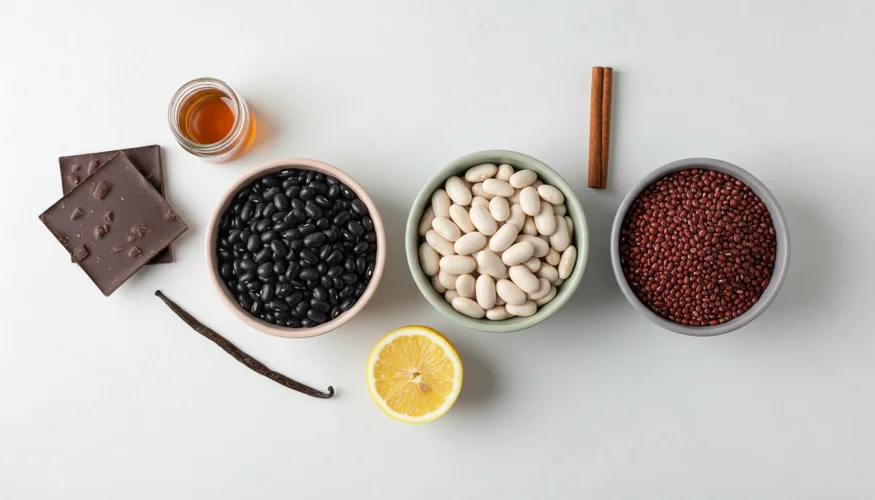
It is also important to work with high-quality complementary ingredients. Good chocolate, natural vanilla extract, or freshly grated citrus zest significantly elevate the overall result. Beans themselves are a neutral canvas – it is precisely these additions that determine the final flavour.
As American chef and healthy cooking advocate Mark Bittman once remarked: "The best food is not that which is healthy despite its flavour, but that which is healthy because of its flavour." Sweet recipes made from beans fulfil this idea perhaps better than anything else – they are not a compromise, they are an upgraded version of the classic.
For those who wish to go even further in their ecological approach to cooking, it is worth noting that legumes are among the most ecologically sustainable foods of all. Their cultivation requires significantly less water and produces fewer greenhouse gases than animal protein sources. Our World in Data reports that producing one kilogram of legumes generates approximately twice fewer CO₂ emissions than producing the same quantity of poultry – and several times fewer than beef. Baking brownies from black beans is therefore not only a healthier choice for the body, but also a conscious decision in favour of the planet.
Sweet bean recipes thus stand at the intersection of several contemporary trends at once – plant-based eating, gluten-free baking, reducing sugar in the diet, and a sustainable approach to food. It is no wonder that more and more people are gradually discovering them for themselves: from athletes seeking nutritious snacks, to parents trying to improve their children's diet, to enthusiastic bakers who enjoy experimenting and seeking new flavour horizons. And once someone has tasted their first moist black bean brownie or a spoonful of creamy chocolate chickpea dip, it is very likely that they will return to beans in sweet cooking again and again.