

Try five layers of storage space for permanent order
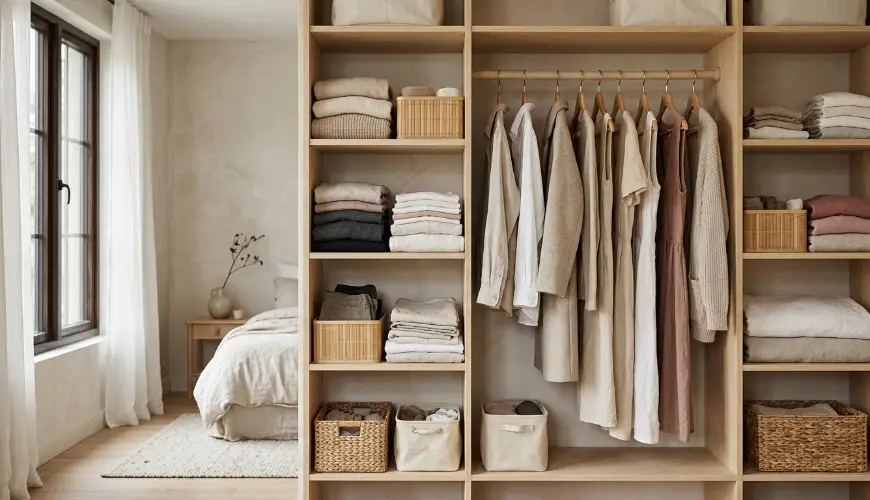
Everyone knows it. You open the wardrobe, and instead of a tidy storage space, an avalanche of jumpers tumbles out at you, along with lost socks from last winter and a bag you thought you'd lost two years ago. And yet that exact same wardrobe, in the exact same flat, could function as a perfectly organised system – if it were arranged properly. The question, then, is not whether to get more wardrobes or a bigger flat, but how to work with the space you already have.
The organisation of wardrobes and storage space is a topic that has been attracting increasing attention in recent years – and not only in the context of minimalism or Scandinavian design. Psychologists and designers alike agree that an organised home environment directly influences mental wellbeing, reduces stress and increases productivity. Research published in the journal Personality and Social Psychology Bulletin showed that people who describe their home as "cluttered" or "unfinished" exhibit higher levels of cortisol – the stress hormone – than those who perceive their space as tidy and functional.
But how does one go about it? The answer lies in a systematic approach that space organisers call layered storage. It is not some complex theory, but a practical way of thinking that helps you set up any wardrobe – whether a clothes wardrobe, kitchen cupboard or bathroom cabinet – so that it serves you in the long term without the need for constant rearranging.
Try our natural products





Why simply "tidying up" is not enough
Before we get into the five-layer system itself, it is important to understand why ordinary tidying loses its effect so quickly. Most people approach wardrobes reactively: when things stop fitting, they rearrange what they can and stuff the rest wherever space remains. The result is a temporary order that falls apart at the first rushed morning when you are searching for a particular jumper or the right lid.
Lasting wardrobe organisation requires a system, not just effort. And it is precisely the five-layer system that offers a structure respecting how people actually live – not always carefully and with time to think, but often quickly, on the move and under the pressure of daily routine.
Take a real-life example. Jana, a thirty-three-year-old teacher from Brno, had a large built-in wardrobe in her bedroom that still never seemed sufficient. Every morning she spent minutes searching for clothes, even though she did not own an unreasonable amount. The problem was not the quantity of things, but the fact that the wardrobe had no internal logic. After applying the layered storage system – dividing the wardrobe into five functional zones according to frequency of use and category – the situation changed fundamentally. Not only did she stop losing time, but she discovered that she did not need some of her things at all, because she had not seen them in years.
The five layers of storage space, step by step
The five-layer system is based on a simple principle: every item in a wardrobe should have an assigned place corresponding to how often you use it, how large it is and how you handle it. Let us go through the individual layers.
The first layer – the active zone within arm's reach. This is the most important part of any wardrobe. It is where things you use daily or several times a week belong. In a clothes wardrobe, this means current-season clothing; in a kitchen cupboard, the pots and dishes you cook with every day. This layer should be clear, easily accessible and never overcrowded. The golden rule states that if you have to move things around to reach what you are looking for, the active zone is overloaded.
The second layer – occasional items. This is where objects you do use, but not every day, belong. Clothing for special occasions, specialist kitchen tools, seasonal accessories. This zone can be slightly less accessible – upper shelves, side compartments or deeper drawers. The key is that items in this layer are visible, or at least easily locatable without having to take everything out.
The third layer – seasonal storage. Winter blankets in summer, summer clothing in winter, Christmas decorations in February. This layer is used only a few times a year and can be placed in hard-to-reach spots – the highest shelves, bottom drawers or the back of the wardrobe. This is precisely where it pays to invest in quality storage boxes or vacuum bags, which protect items from dust while also saving space.
The fourth layer – archive space. Documents, photographs, items of sentimental value, spare parts for household appliances. You do not need these items quickly, but you occasionally look for them – and when you do, you will appreciate that they are stored systematically rather than "somewhere in the back". The archive layer should be labelled, ideally with a brief description of the contents.
The fifth layer – transitional space. This layer is most often overlooked, yet it is crucial for the long-term functionality of the system. It is a place designated for items that are "in transit" – clothing in need of repair, things to be donated, items you are not yet sure where to place. Without a dedicated transitional space, these items will invade the active zone and the entire system will gradually fall apart.
How to ensure the organisation lasts
Setting up a system is one thing; maintaining it is another. This is precisely where most attempts at organisation fail. People invest a weekend in rearranging wardrobes, the result looks wonderful – and three months later everything is back in its original chaos. Why? Because the system was not designed to feel natural in everyday use.
As American organiser and author Marie Kondo says: "The goal is not to have a perfect wardrobe, but a wardrobe that makes your life easier every day." This idea is fundamental – a good system must be simple enough to follow even on a Tuesday morning when you are running late and looking for a clean shirt.
Several concrete principles help ensure that wardrobe organisation truly lasts. The first is a regular audit, ideally twice a year when changing seasonal clothing. This is the moment to move items between layers, discard anything you have not used in half a year, and check whether the system still matches your current needs. Life circumstances change – what worked for a single person may not work for a family with two children.
The second principle is visibility. Things you cannot see might as well not exist. It therefore pays to favour open shelves over closed drawers where possible, transparent boxes over opaque ones, and vertical clothing storage – that is, folding items into upright rows rather than horizontal stacks – which allows you to see every piece at once. This folding method, popularly known as the "KonMari method", is described in detail by Real Simple, a leading American magazine dedicated to home organisation.
The third key principle is proportionality of quantity. No system can withstand an unlimited amount of things. Each layer has its capacity, and exceeding that capacity inevitably leads to the collapse of the entire system. As a general rule, a wardrobe should never be filled to more than eighty per cent of its capacity – the remaining twenty per cent is space for movement, for new items and for natural fluctuations in the amount of clothing or equipment.
The fourth principle, which proves particularly effective in multi-member households, is personalisation of zones. Each member of the family should have a clearly defined space that they manage themselves. Shared wardrobes without clear division are the most common source of organisational chaos, because no one feels responsible for the whole.
The storage accessories themselves also play an important role. Investing in quality organisers, dividing inserts, hanging pockets or drawer liners pays off not only in terms of functionality but also in terms of sustainability. Well-crafted storage accessories made from natural materials – bamboo, cotton or recycled plastic – last for years and at the same time do not contaminate the home environment with toxic substances, unlike cheap plastic alternatives.
If you wish to take the path of more eco-friendly living, it is also worth paying attention to what your storage accessories are made from. Bamboo organisers, cotton baskets or storage boxes made from recycled materials are not only kinder to the environment, but thanks to their durability and aesthetics they are also more pleasing to look at – and that in itself motivates you to maintain order.
The five-layer system is not some revolutionary novelty, but rather a formalisation of what people with naturally organised homes do intuitively. These people do not devote more time to organisation – on the contrary, they devote less, because their system works automatically. The key is to think of a wardrobe not as a space for storing things, but as a functional tool of everyday life. And just like any tool – a wardrobe performs best when it is properly set up, regularly maintained and adapted to the person using it.