
Try a home chemistry audit and simplify your cleaning
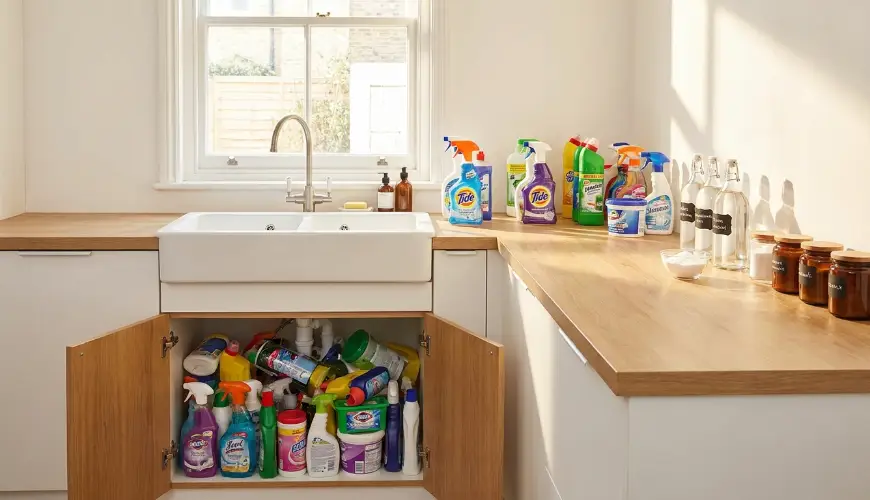
Open the cabinet under the kitchen sink and what do you see? In all likelihood, an entire army of plastic bottles, sprays, gels and powders that have accumulated there over months or years. Dish soap, degreaser, drain cleaner, sink polish, disinfectant for work surfaces, glass spray, dishwasher tablets, limescale remover gel... and several other products whose names you can barely read. The average Czech household uses dozens of different cleaning products per year, with a large proportion of them sitting unused or unnecessarily duplicating each other. A household chemical audit – a thorough examination of what you have under the sink and what you actually need – is one of the simplest steps towards a more economical, healthier and more eco-friendly home.
It's not just about tidying up a cupboard. It's about understanding what we bring into our homes every day, what substances evaporate into the air we breathe, and what we flush into wastewater. According to data from the European Chemicals Agency (ECHA), households are one of the most significant sources of human exposure to chemical substances in everyday life – and yet we have far more control over what we use at home than we think.
Try our natural products
Why we have so much and why we mostly don't need it
Before discussing how to carry out an audit, it's worth reflecting on how such an overstuffed cupboard comes about in the first place. The marketing of cleaning products is built on a single principle: every problem requires a specialised product. One spray for the bathroom, another for the kitchen, a third for the sink, a fourth for the toilet. A different product for carpets than for wooden floors, a different one for stainless steel than for ceramics. The result is that we keep buying more and more, even though the chemistry in these products is very similar – or even identical.
Consider a situation that is perfectly common in many households: Jana, a thirty-four-year-old mother of two from Brno, once counted how many different cleaning products she had at home. She counted seventeen. When she went through them one by one, she found that three had expired, two were nearly empty and forgotten, and at least five of them did essentially the same thing – degreasing surfaces. Over the course of a year, she had spent over three thousand crowns on cleaning products. After a household chemical audit, she settled on four products and her annual costs dropped below eight hundred crowns.
This story is not an exception. It is the rule. The cleaning products industry is a globally enormous business precisely because it convinces us of the necessity of products we don't actually need. A basic household chemical audit takes no more than an hour, and its results can be surprisingly liberating.
The key question you need to ask yourself during such an audit is: Do I have this product because I genuinely need it and use it regularly, or do I have it because I bought it once and never threw it away? A surprisingly large number of bottles fall into the second category.
How to carry out a household chemical audit step by step
The process itself is not complicated, but it does require a degree of systematic thinking. Start by taking everything out of the cupboard – literally everything. Place the bottles on a table or on the floor and, for the first time in a long while, see them all at once. This sight alone is often a revelation for many people.
The first step is sorting by function. Create groups: dish-washing products, degreasers, bathroom cleaners, toilet products, floor cleaners, polishes, disinfectants. Duplicates will become apparent very quickly. Two different brands of degreasing spray do exactly the same thing – there is no reason to keep both.
The second step is checking expiry dates and the condition of packaging. Expired or damaged products must be disposed of properly – meaning not poured down the drain or thrown in the bin, but handed in at a collection point or through a special hazardous waste collection scheme. Most Czech towns and municipalities offer these options; you can find information on your municipality's website or on the portal of the Czech Environmental Information Agency (CENIA).
The third and most important step is critically reassessing what remains. For each bottle, ask yourself three questions: How often do I use this? Could another product I already own replace it? Is there a more eco-friendly or health-conscious alternative?
This is where we get to the heart of the matter. Many products can be replaced by more versatile ones, or even by natural alternatives that are not only cheaper but also gentler on health and the environment.
A universal cleaning product based on natural ingredients can handle most surfaces in the home. Citric acid – available as a powder at a fraction of the cost of specialised products – is an excellent limescale remover and works in both the bathroom and the kitchen. Baking soda combined with a little water or vinegar degreases, deodorises and gently cleans with mild abrasion. This is no fashionable ecological fad – these are tried-and-tested methods that people used long before the chemical industry came up with a thousand specialised bottles.
What you actually need and what to do with what remains
After carrying out an audit, most households end up with a surprisingly short list of genuinely essential products. Typically this includes dish soap (or dishwasher tablets), a universal surface cleaner, a toilet cleaner, a floor cleaner, and possibly a specialised cleaner for a particular material you have a lot of in your home – such as wood or stainless steel. That's five items instead of seventeen. The rest is marketing.
As German ecologist and author Michael Braungart, one of the pioneers of the circular economy concept, noted: "The best waste is the waste that is never created." The same applies to household chemicals – the best chemical is the one you don't need to buy at all, because you don't need it.
When choosing which products to keep in the cupboard or buy new, it is worth paying attention to ingredients and eco-certifications. Certifications such as the EU Ecolabel or Nordic Swan guarantee that a product meets strict criteria for environmental friendliness and user health. This certification is not just a marketing gimmick – it is an independently verified standard whose conditions are publicly available and regularly updated. An overview of certified products available in the Czech Republic can be found on the EU Ecolabel website.
An important aspect that many people overlook during a household chemical audit is the question of packaging. Switching to concentrated products, refills or products in paper or glass packaging significantly reduces the amount of plastic waste. Some products are now available in tablet or powder form, which you dilute yourself in a reusable bottle – a solution that is economical, eco-friendly and perfectly convenient.
A special case involves products kept at home as a precaution – disinfectants, powerful stain removers or aggressive drain cleaners. These products are often the most problematic in terms of their composition, yet they are used the least. It is worth considering whether you genuinely need them regularly to hand, or whether it would be sufficient to have them available only occasionally – or to replace them with gentler alternatives for everyday use.
When transitioning to more eco-friendly alternatives, there is no need to change everything at once. A sensible approach is gradual replacement: when an existing product runs out, replace it with a more environmentally friendly option. This way you don't throw away what you already have, while gradually transforming the contents of your chemical cupboard towards what actually makes sense.
The result of a household chemical audit is not just a emptier cupboard and financial savings. It is also the peace of mind that comes from knowing what you have at home, what you do with it, and what impact it has – on your health, on the health of your children, and on the environment in which we all live. And that is a value no bottle from the supermarket can provide.