

Strong and Healthy Shoulder Blades with Prone Y-T-W Exercises
Pain between the shoulder blades, a feeling of stiffness in the upper back, or uncomfortable tension in the shoulders – these are problems familiar to almost everyone who spends long hours at a computer or in a car. Yet the solution can be surprisingly simple and requires no expensive equipment or gym membership. Prone Y, T, and W exercises are among the most effective ways to strengthen the muscles around the shoulder blades, improve posture, and prevent a wide range of problems associated with a sedentary lifestyle.
Shoulder blades are fascinating bony structures that serve as a base for movement of the entire arm. Their correct position and stability depend on the coordination of many small muscles – especially the trapezius, rhomboids, serratus anterior, and rotator cuff. These are precisely the muscles that are weakened in most people because modern lifestyles systematically neglect them. We sit with our shoulders hunched forward, look down at screens, and movements that would naturally strengthen these muscles – such as climbing, throwing, or carrying loads overhead – have almost disappeared from our daily routines.
Physiotherapists and musculoskeletal specialists are therefore increasingly recommending targeted strengthening of the shoulder blade muscles as part of both prevention and rehabilitation. The exercises named after the letters Y, T, and W are particularly effective in this respect because each activates a slightly different muscle group, and together they provide a complete workout for the shoulder blade stabilizers.
Try our natural products
How to perform Y, T, and W exercises correctly
The starting position is the same for all three exercises: lie face down on a mat, rest your forehead on the floor or a rolled-up towel, and place your arms loosely at your sides. Some people prefer to perform these exercises on an exercise ball or at the edge of a bench to achieve a greater range of motion, but for beginners, a mat on the floor is a perfectly adequate and safe option.
The Y exercise is performed by raising your arms diagonally overhead to form the shape of the letter Y – thumbs pointing up toward the ceiling and both arms lifted off the mat. The movement should come from the shoulder blades, not the shoulders. It is important not to push the shoulders toward the ears, but instead to keep them pulled down and back. Hold the top position for three to five seconds, then slowly lower your arms – this is the basic movement everyone should master. This exercise primarily targets the lower trapezius and the serratus anterior, the muscles responsible for rotating the shoulder blade upward.
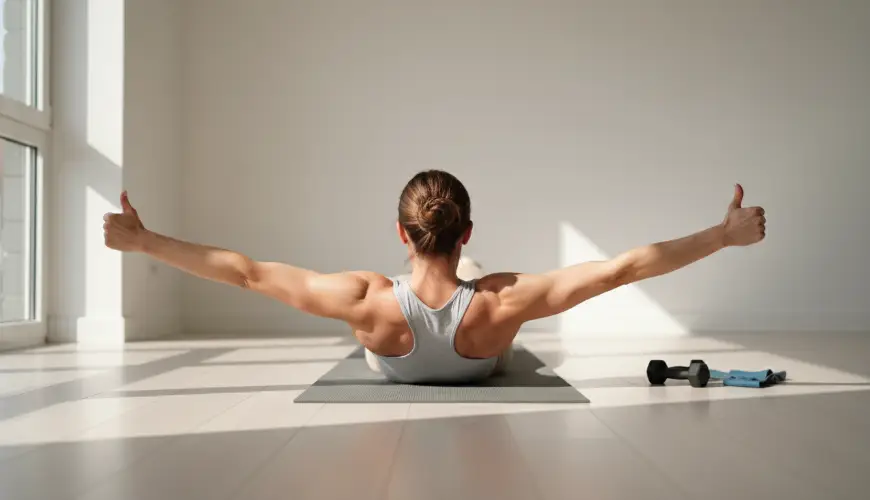
The T exercise is perhaps the best known of the three. Extend your arms out to the sides at exactly shoulder height, forming the shape of the letter T. Once again, the movement comes from the shoulder blades and the thumbs point toward the ceiling. This exercise strongly engages the middle trapezius and the rhomboids – muscles that pull the shoulder blades together and are crucial for good posture. Many people find that on their first attempt they can lift their arms only slightly above the mat, and that is perfectly normal. The weakened muscles will gradually grow stronger and the range of motion will improve.
The W exercise is the most challenging of the three in terms of coordination. Bend your elbows to approximately a right angle and lift your entire arms into a position resembling the letter W. The elbows point outward and downward, and the forearms form an angle of approximately forty-five degrees with the mat. This exercise is particularly effective for strengthening the rotator cuff and the lower trapezius. That is why physiotherapists so often include it in rehabilitation programs after shoulder injuries or in the treatment of impingement syndrome.
When performing all three exercises, it is essential to keep the abdominal muscles slightly engaged to avoid overloading the lower back. Movements should be slow and controlled – quality of execution is more important than the number of repetitions. Beginners are advised to start with two sets of ten repetitions of each exercise and gradually increase the number.
Why are these exercises so popular among physiotherapists and fitness trainers alike? The answer lies in their simplicity and effectiveness. Unlike complex strength exercises, they require no equipment, can be performed anywhere, and are safe even for people with various movement limitations. Research published in professional journals such as the Journal of Orthopaedic & Sports Physical Therapy repeatedly confirms that strengthening the lower trapezius and shoulder blade stabilizers leads to a significant reduction in shoulder pain and improved arm function.

Why healthy shoulder blades affect the whole body
It is easy to underestimate the shoulder blades as just another part of the back. In reality, however, they are a key link in the entire movement chain of the upper body. Physiotherapist Pavel Kolář, one of the leading Czech musculoskeletal specialists and founder of the dynamic neuromuscular stabilization concept, says: “Shoulder blade stability is a prerequisite for the proper function of the entire upper limb – without it, every arm movement becomes less efficient and potentially harmful.”
This idea has far-reaching implications. If the muscles around the shoulder blade are weak or imbalanced, other structures compensate – the cervical spine, the rotator cuff, or even the lower back. Chronic headaches caused by neck tension, recurring shoulder tendon inflammation, or a feeling of fatigue in the arms may all originate in insufficient shoulder blade stability.
Consider a specific situation: Marie, a thirty-five-year-old graphic designer, had suffered for several months from a dull pain between her shoulder blades and occasional tingling in her right hand. An orthopedic specialist found no structural damage, and her MRI was normal. Among other things, a physiotherapist recommended Y, T, and W exercises, which she incorporated into her morning routine. After six weeks of regular exercise – just fifteen minutes a day – the pain between her shoulder blades had eased considerably and the tingling in her hand had almost disappeared. This story is not unusual; thousands of people who have decided to pay attention to such an overlooked part of the body as the shoulder blades describe similar experiences.
Healthy shoulder blades also directly affect breathing. When the shoulders are hunched forward and the shoulder blades turn outward – a typical position when sitting at a computer for long periods – the rib cage mechanically closes in and breathing capacity decreases. Regularly strengthening the shoulder blade muscles naturally opens up the chest, improves lung capacity, and makes breathing deeper and more efficient. This effect is particularly appreciated by people who take part in endurance sports or practice yoga.
Another aspect worth mentioning is the effect on mental well-being. Research in body psychology shows that upright posture has a positive effect on mood, self-confidence, and even hormonal balance. A study published in the journal Health Psychology found that people with upright posture had lower cortisol levels and higher testosterone levels than people who sat in a hunched position. Y, T, and W exercises are therefore not just a matter of physical health – they can affect overall well-being and vitality.
To make training as effective as possible, it is advisable to combine Y, T, and W exercises with other activities that support musculoskeletal health. Stretching the chest muscles, which are shortened in most people, will make it much easier to perform the exercises correctly and speed up results. Strengthening the deep stabilizing system – the core muscles – also helps by providing overall spinal stability. Yoga, Pilates, or swimming are activities that naturally complement targeted shoulder blade strengthening and contribute to balanced development of the whole body.
For those who want to support their approach to healthy movement from within, it may be worth considering natural dietary supplements that support muscle and joint health – such as magnesium, collagen, or anti-inflammatory plant extracts. Quality products of this kind can be found, for example, at Ferwer.cz, which focuses on natural and environmentally friendly solutions for a healthy lifestyle.
Consistency is absolutely essential when strengthening the shoulder blades. Unlike strength exercises for large muscle groups, which require rest between workouts, the shoulder blade stabilizers can be exercised every day or every other day without the risk of overtraining. Fifteen to twenty minutes a day is enough, and results appear surprisingly quickly – most people notice the first positive changes after just two to three weeks.
When it comes to progressive overload, the difficulty of the exercises can be gradually increased by adding small weights – such as light dumbbells or resistance bands. However, it is always important to prioritize correct form over a heavier load. An exercise performed incorrectly with a heavy weight can do more harm than good, while an exercise performed correctly without added weight will produce lasting and meaningful results.
Prone Y, T, and W exercises are simple, require little equipment, and are exceptionally effective. They prove that taking care of your health does not have to be complicated or expensive. All you need is a mat, a little space, and a willingness to devote a few minutes each day to movement that truly matters. Your shoulder blades will appreciate it – and so will your whole body.