

Pilates or Yoga? How to Choose the Right Exercise
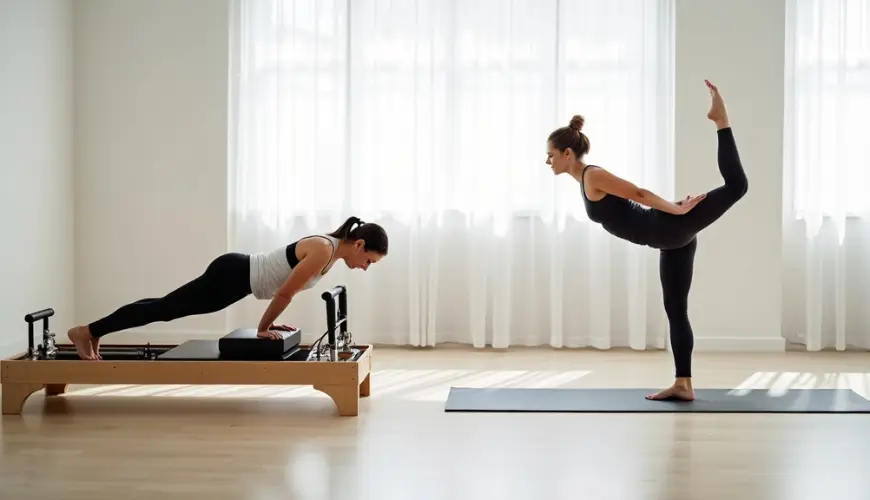
When people hear pilates or yoga, most of them picture similar images – a calm studio, a mat on the floor, and slow, controlled movements. At first glance, the two disciplines may seem almost interchangeable, yet behind each one lies an entirely different philosophy, history, and approach to the body. Choosing between them can be surprisingly difficult, because both promise the same thing: a stronger, more mobile, and more balanced body. But how do you navigate the wealth of information out there and pick what truly suits you?
Let's start with where both disciplines actually come from, because their roots reveal a lot about why to practice pilates or yoga and what you can realistically expect from them. Yoga is thousands of years old – its origins reach back to ancient India, where it emerged as a comprehensive spiritual practice connecting body, mind, and breath. The earliest references can already be found in texts called the Vedas, dating roughly three thousand years before the common era. Over the centuries, yoga branched into dozens of styles, from meditative yin yoga to dynamic ashtanga to modern power yoga, which is now practiced in air-conditioned studios around the world. Pilates, by contrast, is a relatively young method. It was developed in the early 20th century by German-born Joseph Pilates, originally as rehabilitative exercise for injured soldiers during World War I. He later brought his method to New York, where it became particularly popular among dancers and athletes looking for a way to strengthen deep stabilizing muscles without excessive joint strain. So while yoga grows from a spiritual tradition and views movement as a path to inner peace, pilates was conceived from the start as functional physical training focused on biomechanics and proper posture.
It is precisely this different origin that also shapes how both practices look in real life. In a yoga class, you typically work with so-called asanas – positions that are held for longer periods and gradually deepened. The emphasis is on breath, focus, and connecting movement with awareness. Many yoga styles also incorporate meditation, mantra chanting, or relaxation techniques. A pilates class, on the other hand, resembles more of a targeted training session – exercises are repeated in sets, movements are precise and controlled, and the instructor often corrects the alignment of the spine, pelvis, or shoulder blades. At the center of everything is the so-called "powerhouse" – the area of the deep abdominal muscles, pelvic floor, and muscles along the spine. Joseph Pilates once declared: "In 10 sessions you feel the difference, in 20 you see the difference, and in 30 you have a whole new body." While this is obviously an exaggeration, it captures the emphasis pilates places on measurable physical progress.
Try our natural products





The difference between pilates and yoga in practice
When we look at the difference between pilates and yoga in more detail, we find that it's not just about philosophy but also about very concrete things – the type of breathing, muscle engagement, or the use of props. In yoga, deep abdominal breathing or so-called ujjayi breathing is most commonly used, where air flows through a slightly constricted throat, producing a characteristic gentle sound. This breathing has a calming effect on the nervous system and helps maintain concentration during more challenging positions. In pilates, by contrast, lateral or rib breathing is practiced – the inhale is directed into the sides and back of the ribcage, while the abdominal wall remains actively drawn in. The reason is simple: if the abdomen relaxed during inhalation, the core stabilization that is key to pilates would be lost.
Another practical difference is the pace and structure of the class. Yoga tends to be slower, positions are held longer, and transitions or short rests are often incorporated between them. Classes usually end with relaxation in savasana, where the practitioner lies on their back and consciously releases the entire body. Pilates is more dynamic – exercises flow into one another more smoothly, are repeated in sets, and the class has a clearly defined structure from warm-up through the main block to stretching. A relaxation closing in the traditional sense is usually absent here, although a quality instructor will finish the class with at least a brief cool-down.
Interestingly, both methods have been proven to work for reducing back pain, improving posture, and increasing flexibility. A study published in the Journal of Bodywork and Movement Therapies showed that regular pilates and yoga practice leads to a significant reduction in chronic lower back pain after just eight weeks. The difference lies more in the mechanism – pilates strengthens the muscles that actively stabilize the spine, while yoga increases range of motion and releases tension in muscles and fascia. Ideally, the two methods complement each other, which is why it's not uncommon for people to eventually incorporate both into their weekly schedule.
To complete the picture, it's worth mentioning a real-life example. Imagine Kateřina, a woman in her thirties working in an office, who suffers from neck pain and a general feeling of stiffness. On the recommendation of a physiotherapist, she starts with pilates, where she learns to properly activate her deep stabilizing muscles and correct her posture at the computer. After several months, once the pain subsides, she discovers yoga – drawn to the opportunity to slow down, work with her breath, and gain space for mental rest. Eventually, she combines both disciplines: pilates twice a week for strength and stability, yoga once a week for flexibility and mental balance. This is precisely the approach recommended by many movement therapy experts.
What is reformer pilates and how is it different
A separate chapter is reformer pilates, meaning exercise on a special machine that Joseph Pilates originally constructed from hospital beds and springs. A modern reformer looks like a narrow sliding bench with adjustable springs, straps, and supports. Unlike classic mat pilates, where you work primarily with your own body weight, the reformer allows you to add or reduce resistance using springs. This makes it an extraordinarily versatile tool – it can serve for gentle rehabilitative exercise as well as intensive strength training.
Exercising on a reformer has several key advantages. First, the spring resistance forces the body to work through the full range of motion, both in the muscle-shortening phase and the muscle-lengthening phase. This means muscles are loaded more evenly than during mat exercises. Second, the unstable sliding surface of the reformer requires constant activation of the deep stabilizing muscles – the body must "monitor itself" at every moment of the movement, which leads to faster development of functional strength. Third, the reformer allows you to exercise in positions that wouldn't be possible on a mat – for example, lying on your side with spring resistance or standing on a sliding platform.
Who is reformer pilates suitable for? Practically anyone, from complete beginners to elite athletes. Thanks to the adjustable resistance, an instructor can tailor the intensity of the workout to a specific person – their fitness level, any health limitations, and their goals. The reformer is widely used in post-injury rehabilitation, for back pain, during pregnancy, and in the postnatal period. At the same time, it's also sought out by runners, cyclists, or tennis players who want to improve their performance and prevent injuries. Reformer classes tend to be smaller, often individual or in small groups of up to five people, which ensures quality corrections and a personal approach. It's worth noting that they are significantly more expensive than group mat classes, but according to the experience of many practitioners, the investment is definitely worthwhile.
If you're interested in a more detailed comparison of both approaches to pilates, a comprehensive article on Healthline offers a solid foundation of information backed by expert sources.
What remains is to answer perhaps the most important question: for whom and when is yoga or pilates suitable? Generally speaking, both methods are extraordinarily inclusive – they can be practiced by people of virtually any age and any fitness level. Nevertheless, there are certain situations where one is more suitable than the other.
Pilates tends to be the first choice for people with back pain, posture problems, or after orthopedic surgeries. Physiotherapists often recommend it as a complement to rehabilitation because it specifically strengthens muscles that conventional exercise overlooks. It's also excellent for those who spend most of the day sitting and need to "wake up" their body without the risk of overloading it. Pilates is also a great choice for pregnant women – there are special prenatal programs focused on strengthening the pelvic floor and preparing the body for childbirth. After delivery, pilates then helps restore core stability and address potential diastasis recti.
Yoga is ideal for those seeking not only physical but also mental benefits. If you're dealing with stress, anxiety, insomnia, or simply the feeling that you're losing yourself in the daily rush, yoga offers space to slow down and listen to your own body. Research has repeatedly confirmed that regular yoga practice lowers cortisol levels – the stress hormone – and positively affects mood. A Harvard study, for example, documented that yoga can be an effective complement to the treatment of depression and anxiety disorders. Yoga is also suitable for older adults who want to maintain joint mobility and balance – falls and the fractures associated with them are among the most common health complications in older age, and regular balance training has been proven to prevent them.
Of course, there are also situations where caution is needed. In cases of acute joint inflammation, serious cardiovascular problems, or fresh injuries, any exercise should be discussed with a doctor. Some yoga positions – such as deep backbends or headstands – may be contraindicated for certain diagnoses. The same applies to pilates: even though it is generally gentle, incorrectly performed exercises can worsen conditions involving existing disc or spinal problems. That's why, especially at the beginning, it's crucial to choose a qualified instructor who can adapt the exercise to individual needs.
So how do you choose? The best advice is to try both. Most studios offer introductory classes at a discounted price or even for free. Pay attention to how you feel during the practice – not just physically but also mentally. Some people prefer the structured, almost "engineering-like" approach of pilates, while others need the freer, more meditative atmosphere of yoga. And as already mentioned, combining both disciplines may be the best path to a body that is strong, flexible, and balanced. After all, movement should be a joy, not an obligation – and whether you choose yoga, pilates, or both, what matters most is that you decide to start.